Key takeaways
- Slot Compatibility: Most contractor and cabinet saws use a standard 3/4″ × 3/8″ miter slot, but always measure yours before ordering — a gauge that fits loosely in the slot defeats its entire purpose.
- Fence Length and Extensibility: A short fence works for narrow boards, but if you crosscut plywood or wider hardwood slabs, look for a gauge with an extendable fence that stretches past 30 inches for reliable workpiece registration.
- Angle Detent Precision: Positive stops (detents) at common angles like 90°, 45°, and 22.5° let you dial in repeatable cuts without squinting at a protractor scale. More detent positions give you finer options for compound work.
- Flip Stop Quality: A micro-adjustable flip stop is the difference between “close enough” and repeatable accuracy. Cheap stops drift under clamping pressure; a well-designed one locks down firmly and flips out of the way cleanly.
- Zero-Play Adjustment: Look for gauges with a spring-loaded plunger or eccentric adjustment mechanism that eliminates lateral play in the slot. Even 0.5mm of wobble at the gauge translates to visible error at the end of a long board.
What's inside
If you’ve ever tried to make a precise crosscut on a table saw using the factory-supplied miter gauge, you already know the frustration: wobbling in the slot, inconsistent angle locks, and a fence that gives you nowhere near the support you need for wider panels. That sloppy setup costs you time, material, and confidence in your own cuts.
This guide cuts through the noise. We tested and compared the leading aftermarket miter gauges available in 2026 — models that replace that flimsy stock unit with zero-play fit, reliable angle detents, and extendable fences that actually hold a square. Below you’ll find our curated picks followed by a straightforward buyer’s guide so you can match the right gauge to your shop’s demands.
As an Amazon Associate we earn from qualifying purchases.


How to Choose a Miter Gauge Table Saw (2026)
- Slot Compatibility: Most contractor and cabinet saws use a standard 3/4″ × 3/8″ miter slot, but always measure yours before ordering — a gauge that fits loosely in the slot defeats its entire purpose.
- Fence Length and Extensibility: A short fence works for narrow boards, but if you crosscut plywood or wider hardwood slabs, look for a gauge with an extendable fence that stretches past 30 inches for reliable workpiece registration.
- Angle Detent Precision: Positive stops (detents) at common angles like 90°, 45°, and 22.5° let you dial in repeatable cuts without squinting at a protractor scale. More detent positions give you finer options for compound work.
- Flip Stop Quality: A micro-adjustable flip stop is the difference between “close enough” and repeatable accuracy. Cheap stops drift under clamping pressure; a well-designed one locks down firmly and flips out of the way cleanly.
- Zero-Play Adjustment: Look for gauges with a spring-loaded plunger or eccentric adjustment mechanism that eliminates lateral play in the slot. Even 0.5mm of wobble at the gauge translates to visible error at the end of a long board.
The Best Miter Gauge Table Saw (2026)s Reviewed
GOINGMAKE Compact 360mm Miter Gauge
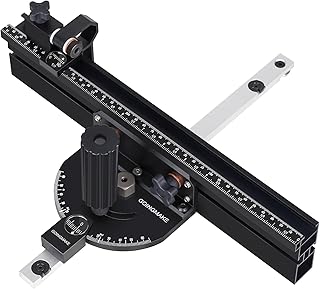
The most affordable option here doesn’t feel like a compromise. Its 360mm fence is compact but well-built, the multifunction flip stop holds position without creep, and the positive angle stops click in with a reassuring snap. Ideal for hobbyists with limited bench space who still demand clean, square crosscuts.
GOINGMAKE 18–32 Inch Micro Adjust Gauge
This mid-range model hits a sweet spot: the telescoping fence extends to a generous 32 inches, 13 angle detents cover every common woodworking task, and the micro-adjust flip stop lets you dial in repeatable cuts down to a fraction of a millimeter. A strong all-around choice for serious home workshops.
O’SKOOL PTA026 Miter Gauge
Built for woodworkers who move between cabinet-scale and detail work, the O’SKOOL pairs a 22–36 inch extension fence with 27 positive angle stops — the most of any gauge tested here. The reversible fence setup adds versatility for left- or right-blade tilt operations, and its zero-play fit adjustment keeps everything tight under load.
VEVOR Precision Miter Gauge
The VEVOR stands out with a spring-loaded plunger that maintains consistent pressure against the slot walls, virtually eliminating the lateral drift that plagues cheaper units. Its 19–35 inch grating fence and 15 detent positions are solid, and the removable disc feature simplifies blade-clearance adjustments when switching between tasks.
GOINGMAKE 21–38 Inch Extended Fence Gauge
When fence length is non-negotiable, this is the model to beat. Extending to a full 38 inches, it supports full-width plywood crosscuts without auxiliary jigs. The 13 angle stops and micro-adjust flip stop carry over from GOINGMAKE’s other mid-tier gauges, making this a straightforward upgrade for anyone who regularly handles large sheet goods.
Frequently Asked Questions
Will these miter gauges fit my specific table saw?
Most standard table saws from brands like DeWalt, Bosch, SawStop, and Grizzly use a 3/4″ × 3/8″ miter slot, which is the size all five gauges in this roundup are designed for. Measure your slot with calipers before purchasing — if your saw has a non-standard slot width, you may need shims or a different model.
Can I use a miter gauge for joinery cuts like tenons?
Absolutely, and this is where aftermarket gauges really outperform stock units. The zero-play adjustment and fine fence control let you make repeatable shoulder cuts. For deeper tenon work, pair the gauge with a tall auxiliary fence screwed to the main fence for added workpiece support.
Do I need the longest fence available?
Not necessarily. If you primarily crosscut boards under 16 inches wide, a compact or standard-length fence is lighter and easier to maneuver. Go with an extended fence only if you regularly process wide boards or sheet goods — the extra length adds weight and can feel unwieldy for small, detailed cuts.
How important are positive angle stops versus free-angle adjustment?
If you mostly cut at 90° and 45°, a few well-placed detents are sufficient. But if you do furniture work with compound angles, beveled miters, or segmented turning, a gauge with 15 or more stops saves significant setup time. Free-angle adjustment remains essential for the in-between angles where no detent exists.
Final Thoughts
For most home furniture builders, the O’SKOOL PTA026 offers the best balance of fence range, detent count, and build quality. Budget-conscious woodworkers should look at the GOINGMAKE Compact 360mm, which punches well above its price. And if you regularly crosscut full plywood sheets, the GOINGMAKE 21–38 Inch Extended Fence model is the one that won’t leave you reaching for supplementary jigs.