Key takeaways
- Confirm the heat is real heat: Some units run a reversible heat pump, others use electric resistance coils. Heat pumps are far cheaper to run but taper off below roughly 40°F outdoors, so in a cold climate treat the heat function as shoulder-season comfort, not a furnace substitute.
- Size to the room, not the ambition: Roughly 20 BTU per square foot is a sane starting point. Oversized units short-cycle, leave the air clammy, and create that stop-start drone that reads as restless in a quiet room.
- Measure the daylight you’ll lose: Note cabinet height and sill depth before buying. In a single small window, a tall chassis can swallow half your glass and throw a permanent hard-edged shadow; in a wide double-hung, the same unit barely registers.
- Check the noise floor and the night glow: Inverter compressors modulate instead of slamming on and off, which keeps the sound closer to a steady baseline. Also look for a dimmable or sleep-mode display, since an undimmable LED reads as a bright point source against a dark wall.
- Seal like you’re blocking light: Any gap that leaks a sliver of streetlight is also leaking air. Foam side panels, a proper window kit, and a sash seal do more for comfort and efficiency than a step up in BTUs.
What's inside
Anyone who has spent a season with a window unit knows the real trade-off isn’t just cooling power. It’s what happens to the room. A chassis in the sash line eats a third of your glass, drops a hard shadow across the floor at midday, and after dark it hums and blinks a little blue star into an otherwise settled bedroom. Buyers looking for a combo cooling-and-heating unit face a second problem on top of that: shoulder-season rooms that swing from stuffy at 3 p.m. to raw at 6 a.m., and no appetite for storing a second appliance six months a year.
This guide looks at the current crop of window air conditioner heaters through a slightly unusual lens: how each one behaves as a fixture in the room, not just a spec sheet. Heating method and honest temperature limits, sizing against square footage, how much daylight and sightline the cabinet costs you, the noise floor at night, and whether the display can be dimmed or killed. Cards are below; the reasoning follows.
As an Amazon Associate we earn from qualifying purchases.


![LG 5000 BTU Window Air Conditioners [2023 New] Easy Mechanical Control Ultra-Quiet Compact-size Cools Washable Filter 150 Sq.Ft. for Small Room AC Unit air conditioner Easy Installation White LW5023](https://m.media-amazon.com/images/I/71A7Uu7TEtL._AC_UL320_.jpg)
![LG 10000 BTU Window Air Conditioners [2023 New] Dual Inverter Remote WiFi Enabled App Ultra-Quiet Washable Filter Cools 450 Sq.Ft AC Unit air conditioner Easy Install White LW1022FVSM](https://m.media-amazon.com/images/I/61gXq9YonVL._AC_UL320_.jpg)

How to Choose a/an Window Air Conditioner Heater (2026)
- Confirm the heat is real heat: Some units run a reversible heat pump, others use electric resistance coils. Heat pumps are far cheaper to run but taper off below roughly 40°F outdoors, so in a cold climate treat the heat function as shoulder-season comfort, not a furnace substitute.
- Size to the room, not the ambition: Roughly 20 BTU per square foot is a sane starting point. Oversized units short-cycle, leave the air clammy, and create that stop-start drone that reads as restless in a quiet room.
- Measure the daylight you’ll lose: Note cabinet height and sill depth before buying. In a single small window, a tall chassis can swallow half your glass and throw a permanent hard-edged shadow; in a wide double-hung, the same unit barely registers.
- Check the noise floor and the night glow: Inverter compressors modulate instead of slamming on and off, which keeps the sound closer to a steady baseline. Also look for a dimmable or sleep-mode display, since an undimmable LED reads as a bright point source against a dark wall.
- Seal like you’re blocking light: Any gap that leaks a sliver of streetlight is also leaking air. Foam side panels, a proper window kit, and a sash seal do more for comfort and efficiency than a step up in BTUs.
The Best Window Air Conditioner Heater (2026)s Reviewed
Midea 12,000 BTU Smart Inverter with Heat
This is the most complete pick here: inverter cooling, a genuine heat mode, dehumidification, Energy Star certification, and a low enough sound signature that it fades into the room rather than announcing itself. At 550 sq ft of coverage it suits a main bedroom or open living space, and the electronic controls plus remote mean you can set it once and stop thinking about it.
Garvee 8000 BTU AC and Heater Combo
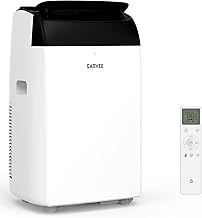
The smart bet for apartments and rooms up to about 350 sq ft, with cooling, heating, dehumidifier, and fan modes in one compact cabinet plus app and remote control. Its smaller footprint is the ambience advantage: less glass blocked, less shadow, and a lighter visual mass in a narrow window.
Midea 14,000 BTU Smart Inverter
Cooling-only, but worth knowing about if your room pushes past 550 sq ft, since it handles up to 700 sq ft on a standard 115V circuit with app and Alexa control. Choose it when capacity matters more than a combined heat function, and pair it with a separate heater for the cold months.
LG LW1022FVSM Dual Inverter, 10,000 BTU
The quietest unit on this list by a comfortable margin, thanks to LG’s dual inverter compressor, with WiFi and app control across 450 sq ft. Again, cooling only, so it’s the pick for anyone whose priority is a near-silent room in summer rather than year-round duty from one box.
Towallmark 6000 BTU Compact
A straightforward, low-cost option for rooms up to 250 sq ft with cool and fan modes, a washable filter, digital temperature display, and an adjustable window kit. It’s cooling only, but the small chassis preserves more daylight than anything bigger here, which matters in a study or nursery with a single window.
Frequently Asked Questions
Will a window heat pump keep a room warm in winter?
Not on its own in a cold climate. Most window units with heat are effective in the 40s and above and lose capacity quickly below that. Treat them as spring and autumn comfort, or as supplementary heat in a mild region.
How much daylight will I actually lose?
Expect a compact 5,000 to 6,000 BTU unit such as the LG LW5023 to occupy the lower third of a standard double-hung sash, and a 12,000 to 14,000 BTU chassis to take closer to half. Light-colored side panels and a sheer above the unit soften the resulting shadow line considerably.
Do the control panels stay lit all night?
Many dim automatically in sleep mode, and some allow the display to be switched off entirely from the remote. If yours can’t, a small piece of low-tack tape over the LED is a legitimate fix.
Can I leave the unit installed year-round?
Yes, and with a combo cooling and heating unit it makes sense. Just check the seal each season, because compressed foam and shifting sash pressure open gaps that draft and dust find quickly.
Final Thoughts
For a single appliance that earns its window spot in both directions, the Midea 12,000 BTU with heat is the clearest recommendation, balancing real heating, quiet inverter cooling, and dehumidification. Smaller apartments are better served by the Garvee 8000 BTU combo, which delivers the same four modes with less visual mass in the glass, and if summer silence outweighs winter versatility, the LG LW1022FVSM remains the calmest unit in the room.