Key takeaways
- SCFM at 90 PSI: This single number decides whether a spray gun works or sputters. Nailers sip air and will run on almost anything, but a small HVLP or detail gun wants steady flow, so look for 4 SCFM or better and add margin rather than matching the tool’s minimum exactly.
- Noise in decibels: If you evaluate light quality in the same room where you build, a 70 dB ultra-quiet unit changes the whole day. Standard direct-drive compressors land closer to 85 to 90 dB, which is hearing-protection territory and unpleasant in a finished space.
- Duty cycle and recovery: A 75 percent duty cycle means the pump can keep working through a long spray session instead of forcing you to stop and let it cool. Fast recovery matters more than raw tank size once you are past the first minute of use.
- Oil-free versus oil-lubricated: Oil-free pumps skip the maintenance and, more importantly for finish work, remove one source of carryover into your air line. If you are spraying lamp bases or diffuser panels, that peace of mind is worth the slightly shorter pump lifespan.
- Drain, footprint, and mobility: Vertical tanks free up floor space, real rubber-tread wheels handle thresholds and gravel, and an accessible or automatic tank drain is the difference between draining condensate weekly and forgetting until rust becomes a problem.
What's inside
Ambience work lives in the details: a cove that hides its LED strip cleanly, a plaster reveal with no visible fasteners, a spray-lacquered sconce backplate that reads as one continuous surface. Those details are almost always won with air. And the moment you start pairing a brad nailer, a HVLP gun, and a blowgun for dusting fixtures before final aim, the little pancake compressor under the bench stops keeping up. It cycles constantly, starves the gun mid-pass, and fills a quiet install room with noise you cannot design around.
A 20 gallon tank is the sweet spot for that kind of work. It holds enough air to finish a run of trim or a full shade coat without the motor interrupting your rhythm, yet it still rolls through a doorway and parks in a corner of the shop. This guide looks at the 20 gallon class in 2026, plus a few smaller units worth owning as a second compressor for punch-list days, and explains what actually matters when your tools are feeding finish work rather than framing.
As an Amazon Associate we earn from qualifying purchases.



How to Choose a 20 Gallon Air Compressor (2026)
- SCFM at 90 PSI: This single number decides whether a spray gun works or sputters. Nailers sip air and will run on almost anything, but a small HVLP or detail gun wants steady flow, so look for 4 SCFM or better and add margin rather than matching the tool’s minimum exactly.
- Noise in decibels: If you evaluate light quality in the same room where you build, a 70 dB ultra-quiet unit changes the whole day. Standard direct-drive compressors land closer to 85 to 90 dB, which is hearing-protection territory and unpleasant in a finished space.
- Duty cycle and recovery: A 75 percent duty cycle means the pump can keep working through a long spray session instead of forcing you to stop and let it cool. Fast recovery matters more than raw tank size once you are past the first minute of use.
- Oil-free versus oil-lubricated: Oil-free pumps skip the maintenance and, more importantly for finish work, remove one source of carryover into your air line. If you are spraying lamp bases or diffuser panels, that peace of mind is worth the slightly shorter pump lifespan.
- Drain, footprint, and mobility: Vertical tanks free up floor space, real rubber-tread wheels handle thresholds and gravel, and an accessible or automatic tank drain is the difference between draining condensate weekly and forgetting until rust becomes a problem.
The Best 20 Gallon Air Compressor (2026)s Reviewed
Klutch 20-Gallon Air Compressor, 2 HP
The strongest all-around pick here: 175 PSI, 4.2 SCFM at 90 PSI, and a 75 percent duty cycle in an oil-free vertical package that runs on a standard 120V circuit. The higher tank pressure means more usable air between cycles, which shows up as uninterrupted passes when you are spraying a batch of fixture components.
California Air Tools 20020AD Ultra Quiet
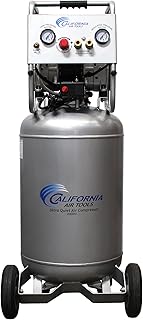
At roughly 70 dB, this one is genuinely conversational, which makes it the obvious choice if your build area doubles as a space where you assess light temperature and glare. The automatic drain valve is a quietly excellent feature, handling the maintenance step most people skip, and the 2.0 HP oil-free pump keeps upkeep minimal.
VEVOR 13-Gallon Air Compressor, 2HP
A smaller tank with a surprisingly generous 4.6 SCFM at 90 PSI and 66 dB operation, so it punches above its capacity for continuous tool use. Cap pressure is 125 PSI rather than 175, so plan on slightly more frequent cycling, but the thickened steel body and wheels make it an easy unit to move between job sites.
Craftsman 2 Gallon Hot Dog
This is your walk-in compressor, the one that goes upstairs for a single sconce backplate or a handful of brads on a cove return. At 0.5 CFM it will not spray anything, but it is light, oil-free, and hits 125 PSI, which covers finish nailing and inflation duties without dragging the big tank out.
Ironton 3-Gallon Pancake
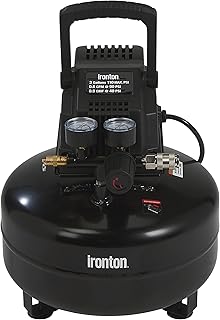
The most modest unit in the group and the most honest about it: 0.3 HP, 110 PSI, maintenance-free, and small enough to store on a shelf. Treat it as a dedicated blowgun and brad nailer companion for punch-list days rather than a primary shop compressor.
Frequently Asked Questions
Will a 20 gallon compressor run a spray gun?
A small detail or touch-up gun, yes, provided the compressor delivers around 4 SCFM at 90 PSI. Full-size HVLP guns often want 8 to 12 SCFM continuous, which is beyond this class no matter how large the tank is.
Do I need a 240V circuit?
Not for these. Both 20 gallon models here run on 120V, though you should give the compressor its own circuit and avoid long extension cords, which cause voltage drop and hard starts.
How often should I drain the tank?
After every working day in humid conditions, weekly at minimum. Condensate is what turns a tank into scrap, and an automatic drain valve removes the guesswork entirely.
Is oil-free loud by nature?
Traditionally yes, but the ultra-quiet designs use lower-RPM motors to get around it. You trade a little recovery speed for a working environment you can actually think in.
Final Thoughts
For most ambience and finish work, the Klutch 20-Gallon is the best balance of pressure, flow, and duty cycle at a sane price, while the California Air Tools 20020AD earns its keep any time noise would compromise the space you are working in. Pair either with the Craftsman Hot Dog for quick upstairs calls and you have the full range covered.