Key takeaways
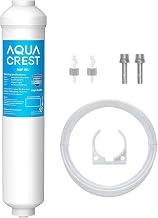
- Hose Compatibility: Verify whether the unit ships with both 1/2″ and 1/4″ connectors or requires a separate adapter kit. A 10-foot inlet hose gives you placement flexibility, while shorter lines force you to park the machine directly beside the supply valve.
- Daily Ice Output: A household of two to three people typically needs 30–40 lbs of ice per day. Larger families or entertainers should target 44 lbs+ to avoid running dry during gatherings.
- Noise Rating: Anything above 50 dB will be noticeable in an open-plan kitchen. Models rated at 43–45 dB operate at roughly the volume of a quiet refrigerator and won’t compete with conversation.
- Energy Consumption: Draw matters for a device that runs continuously. Units at 160–300W keep electricity costs reasonable, but compare wattage against daily yield—lower power with comparable output signals better engineering.
- Ice Type and Texture: Bullet ice works well for everyday drinks, while nugget or sonic ice has a chewable, cloud-like texture that many people prefer. Crushed-ice capability adds versatility for cocktails and smoothies.
What's inside
Choosing a countertop ice maker that actually hooks up to a water line sounds simple—until you realize half the listings are vague about hose compatibility, wattage, or whether the machine even supports a continuous connection. Buyers end up with units that demand constant manual refills, or worse, arrive with connectors that don’t match their kitchen setup. The frustration compounds when you factor in noise levels that turn a sleek countertop appliance into a buzzing distraction nobody wants near the living space.
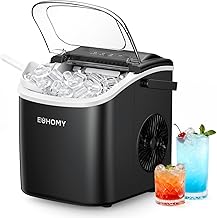
This guide cuts through the noise. We evaluated six top-rated countertop ice makers with water line connectivity on cooling speed, daily yield, energy draw, noise output, and real-world installation ease—then distilled everything into clear picks for different household needs. Whether you want a combo dispenser that handles hot and cold water alongside ice production, or a dedicated nugget-ice machine that keeps a home bar stocked, the selections below reflect what actually performs once it’s sitting on your counter and plumbed in.
As an Amazon Associate we earn from qualifying purchases.



How to Choose a Countertop Ice Maker With Water Line Connection (2026)
- Hose Compatibility: Verify whether the unit ships with both 1/2″ and 1/4″ connectors or requires a separate adapter kit. A 10-foot inlet hose gives you placement flexibility, while shorter lines force you to park the machine directly beside the supply valve.
- Daily Ice Output: A household of two to three people typically needs 30–40 lbs of ice per day. Larger families or entertainers should target 44 lbs+ to avoid running dry during gatherings.
- Noise Rating: Anything above 50 dB will be noticeable in an open-plan kitchen. Models rated at 43–45 dB operate at roughly the volume of a quiet refrigerator and won’t compete with conversation.
- Energy Consumption: Draw matters for a device that runs continuously. Units at 160–300W keep electricity costs reasonable, but compare wattage against daily yield—lower power with comparable output signals better engineering.
- Ice Type and Texture: Bullet ice works well for everyday drinks, while nugget or sonic ice has a chewable, cloud-like texture that many people prefer. Crushed-ice capability adds versatility for cocktails and smoothies.
The Best Countertop Ice Maker With Water Line Connection (2026)s Reviewed
Whynter IMC-491DC Direct Connection Ice Maker
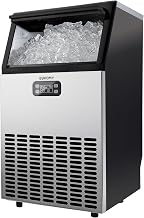
The Whynter IMC-491DC remains the benchmark for dedicated countertop ice makers with direct water line hookup. Its stainless-steel build feels substantial, the self-cleaning cycle runs automatically, and energy-efficient operation keeps the power bill in check—all while producing odorless, clear ice on demand with minimal fan noise.
3-in-1 Water Dispenser Ice Maker Combo (44 lb)
For kitchens where counter real estate is premium, this stainless-steel 3-in-1 unit consolidates hot water, cold water, and 44 lbs of daily ice production into a single footprint. The included 10-foot hose gives generous placement freedom, and at 45 dB and 300W, it balances performance with livable noise and power draw.
3-in-1 Countertop Ice Maker and Hot/Cold Water Dispenser (160W)
Running at just 160 watts while still delivering 44 lbs of ice per day, this model stands out for its energy efficiency. The dual-size connector (1/2″ and 1/4″) simplifies installation across different water line standards, and the manual-fill backup keeps it functional even when you skip the permanent hookup.
VEVOR 3-in-1 Water Dispenser with Ice Maker
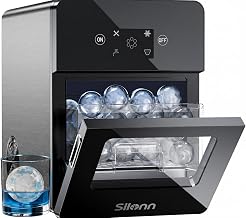
VEVOR’s countertop dispenser produces bullet or crushed ice at a rate of 12 cubes every seven minutes, stacking up to 4 lbs of storage before you need to empty the basket. It’s a solid pick for entertaining—the crushed-ice mode in particular shines for cocktail nights and parties where texture matters as much as temperature.
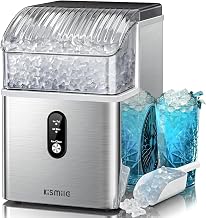
Kismile Nugget Ice Maker
Nugget-ice fans will find the Kismile irresistible. It delivers chewable sonic pebbles in roughly seven minutes, runs at a barely perceptible 43 dB, and the one-touch self-cleaning function removes a maintenance headache that plagues many portable ice machines. It’s compact enough for office counters and home bars alike.
Frequently Asked Questions
Can I use a countertop ice maker without connecting it to a water line?
Yes. All models listed here support manual filling when you choose not to plumb them in. The water line connection simply automates refilling so you never have to babysit the reservoir.
How often should I clean my countertop ice maker?
Most manufacturers recommend a cleaning cycle every two to four weeks during regular use. Models with self-cleaning functions—like the Whynter IMC-491DC and Kismile—reduce this to a button press, though a monthly deep clean with food-safe descaler is still worthwhile.
What water line connector size do I need?
The most common sizes are 1/4″ for standard refrigerator water lines and 1/2″ for dedicated supply valves. The 3-in-1 models reviewed here include both connector sizes, so you won’t need a hardware-store trip to get started.
Do ice makers with water line connections use more electricity?
Not necessarily. Continuous water supply means the compressor cycles on and off based on ice demand rather than running continuously to compensate for a depleted reservoir. Units rated at 160–300W typically cost only a few dollars per month to operate.
Final Thoughts
For most households, the Whynter IMC-491DC delivers the most reliable pure-ice performance with minimal fuss. Families who want hot and cold water alongside ice will find the 3-in-1 Water Dispenser Ice Maker Combo to be the most space-efficient all-in-one. And if you care about ice texture as much as convenience, the Kismile Nugget Ice Maker produces the kind of chewable pebbles that turn a regular drink into something worth savoring.