Key takeaways
- Tooth count and finish quality: 24 to 40 teeth clear waste fast for framing and rough stock; 60 to 100 teeth leave a surface that reflects light evenly with almost no sanding. Above 100 teeth, you gain glassiness but lose feed speed, so reserve those for veneered panels, hardwood trim, and anything that will sit under a fixture.
- Grind geometry: An ATB (alternate top bevel) grind slices cross-grain fibers cleanly and is the default for crosscutting. TCG grinds suit laminates and non-ferrous stock. Match the grind to the cut, not to the price tag.
- Kerf thickness: Thin-kerf blades remove less material and reduce strain on sliding compound saws, which matters on 12-inch machines and underpowered motors. Full-kerf blades resist deflection better on long bevel cuts.
- Arbor and diameter fit: Confirm your arbor before buying. Most 10-inch and 12-inch saws use a 5/8-inch (16mm) arbor, but never assume. A blade that is even slightly oversized will not seat correctly and will introduce runout you can feel in the finished edge.
- Carbide quality and expansion slots: Denser carbide holds an edge through more linear feet. Laser-cut expansion slots keep the plate flat as it heats, and that flatness is what separates a joint that closes tight from one that telegraphs a shadow.
What's inside
Anyone who has cut a mitered return under a work light knows the moment: the joint looks clean until you angle a lamp across it, and suddenly a hairline gap throws a shadow line that runs the length of the piece. Miter saw blades are the single most overlooked variable in that outcome. A well-built saw with a tired 40-tooth blade will still leave torn fibers and a faintly furred edge, and once finish oil hits that edge, every one of those flaws catches light differently than the surface beside it.
This guide looks at miter saw blades the way a lighting designer looks at a surface: what will this cut do under raking light, under a warm bulb, under a spotlit shelf? We compare fine-finish blades from DEWALT, Freud, and WEN alongside high-tooth-count and multi-pack options, and cover tooth geometry, kerf thickness, and arbor fit so you can match a blade to the material and the finish you actually need.
As an Amazon Associate we earn from qualifying purchases.


How to Choose a Blades For Miter Saw (2026)
- Tooth count and finish quality: 24 to 40 teeth clear waste fast for framing and rough stock; 60 to 100 teeth leave a surface that reflects light evenly with almost no sanding. Above 100 teeth, you gain glassiness but lose feed speed, so reserve those for veneered panels, hardwood trim, and anything that will sit under a fixture.
- Grind geometry: An ATB (alternate top bevel) grind slices cross-grain fibers cleanly and is the default for crosscutting. TCG grinds suit laminates and non-ferrous stock. Match the grind to the cut, not to the price tag.
- Kerf thickness: Thin-kerf blades remove less material and reduce strain on sliding compound saws, which matters on 12-inch machines and underpowered motors. Full-kerf blades resist deflection better on long bevel cuts.
- Arbor and diameter fit: Confirm your arbor before buying. Most 10-inch and 12-inch saws use a 5/8-inch (16mm) arbor, but never assume. A blade that is even slightly oversized will not seat correctly and will introduce runout you can feel in the finished edge.
- Carbide quality and expansion slots: Denser carbide holds an edge through more linear feet. Laser-cut expansion slots keep the plate flat as it heats, and that flatness is what separates a joint that closes tight from one that telegraphs a shadow.
The Best Blades For Miter Saw (2026)s Reviewed
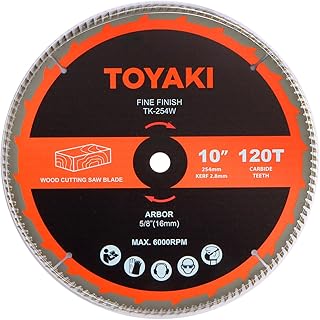
120-Tooth Fine-Finish 10-Inch Blade
At 120 teeth on a 10-inch plate, this blade produces the closest thing to a planed edge you will get straight off a miter saw, which is exactly what you want on picture-frame returns and exposed trim. Feed slowly and let the tooth count do the work; rushing it will burn hardwood rather than cut it.
WEN BL1080 80-Tooth Carbide-Tipped Blade
The BL1080 hits a practical middle ground: enough teeth for clean crosscuts in oak, maple, and pre-finished trim without the sluggish feed of an ultra-high-count blade. It is a sensible everyday blade for a 10-inch saw that sees mixed work.
DEWALT DWA112100 12-Inch 100-Tooth Blade
For 12-inch sliding compound saws, this is the finish blade to reach for when the cut will be visible. The carbide is genuinely sharp out of the package and holds up well through crown, casing, and wider hardwood stock where a lesser blade starts to wander.
Freud LU91R012 Thin Kerf 72-Tooth Blade
Freud’s thin-kerf design paired with Tico hi-density carbide is purpose-built for sliding compound saws, reducing motor load on long slide cuts while keeping the plate stable. The 72-tooth ATB grind leaves a crisp, uniform edge that takes stain without blotching along the cut line.
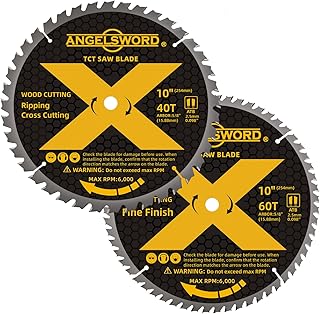
32T/60T/80T 10-Inch Blade 3-Pack
This three-blade set covers framing, fine finish, and ultra-fine finish in one purchase, which is the fastest way to stop compromising on a single blade for every task. Practical value for a home shop that swings between structural work and trim.
Frequently Asked Questions
Does tooth count really change how a finished piece looks?
Yes, and it is most visible under directional light. Higher tooth counts leave shallower tear-out, so the cut edge reflects light at the same angle as the face grain instead of scattering it.
Can I use a table saw blade on a miter saw?
Many blades are rated for both, but check the manufacturer’s listing and confirm the diameter, arbor size, and maximum RPM match your saw. Blades with negative hook angles are safer on miter saws.
Thin kerf or full kerf for a 12-inch saw?
Thin kerf if your saw is a slider or the motor labors on wide stock. Full kerf if you make frequent steep bevel cuts and want maximum plate rigidity.
How often should I replace a finish blade?
Watch the cut, not the calendar. Burn marks, increased feed resistance, and fuzzy edges on softwood all signal a dull blade. Quality carbide can often be professionally sharpened two or three times.
Final Thoughts
If your work ends up under a lamp, in a sconce’s throw, or on a lit shelf, the DEWALT DWA112100 is the most reliable 12-inch finish blade here, with the Freud LU91R012 the better pick for sliders where motor load matters. For 10-inch saws, the WEN BL1080 delivers clean, repeatable crosscuts without asking you to slow down.