Key takeaways
- Weave depth vs. your light angle: Chunky braids and thick cables cast visible micro-shadows. Under a low, raking light source (floor lamps, sconces, late sun), that texture reads sculptural and rich. Under a single ceiling fixture beaming straight down, the same rug can look busy and shadow-pocked. Flat or low-pile weaves stay calmer under overheads.
- Undertone honesty: Unbleached jute leans warm tan with olive flickers. Warm bulbs (2700K) push it amber; cool daylight LEDs (4000K+) pull the green forward and can make it look dusty. Bring a swatch or a return-friendly rug into your actual evening lighting before committing.
- Fiber blends change the sheen: Pure jute has a dry, matte hand that absorbs light. Cotton or wool blended in adds a faint softness and slight reflectivity, which lifts the surface in dim rooms and reads less rustic.
- Size to the light pool, not just the sofa: A rug that stops short of your lamp-lit seating zone visually fragments the room. Aim for the rug to extend under the front legs of all seating so the lit area reads as one continuous plane.
- Pad and shed tolerance: All natural jute sheds initially. A felt-and-rubber pad reduces fiber abrasion and stops the rug shifting, which also keeps the weave direction consistent so light hits it uniformly.
What's inside
Jute is one of the few floor coverings that changes character with the light. At noon it reads pale and papery; by evening, under a warm bulb, the same weave turns honey-gold and starts throwing tiny shadows across every braid. That’s precisely why so many living room jute purchases disappoint. Buyers pick a rug from a photograph shot in bright, even daylight, then unroll it in a room lit by two table lamps and a north-facing window, and the thing looks muddy, flat, or unexpectedly green.
This guide approaches jute the way a lighting designer would: as a textured surface that interacts with whatever illumination you already have. Below you’ll find the current standouts for living rooms in 2026, plus a selection framework built around weave depth, undertone, and how each construction behaves under lamplight versus overheads. Every pick is a real, widely available option, chosen for how it performs in a room people actually sit in.
As an Amazon Associate we earn from qualifying purchases.


How to Choose a Jute Rug For Living Room (2026)
- Weave depth vs. your light angle: Chunky braids and thick cables cast visible micro-shadows. Under a low, raking light source (floor lamps, sconces, late sun), that texture reads sculptural and rich. Under a single ceiling fixture beaming straight down, the same rug can look busy and shadow-pocked. Flat or low-pile weaves stay calmer under overheads.
- Undertone honesty: Unbleached jute leans warm tan with olive flickers. Warm bulbs (2700K) push it amber; cool daylight LEDs (4000K+) pull the green forward and can make it look dusty. Bring a swatch or a return-friendly rug into your actual evening lighting before committing.
- Fiber blends change the sheen: Pure jute has a dry, matte hand that absorbs light. Cotton or wool blended in adds a faint softness and slight reflectivity, which lifts the surface in dim rooms and reads less rustic.
- Size to the light pool, not just the sofa: A rug that stops short of your lamp-lit seating zone visually fragments the room. Aim for the rug to extend under the front legs of all seating so the lit area reads as one continuous plane.
- Pad and shed tolerance: All natural jute sheds initially. A felt-and-rubber pad reduces fiber abrasion and stops the rug shifting, which also keeps the weave direction consistent so light hits it uniformly.
The Best Jute Rug For Living Room (2026)s Reviewed
KEMA Jute Braided Reversible Rug, 5×7
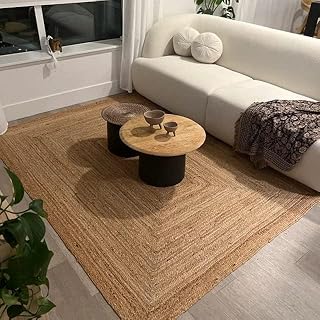
The tight rustic braiding here is a shadow-catcher in the best way, coming alive under angled floor-lamp light where the coils build real dimensionality. At 5×7 it suits smaller seating groups or a layered arrangement, and reversibility gives you a second life when one face fades from sun exposure.
Natural Hand Braided Jute Rug, 8’x10′
A generous farmhouse footprint with hand-braided construction that reads warm and substantial in lamp-lit rooms. The braid scale is bold enough to hold visual interest across a large floor without needing a pattern to carry it.
nuLOOM Ashli Natural Solid Handwoven Rug, 8’x10′
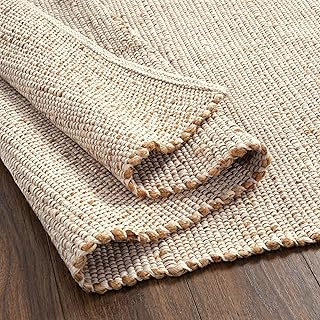
The smartest choice if your living room relies on ceiling fixtures or recessed cans, since the even handwoven surface stays serene rather than shadow-speckled under direct downlight. Its solid, uniform tone also plays well as a neutral base under patterned furniture.
SAFAVIEH Natural Fiber Tassel Jute Rug, 6’x9′
Built for high-traffic living rooms, with a dense handmade weave and tassel detailing that adds a soft edge where the rug meets the floor. The consistent surface holds its color read across mixed lighting, making it forgiving in rooms with both windows and lamps.
Natural Jute & Wool Mini Check Rug, 8’x10′
The wool content introduces a subtle light-catching quality that pure jute lacks, and the mini-check pattern with its 4″ border creates gentle tonal variation instead of flat expanse. At 0.6″ pile it stays low enough to sit cleanly under furniture legs.
Frequently Asked Questions
Will a jute rug look yellow under my LED bulbs?
Cooler LEDs above 4000K tend to emphasize jute’s greenish-grey undertones rather than yellow. If you want that warm honey look, use 2700K to 3000K bulbs, which flatter natural fibers considerably.
Is jute too rough for a living room where people sit on the floor?
Pure jute has a firm, textured hand. Blended options like the GRUHUM Jute Cotton rug soften noticeably underfoot while keeping the natural look, making them better suited to floor-sitting households.
How much does jute shed, and does it stop?
Expect loose fibers for the first two to four weeks. Vacuum with suction only, no beater bar, and shedding drops off substantially once the surface fibers settle.
Can jute handle a sunny living room?
It lightens over time in direct sun, which is not always unwelcome. Rotate the rug every six months so fading stays even rather than creating a hard line at your window’s light edge.
Final Thoughts
For rooms lit by lamps and low, angled light, the KEMA braided rug delivers the most texture and depth for the money. If overhead lighting dominates, the nuLOOM Ashli stays calm and even where chunkier weaves would look restless, while the Jute & Wool mini check offers the best middle path with a touch of softness and subtle tonal movement.