Key takeaways
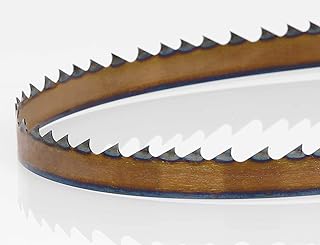
- Tooth pitch: Deep cuts in wood want 2–4 TPI. Big gullets carry chips out of a 6″ kerf; anything above roughly 6 TPI packs solid, heats the blade, and glazes the surface with burn that shows badly under backlighting.
- Width and beam strength: A 3/4″ or 1″ blade resists the sideways deflection that makes veneer taper from end to end. Confirm your saw’s maximum width first, since many 14″ machines top out at 3/4″ and cast-frame saws dislike being overtensioned.
- Tooth geometry: Hook teeth with positive rake feed themselves through hardwood and cut fast. Raker and wavy sets are engineered for metal and thin sheet, where a hook would grab.
- Steel and tension class: Silicon steel low-tension blades suit hobby saws with lighter frames and lower tension ceilings. Bimetal survives abrasive material and long duty cycles but wants a rigid, well-tuned machine to perform.
- Exact length and gauge: Measure your saw’s blade length rather than trusting the manual, and keep gauge in mind. A 0.025″ body flexes around small wheels; 0.035″ is stiffer and better suited to larger wheel diameters.
What's inside
Resawing is where a furniture shop starts behaving like a lighting studio. Split a board into thin leaves and you stop working with an opaque solid and start working with a translucent membrane, the kind of 1/16″ ash or cherry that turns a pendant shade into a warm lantern or lets a cabinet door glow from within. The trouble is that light is a merciless inspector. A blade that wanders half a millimetre leaves a wedge-shaped leaf that reads as an uneven pool of brightness. Washboard tooth marks that would vanish under a coat of finish become hard ripples once a lamp sits behind them. Burnished, burned patches show up as dead spots that no amount of sanding fully revives.
This guide looks at resaw blades through that lens: which pitches and widths track straight enough for repeatable veneer thickness, which tooth geometries clear dust from a 6″ or 8″ deep cut without polishing the wall of the kerf, and which steels hold an edge through figured stock. We also flag the fine-tooth bimetal blades in the lineup, because they are not resaw blades at all, they are the ones you reach for when a fixture needs brass tube, aluminium channel, or acrylic diffuser stock cut cleanly on the same machine.
As an Amazon Associate we earn from qualifying purchases.


How to Choose a Band Saw Blades For Resawing (2026)
- Tooth pitch: Deep cuts in wood want 2–4 TPI. Big gullets carry chips out of a 6″ kerf; anything above roughly 6 TPI packs solid, heats the blade, and glazes the surface with burn that shows badly under backlighting.
- Width and beam strength: A 3/4″ or 1″ blade resists the sideways deflection that makes veneer taper from end to end. Confirm your saw’s maximum width first, since many 14″ machines top out at 3/4″ and cast-frame saws dislike being overtensioned.
- Tooth geometry: Hook teeth with positive rake feed themselves through hardwood and cut fast. Raker and wavy sets are engineered for metal and thin sheet, where a hook would grab.
- Steel and tension class: Silicon steel low-tension blades suit hobby saws with lighter frames and lower tension ceilings. Bimetal survives abrasive material and long duty cycles but wants a rigid, well-tuned machine to perform.
- Exact length and gauge: Measure your saw’s blade length rather than trusting the manual, and keep gauge in mind. A 0.025″ body flexes around small wheels; 0.035″ is stiffer and better suited to larger wheel diameters.
The Best Band Saw Blades For Resawing (2026)s Reviewed
Timber Wolf 105″ x 3/4″ Silicon Steel Low Tension Resaw Blade
This is the blade to buy if consistent veneer is the goal, because the low-tension silicon steel body tracks straight on lighter 14″ and 17″ saws that cannot safely crank a bimetal blade tight. Expect a cool, quiet cut with a clean surface that needs only light drum sanding before it goes in front of a lamp.
Lenox Classic Pro 106″ x 1″ Vari-Raker, 5–8 TPI
The widest and stiffest option here, and the 1″ body gives excellent resistance to bowing in dense stock. The 5–8 TPI variable pitch is on the fine side for deep wood, so keep the feed patient and reserve it for shallower resaw work, dense exotics, and composite panels.
AYAO 70-1/2″ x 1/2″ 4 TPI Hardened Teeth
A sensible, affordable resaw pitch for the Rikon 10-305 and Craftsman 921400 class of benchtop saws, where 70-1/2″ is the fitment that actually matters. The 1/2″ width means you should slow your feed and use a tall fence to keep drift in check, but for splitting small shade blanks it earns its keep.
Lenox Diemaster 2 154″ x 1/2″ Hook Tooth, 6 TPI
Hook teeth and positive rake make this the most aggressive cutter of the bimetal group, and 6 TPI is workable on shallower wood cuts while remaining a durable general-purpose blade. At 154″ it is aimed at larger industrial saws, so check your wheel spacing before ordering.
Lenox Classic Tuff Tooth 93″ x 3/4″ Vari-Raker, 10–14 TPI
Treat this as your metal and hardware blade rather than a resaw blade. The tough bimetal edge and 10–14 TPI vari-raker pitch are ideal for cutting brass tube, steel rod, and lamp mounting plate stock without chatter, which matters when a fixture design mixes wood leaves with metal frames.
Frequently Asked Questions
How thin can I resaw for a backlit panel?
With a wide low-tension blade, a tall auxiliary fence, and a stable sled, 3/32″ is comfortable and 1/16″ is achievable in straight-grained stock. Cut slightly thick and bring leaves down to final thickness with a drum sander for even light transmission.
Why does my blade drift or burn?
Drift usually comes from uneven tooth set or a blade too narrow for the cut, while burning almost always means the pitch is too fine to clear chips. Set your fence to the blade’s natural drift angle, then drop to a coarser pitch before assuming the saw is at fault.
Do I need bimetal for wood?
No. Bimetal shines in abrasive material and long production runs, but for wood on a hobby saw, a properly tensioned carbon or silicon steel blade cuts cooler and cleaner for far less money.
Can one blade handle wood and metal fittings?
Not well. Keep a coarse resaw blade for timber and a fine bimetal blade for brass and steel, and swap between them. Changing blades takes two minutes and saves both cuts.
Final Thoughts
For repeatable, light-friendly veneer, the Timber Wolf 105″ 3/4″ low-tension resaw blade is the clear first choice, with the Lenox Classic Pro 1″ offering more beam strength on saws that can tension it. Add the Lenox Classic Tuff Tooth for the brass and steel side of your fixtures, and you can cut every component of a lit piece on one machine.