Key takeaways
- Width and beam strength: Wider blades resist deflection, which is what keeps a cut parallel across a tall face. Go 3/4″ if your saw’s guides and tension system allow it, 1/2″ on 10-inch benchtop machines where the wheels are too small for wide stock.
- Tooth pitch: Aim for 2 to 4 TPI on deep cuts. Fine teeth clog in a 6-inch-tall pass, and packed gullets are the most common cause of burnished, scorched faces that later read as dark patches under light.
- Tooth geometry: Hook teeth with generous gullets clear chips aggressively and cut cool. Skip-tooth patterns are a reasonable middle ground. Anything designed for contour work will fight you in thick hardwood.
- Steel versus carbide: Hardened carbon steel is the sensible starting point and cheap to replace. Carbide tips hold an edge for many multiples longer, stay straighter deep into a session, and earn their keep if you slice veneer in batches.
- Length and tension behavior: Measure your saw’s blade length rather than trusting a model chart, and pay attention to whether a blade is designed for low tension. Low-tension stock is forgiving on lighter frames that cannot be cranked down hard.
What's inside
Backlight a piece of figured cherry sawn to a shade under a tenth of an inch and it stops behaving like lumber. Grain becomes gradient, medullary rays turn into filament streaks, and every ridge left by a wandering blade shows up as a bruise in the glow. That is the frustration most people hit when they start resawing for lamp panels, sconce diffusers, bookmatched cabinet backs, or any surface meant to be read by light rather than by hand. The saw cuts, technically. But the slab tapers, the face washboards, and the finished piece transmits light unevenly no matter how patiently you sand it.
Almost all of that comes down to the blade rather than the machine. Width, tooth count, tooth geometry, and how much beam strength the steel holds under tension decide whether you get a flat, consistent slice or a lens with a wave in it. Below are six blades worth considering in 2026, spanning small benchtop saws through 14-inch cast-iron machines and long-wheel 18- and 20-inch resaws, plus the selection criteria that actually matter when the finished surface will be lit from behind.
As an Amazon Associate we earn from qualifying purchases.

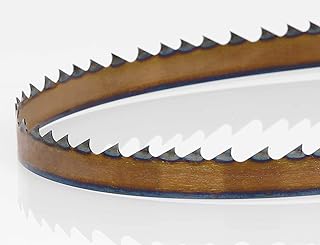


How to Choose a Band Saw Blade For Resawing (2026)
- Width and beam strength: Wider blades resist deflection, which is what keeps a cut parallel across a tall face. Go 3/4″ if your saw’s guides and tension system allow it, 1/2″ on 10-inch benchtop machines where the wheels are too small for wide stock.
- Tooth pitch: Aim for 2 to 4 TPI on deep cuts. Fine teeth clog in a 6-inch-tall pass, and packed gullets are the most common cause of burnished, scorched faces that later read as dark patches under light.
- Tooth geometry: Hook teeth with generous gullets clear chips aggressively and cut cool. Skip-tooth patterns are a reasonable middle ground. Anything designed for contour work will fight you in thick hardwood.
- Steel versus carbide: Hardened carbon steel is the sensible starting point and cheap to replace. Carbide tips hold an edge for many multiples longer, stay straighter deep into a session, and earn their keep if you slice veneer in batches.
- Length and tension behavior: Measure your saw’s blade length rather than trusting a model chart, and pay attention to whether a blade is designed for low tension. Low-tension stock is forgiving on lighter frames that cannot be cranked down hard.
The Best Band Saw Blade For Resawing (2026)s Reviewed
Timber Wolf 3423VPC 93.5″ x 3/4″ Low Tension Resaw Blade
Silicone steel with a variable-pitch grind, run at lower tension than a conventional blade, which makes it a standout for 14-inch saws that flex under heavy cranking. The variable pitch also damps the harmonic hum that leaves faint chatter lines on thin panels.
Dark Stone 111″ Carbide-Tipped Resaw Blade, 3/4″ x 2 TPI
Hook-tooth carbide sized for mid-large resaws, and it tracks dead straight through hard maple and white oak long after a steel blade would start pulling. If you cut veneer in production batches for diffuser panels, this is the sweet spot between cost and longevity.
Dark Stone 131-1/2″ Carbide-Tipped Resaw Blade, 3/4″ x 2 TPI
The same carbide package in a longer loop with a thin 0.032″ gauge, so you lose less stock to kerf on every pass. On tall figured billets that matters, since one extra slice per board is often the difference between two matched shade faces and three.
SK5 Carbon Steel Bandsaw Blade 4-Pack, 93-1/2″
Two 1/2″ 6TPI blades plus 1/4″ and 1/8″ widths, which covers resawing and the curved work that lamp bases and ring-cut shades demand. The 6TPI pitch is finer than ideal for deep cuts, so feed slowly, but as a starter kit for a 14-inch saw it is hard to argue with.
AYAO 70-1/2″ x 1/2″ 4TPI Hardened Teeth
Built for the Craftsman 921400 and Rikon 10-305 class of 10-inch saws, with a 4TPI hardened-tooth grind that clears chips properly instead of packing. Realistic capacity on these machines is around 3 to 4 inches, and within that range it produces a clean enough face to go straight to a light scrape. AYAO’s 72-inch version covers the WEN 10-inch equivalent.
Frequently Asked Questions
How thin can I resaw for a light-transmitting panel?
Most domestic hardwoods start glowing warmly around 1/16″ to 3/32″. Saw slightly thicker than target and bring it down with a drum sander or hand plane, since sawn surfaces scatter light unevenly.
Why does my cut drift even with a good blade?
Usually blade drift angle rather than defect. Set your fence parallel to the blade’s natural tracking line instead of the table slot, and confirm guides sit close behind the gullets.
Is carbide worth it on a benchtop saw?
Rarely. Small wheels and modest tension limit what carbide can deliver, and the payback period is long. Hardened steel in 1/2″ width is the better spend.
Do I need to change blades between resawing and curves?
Yes. A 3/4″ blade cannot follow a tight radius, and a 1/8″ blade will wander badly in thick stock. Keeping both mounted-ready saves frustration.
Final Thoughts
For serious veneer work on a 14-inch or larger saw, the Dark Stone 111″ carbide blade is the one to buy, with the 131-1/2″ thin-gauge version stepping up for longer machines and precious figured stock. If you are working from a benchtop saw or building a first blade collection, the Timber Wolf 3423VPC and the AYAO 70-1/2″ cover the ground affordably and cut clean enough for light to do its work.