Key takeaways
- Weave depth over color swatch: Chenille and bouclé have a raised nap that scatters light in every direction, so they hold a soft, even glow under a single pendant. Flat linen weaves reflect more directionally and can look patchy if your light source is off-center.
- Undertone, not shade name: Warm bulbs amplify yellow and red. A beige with a pink base turns rosy at 2700K; a heathered off-white with grey flecks stays neutral because the grey counterweights the warmth. Test a fabric photo under your own kitchen light before buying, not on a phone in daylight.
- Leg material and specular return: Rubberwood and other matte hardwoods absorb light and quietly ground the chair. Powder-coated metal legs give you thin, sharp highlights and a crisper silhouette, which reads well under directional track or spot lighting but can pick up glare from a low pendant.
- Backrest geometry: Solid curved backs block light and cast one soft mass of shadow. Cane webbing and tufted panels break light into pattern, so the chair contributes texture to the room even when nobody is sitting in it. Choose based on how bare your walls are.
- Surface that forgives: Light fabrics show everything, but a mid-tone flecked weave hides crumbs and stains far better than solid cream. Check for removable or wipeable covers, and prefer tighter weaves in homes with pets, since loose loops catch claws.
What's inside
Most dining chairs are chosen under the worst possible conditions. Showroom floors run cool and bright, often 4000K and flooded from overhead, and warehouse photography is lit even harder. Then the chairs land in a real dining room, under a single pendant on a dimmer at 2700K, and the fabric you picked for its crispness reads yellow, the “greige” leans pink, and the seat cushions sink into shadow while the tabletop takes all the light. Nothing is defective. The material is simply doing something different with a different spectrum.
This guide looks at fabric dining chairs the way a lighting designer would: how a weave scatters or absorbs a beam, which undertones survive a warm bulb, where leg materials throw glare, and how backrest shapes cast shadow across a wall behind them. Below are six sets worth considering in 2026, followed by the traits that actually predict how a chair will look once your fixtures are on.
As an Amazon Associate we earn from qualifying purchases.




How to Choose Fabric Dining Chairs (2026)
- Weave depth over color swatch: Chenille and bouclé have a raised nap that scatters light in every direction, so they hold a soft, even glow under a single pendant. Flat linen weaves reflect more directionally and can look patchy if your light source is off-center.
- Undertone, not shade name: Warm bulbs amplify yellow and red. A beige with a pink base turns rosy at 2700K; a heathered off-white with grey flecks stays neutral because the grey counterweights the warmth. Test a fabric photo under your own kitchen light before buying, not on a phone in daylight.
- Leg material and specular return: Rubberwood and other matte hardwoods absorb light and quietly ground the chair. Powder-coated metal legs give you thin, sharp highlights and a crisper silhouette, which reads well under directional track or spot lighting but can pick up glare from a low pendant.
- Backrest geometry: Solid curved backs block light and cast one soft mass of shadow. Cane webbing and tufted panels break light into pattern, so the chair contributes texture to the room even when nobody is sitting in it. Choose based on how bare your walls are.
- Surface that forgives: Light fabrics show everything, but a mid-tone flecked weave hides crumbs and stains far better than solid cream. Check for removable or wipeable covers, and prefer tighter weaves in homes with pets, since loose loops catch claws.
The Best Fabric Dining Chairs (2026) Reviewed
VKNOW Wooden Dining Chairs, Set of 4 (Heathered Off-White Chenille)
The heathered chenille here is the standout: its raised pile diffuses light instead of bouncing it, so the seats stay evenly lit even with a single fixture overhead, and the grey flecking keeps the off-white from going creamy under warm bulbs. Thick cushions and matte rubberwood legs make this the safest pick for anyone dimming to candlelight levels at dinner.
Christopher Knight Home Lilia Dining Chairs, Set of 2
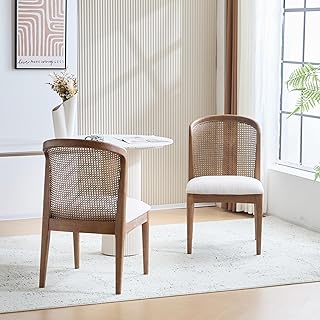
The cane webbing is the reason to buy these. Backlit or side-lit, the open weave throws a fine lattice shadow that adds depth to plain walls, and the walnut frame gives the beige upholstery a warm anchor so it does not float. Best as accent or head-of-table seating rather than a full set.
Linen Fabric Dining Chair, Set of 8 (Tufted, Nailhead Trim)
Nailhead trim behaves like a row of tiny specular points, catching a bright rim of light along the seat edge, while the tufting reads as a soft grid of shadow across the back. In a set of eight, that repetition becomes a real visual rhythm down a long table, and the light wood legs keep the whole arrangement from getting heavy.
COLAMY Upholstered Dining Chairs, Set of 4
A clean, quiet option with wood legs and a plain padded back, which means minimal shadow noise and no competing highlights. Ideal in rooms where a sculptural pendant or a piece of art should be the focal point and the seating needs to recede.
UVV Dining Chairs, Set of 4 (Metal Legs)
The slim metal legs read as thin dark lines under most lighting, which visually lifts the upholstered seat and works especially well over pale flooring where wood legs can blur into the ground. Worth checking your pendant height, since a low, exposed bulb will find those legs and produce a glint.
Frequently Asked Questions
Why do my chairs look darker at home than online?
Product photos are typically lit at high intensity from multiple angles, which fills the weave and eliminates shadow. A single dining pendant lights from one direction only, so the vertical face of the backrest and the front of the seat fall into shade. Adding a wall sconce or a second light source restores most of that lost brightness.
Do beige chairs look yellow under warm bulbs?
They can. Beige with a golden or pink undertone shifts noticeably at 2700K. If you want beige that stays true, look for versions with visible grey or taupe flecking, or move your bulbs to 3000K, which stays cozy while pulling less warmth out of the fabric.
Are light-colored fabric chairs practical for daily use?
With caution. Textured, multi-tone weaves like chenille conceal marks far better than flat solids, and a fabric protector spray helps considerably. If you have small children, consider darker seat cushions with light backs, or a set with removable covers.
Wood legs or metal legs?
Wood absorbs light and creates a softer, more traditional presence. Metal reflects and gives sharper definition, which suits modern rooms with directional lighting. If your fixture hangs low over the table, wood is the lower-risk choice for glare.
Final Thoughts
For most dining rooms, the VKNOW heathered off-white chenille set is the most forgiving under real household lighting, holding its color and softness from full brightness down to a low dimmer. If you want the chairs to add visible texture, the Christopher Knight Lilia pair earns its place through cane-webbing shadow play, and the eight-piece tufted linen set with nailhead trim delivers the same effect at scale for larger tables.