Key takeaways
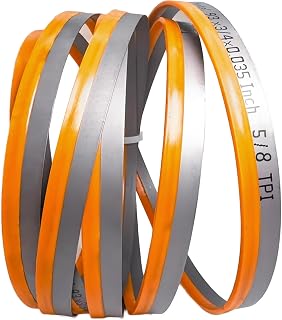
- Blade Material: Bi-metal M42 high-speed steel is the current gold standard for metal cutting. It holds its edge far longer than carbon-steel alternatives and tolerates the heat generated when you are running continuous cuts through mild steel, stainless tubing, or aluminum plate.
- Blade Width: Wider blades (3/4 inch) track straighter and resist deflection during long rip-style cuts, making them ideal for sheet and plate work. Narrower blades (1/2 inch) shine on tight curves and intricate fretwork inside decorative furniture frames.
- Tooth Pitch (TPI): Coarser teeth (5/8 or 10/14 TPI) evacuate chips quickly in thicker stock, while finer teeth (24 TPI) leave a smoother finish on thin-wall tubing and sheet metal where you do not want to spend hours at the grinder cleaning up burrs.
- Blade Length: Always match the blade length to your specific saw. The 93-inch length fits most 14-inch band saws, while the 64-1/2 inch size is purpose-built for smaller benchtop models from Harbor Freight, Wen, and Jet. Getting this wrong means a blade that simply will not mount.
- Pack Quantity and Value: Metal cutting chews through blades faster than wood work. Buying in two-packs keeps a sharp spare on hand and typically lowers the per-blade cost, which matters when you are running a small production run of furniture components.
What's inside
Every metalsmith who builds furniture knows the particular sting of a dull or mismatched blade dragging through steel tubing — the cut wanders, the edge scorches, and what should have been a clean bracket or frame piece ends up back on the scrap pile. For home-furniture makers who cut metal in a garage or small shop, the band saw blade is the single component that determines whether a project looks intentional or improvised.
This guide walks through the best band saw blades for metal available in 2026, focusing on bi-metal M42 construction, tooth geometry, and blade dimensions that matter when you are building everything from welded steel tables to illuminated shelving systems. Each pick here has been evaluated against real-world criteria: cut quality, blade life, vibration dampening, and compatibility with the most popular stationary and portable band saws on the market.
As an Amazon Associate we earn from qualifying purchases.


How to Choose a Band Saw Blade For Metal (2026)
- Blade Material: Bi-metal M42 high-speed steel is the current gold standard for metal cutting. It holds its edge far longer than carbon-steel alternatives and tolerates the heat generated when you are running continuous cuts through mild steel, stainless tubing, or aluminum plate.
- Blade Width: Wider blades (3/4 inch) track straighter and resist deflection during long rip-style cuts, making them ideal for sheet and plate work. Narrower blades (1/2 inch) shine on tight curves and intricate fretwork inside decorative furniture frames.
- Tooth Pitch (TPI): Coarser teeth (5/8 or 10/14 TPI) evacuate chips quickly in thicker stock, while finer teeth (24 TPI) leave a smoother finish on thin-wall tubing and sheet metal where you do not want to spend hours at the grinder cleaning up burrs.
- Blade Length: Always match the blade length to your specific saw. The 93-inch length fits most 14-inch band saws, while the 64-1/2 inch size is purpose-built for smaller benchtop models from Harbor Freight, Wen, and Jet. Getting this wrong means a blade that simply will not mount.
- Pack Quantity and Value: Metal cutting chews through blades faster than wood work. Buying in two-packs keeps a sharp spare on hand and typically lowers the per-blade cost, which matters when you are running a small production run of furniture components.
The Best Band Saw Blade For Metal (2026)s Reviewed
Imachinist M42 93″ 10/14 TPI
The Imachinist S933414 balances aggressive cutting speed with a surprisingly clean finish, making it a reliable everyday blade for medium-thickness steel. Its variable 10/14 TPI pitch breaks up harmonic vibration, so cuts stay true even through solid bar stock without the blade wandering off your scribe line.
FOXBC 93″ 10/14 TPI Bi-Metal
The FOXBC 93-inch blade mirrors the dimensions and tooth count of the Imachinist S933414 at a competitive price point, making it a strong alternative for shops that go through blades frequently. Its M42 edge holds up well across repeated cuts in mild steel and aluminum, and the 3/4-inch width provides solid tracking on standard 14-inch band saws.
Imachinist M42 93-1/2″ 24 TPI
For thin-wall tubing and sheet metal up to roughly 16 gauge, the Imachinist S93121224 with 24 TPI delivers a finish that borders on ready-to-weld. The 1/2-inch width and finer teeth give you the maneuverability needed for cutting decorative metal lattice or curved furniture brackets with minimal post-cut cleanup.
Imachinist M42 93″ Variable 8/12 TPI
The S9334812 is purpose-built for mixed-metal shops where you alternate between thick plate and thin tubing. Its variable 8/12 TPI geometry handles both without swapping blades mid-project, which saves real time when you are batching out furniture frames that combine heavy legs with lighter cross-supports.
FOXBC 64-1/2″ 24 TPI 2-Pack
Sized specifically for compact benchtop band saws, the FOXBC 64-1/2 inch blade fits the Wen 3970, Harbor Freight models, and Jet machines. The two-pack format is practical here because smaller saws generate more heat per cut, and having a fresh blade ready keeps your metal work from stalling out mid-build.
Frequently Asked Questions
Can I use a wood band saw blade to cut metal?
No. Wood blades lack the M42 high-speed-steel teeth needed to survive metal’s heat and abrasion. Attempting it will dull the blade almost instantly and can damage your saw’s guides and tires. Always use a blade explicitly rated for metal cutting.
What TPI should I choose for cutting steel furniture tubing?
For standard square and round tubing between 16 and 11 gauge, a 24 TPI blade leaves the smoothest cut and requires the least deburring. For thicker material over 1/4 inch, step down to 10/14 TPI to keep the cut from bogging down.
How often should I replace my metal-cutting band saw blade?
Replace the blade when you notice increased resistance, a rougher cut surface, or visible tooth damage. In a typical home shop cutting mild steel a few hours per week, a quality M42 blade like the Imachinist S933414 can last several months before performance noticeably degrades.
Will these blades fit a 14-inch band saw?
All the 93-inch and 93-1/2 inch blades listed here fit standard 14-inch band saws, which is the most common size in home and small-production shops. If you run a smaller benchtop saw, the FOXBC 64-1/2 inch two-pack is the correct choice.
Final Thoughts
For most home furniture makers cutting metal, the Imachinist S933414 10/14 TPI is the strongest all-around pick thanks to its balance of cut speed, finish quality, and long edge life. If your work leans toward thin tubing and decorative curves, the Imachinist 24 TPI model is worth adding alongside it. And for smaller benchtop saws, the FOXBC 64-1/2 inch two-pack keeps compact machines running without interruption.