Key takeaways
- Confirm the 3/4″ FHT thread: Nearly every residential dehumidifier uses a 3/4-inch female hose thread port, the same standard as a garden spigot. Check your port before ordering, because an adapter stack is one more joint that can seep onto a finished floor.
- Choose brass over molded plastic: Metal fittings seat evenly against the gasket and survive repeated seasonal removal. Plastic collars deform under hand-tight torque and are the single most common source of the slow drip nobody notices until the baseboard swells.
- Buy for the route, not the distance: Measure the actual path along walls and around obstacles, then add roughly two feet. A hose pulled taut invites strain at the port; too much slack pools water and creates a visible loop under any grazing light.
- Demand real kink resistance: Reinforced or thickened wall construction holds an open bore through tight turns. A single collapsed section stalls gravity drainage and backs water into the tank, defeating the reason you bought the hose.
- Plan for continuous slope: Gravity drainage needs the outlet lower than the port along the entire run, with no rising midsection. If your drain sits above the unit, budget for a condensate pump instead of fighting physics.
What's inside
In the rooms I light, moisture is the quiet saboteur. Damp air hazes a lens, dulls the crisp edge of a wall-wash, and leaves a faint bloom around every warm bulb that no dimmer setting can fix. So a dehumidifier earns its place in a finished basement or a media room. What it does not earn is the ritual that comes with it: hauling a sloshing reservoir past a floor lamp, tripping the shutoff at 2 a.m., and losing the whole atmospheric setup to a full-tank beep. A drain hose ends that ritual. The unit runs continuously, drains to a floor drain or condensate pump, and disappears from your attention entirely, which is exactly where utility hardware belongs.
The catch is that most hoses are made to be tolerated, not integrated. Vinyl that kinks the moment it turns a baseboard corner, plastic couplings that weep at the collar, lengths that leave a coil of slack in the middle of a sightline. This guide covers the drain hoses I actually specify on jobs: what to look for in fittings, routing, and length, plus honest notes on five options worth your money in 2026.
As an Amazon Associate we earn from qualifying purchases.




How to Choose a/an Dehumidifier Drain Hose (2026)
- Confirm the 3/4″ FHT thread: Nearly every residential dehumidifier uses a 3/4-inch female hose thread port, the same standard as a garden spigot. Check your port before ordering, because an adapter stack is one more joint that can seep onto a finished floor.
- Choose brass over molded plastic: Metal fittings seat evenly against the gasket and survive repeated seasonal removal. Plastic collars deform under hand-tight torque and are the single most common source of the slow drip nobody notices until the baseboard swells.
- Buy for the route, not the distance: Measure the actual path along walls and around obstacles, then add roughly two feet. A hose pulled taut invites strain at the port; too much slack pools water and creates a visible loop under any grazing light.
- Demand real kink resistance: Reinforced or thickened wall construction holds an open bore through tight turns. A single collapsed section stalls gravity drainage and backs water into the tank, defeating the reason you bought the hose.
- Plan for continuous slope: Gravity drainage needs the outlet lower than the port along the entire run, with no rising midsection. If your drain sits above the unit, budget for a condensate pump instead of fighting physics.
The Best Dehumidifier Drain Hose (2026)s Reviewed
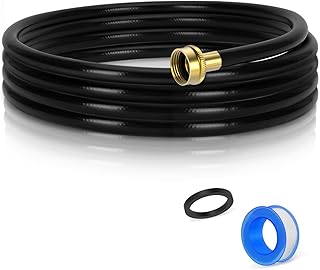
12FT Drain Hose with 3/4″ FHT Brass Connector (7 Length Options)
Twelve feet is the length that finally lets you hide the run: down the wall, behind the console, along the baseboard shadow line to a distant floor drain. The rust-resistant brass fittings thread smoothly and hold a dry seal through a full season, and the seven-length range means you can size it to the room rather than the other way around.
No-Kink Dehumidifier Hose, 3/4″ FHT, 5 Feet, Black
The matte black jacket is the practical detail here, disappearing against dark flooring and painted trim in a way that translucent vinyl never manages. Five feet suits a unit parked close to its drain, and the no-kink build tolerates the tight radius you get behind a wall-hugged appliance.
5FT Leakproof Drain Hose, 3/4″ FHT, Thickened Wall
The thicker wall is what separates this from bargain vinyl, holding its shape through corners instead of pinching flat. A sound pick for a short, permanent install where you want to set it once and stop thinking about it.
Premium Brass Connector Drainage Hose, 3/4″ FHT (5FT)
The connectors are the selling point: cleanly machined, forgiving on the threads, and easy to snug by hand without cross-threading in the awkward crouch behind a unit. Ideal if you disconnect seasonally and want fittings that survive the cycle.
8FT Leakproof Drain Hose, 3/4″ FHT, Rustproof Connector
Eight feet is the sweet spot for most basements, giving you room to route around a support post or under a stair stringer without a coil of surplus in the walkway. Same thickened, leak-resistant construction as its five-foot sibling, with genuinely useful reach.
Frequently Asked Questions
Will any of these fit my dehumidifier?
If your unit has a continuous drain port, it almost certainly uses a 3/4-inch FHT thread, which all of these match. Look for the small threaded outlet behind or beneath the reservoir and confirm before ordering.
Do I need a pump, or will gravity work?
Gravity works only if the drain sits below the port with uninterrupted downhill slope the whole way. Anything else, including a hose that dips and rises, calls for a small condensate pump.
Why is water still filling my tank?
Usually a kink, a low sag holding standing water, or a drain plug left in place. Check for a rubber cap inside the port, then trace the hose for flat spots.
How often should I clean the hose?
Flush it once or twice a season. Condensate is clean, but slow-moving lines develop biofilm that narrows the bore over time.
Final Thoughts
For most finished spaces, the 8FT leakproof hose gives you the routing freedom to keep hardware out of the sightline, while the 12FT brass-fitted hose with seven length options is the one I reach for when the drain is genuinely far away. If your unit sits within arm’s reach of the drain, the black no-kink five-footer is the tidiest, least visible solution on the list.