Key takeaways
- Onboard light quality: Lumens matter less than placement. A light aimed along the hose is task lighting; a light aimed at your face is glare. Look for a forward-throwing LED head or a wide low-glare panel, and treat flashing SOS modes as a bonus, not the main event.
- Gauge legibility in the dark: Backlit digital readouts win over analog dials once ambient light drops below a candle’s worth. Check that the backlight is dim enough not to blow out your dark adaptation while you’re reading it.
- Real airflow, not just PSI: 150 PSI is table stakes. CFM is what fills a tire. Under 2 CFM suits bikes, sports balls, and air mattresses; 6 CFM and up is genuine off-road and light-truck territory.
- Cord reach and power source: A 9.8-foot lead lets you reach all four tires from one socket. Dual 12V DC / 120V AC units double as household pumps for inflatable furniture, no engine idling required.
- Auto shut-off and thermal headroom: Preset-and-walk-away means you can hold the flashlight instead of the trigger. Check the rated duty cycle if you plan to run multiple tires back to back.
What's inside
Every lighting designer knows the same truth: the room you can’t see properly is the room you can’t work in. A flat tire in a garage at 10 p.m., or a guest air mattress that needs topping off while the household sleeps, is really a lighting problem wearing a mechanical costume. You’re crouched in your own shadow, phone balanced on a bumper, squinting at a pressure gauge that reflects every stray beam back at you. The compressor itself might be excellent. The experience is still miserable.
That’s why this guide reads a 12V air compressor the way I’d read a fixture: what does it illuminate, how cleanly does it do it, and does the display stay legible once your eyes have adapted to the dark? We’ll cover inflation speed and duty cycle too, of course, since a slow pump means longer exposure to bad light. But the picks below are ranked with a designer’s bias toward gear that lets you see the task, whether you’re firing up a queen-size guest bed in a dim spare room or airing up truck tires on a gravel shoulder.
As an Amazon Associate we earn from qualifying purchases.




How to Choose a Air Compressor 12v (2026)
- Onboard light quality: Lumens matter less than placement. A light aimed along the hose is task lighting; a light aimed at your face is glare. Look for a forward-throwing LED head or a wide low-glare panel, and treat flashing SOS modes as a bonus, not the main event.
- Gauge legibility in the dark: Backlit digital readouts win over analog dials once ambient light drops below a candle’s worth. Check that the backlight is dim enough not to blow out your dark adaptation while you’re reading it.
- Real airflow, not just PSI: 150 PSI is table stakes. CFM is what fills a tire. Under 2 CFM suits bikes, sports balls, and air mattresses; 6 CFM and up is genuine off-road and light-truck territory.
- Cord reach and power source: A 9.8-foot lead lets you reach all four tires from one socket. Dual 12V DC / 120V AC units double as household pumps for inflatable furniture, no engine idling required.
- Auto shut-off and thermal headroom: Preset-and-walk-away means you can hold the flashlight instead of the trigger. Check the rated duty cycle if you plan to run multiple tires back to back.
The Best Air Compressor 12v (2026)s Reviewed
AstroAI Dual Power 12V DC/120V AC Inflator
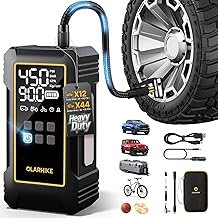
The dual metal motors move air fast enough that you’re not standing in a badly lit driveway any longer than necessary, and the 120V option turns it into a genuine indoor tool for air mattresses and inflatable seating. The best all-rounder here if you want one pump for the car and the guest room.
AstroAI AIRUN H Tire Inflator
The 9.8-foot cord is the underrated feature: you park once, reach every corner, and never drag the unit through a puddle you couldn’t see. Its LED head throws forward rather than sideways, which keeps the valve stem lit instead of your retinas.
AstroAI 12-LED Emergency Light Inflator
Twelve LEDs is enough output to actually function as a work light, not a token gesture, and it’s the pick I’d hand someone who does most of their inflating after sunset. Auto shut-off frees both hands, so you can aim the beam where the job is.
AstroAI H2 Pro Cordless Inflator
Cutting the cord removes the last tether to the dashboard socket, which matters when you’re working around patio furniture or a bike in a shed with no outlet. Battery plus 12V input means it stays useful even when it’s flat.
Uharbour 12V 10.6 CFM Dual Cylinder
At 10.6 CFM this is a different class of machine: airing down and back up on trail tires becomes a short job rather than a long one. Bring your own lighting, but bring it for less time.
Frequently Asked Questions
Can I use a 12V compressor on an air mattress?
Yes, with the right nozzle. Air mattresses need volume at very low pressure, so use a high-flow adapter and stop well short of firm; a dual-power unit like the AstroAI DC/AC model is easiest indoors.
Do I really need the built-in light?
If you ever inflate anything outside daylight hours, yes. Phone flashlights die, wash out digital gauges, and require a spare hand you won’t have.
Is a tank worth it?
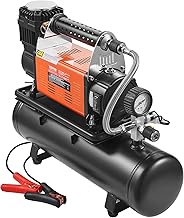
For four-tire off-road work, a tank kit like the VEVOR 6L delivers steadier output and shorter waits. For household and commuter use it’s more hardware than you need.
Will it drain my car battery?
A single tire won’t. For extended runs on high-CFM units, keep the engine running.
Final Thoughts
For most homes, the AstroAI Dual Power inflator is the honest answer: fast, quiet enough for indoor use, and equally at home with tires or inflatable furniture. Choose the 12-LED model if your work happens in the dark, or the Uharbour dual cylinder if your tires are bigger than your driveway.