Key takeaways
- Display legibility in the dark: A backlit LCD or illuminated digital readout is the single biggest usability upgrade. Unlit analog dials force you to hold a phone flashlight in your teeth while the hose fights you — bad ergonomics and worse visibility.
- Airflow matched to your tires: Roughly 1–2 CFM handles bicycles, air mattresses and passenger sedans. For 4x4s, RVs and truck tires you want 6 CFM or more, ideally dual cylinder, or the job stretches past twenty minutes per corner.
- Preset pressure and auto shut-off: Dialing a target PSI lets you walk away and manage the rest of the situation. It’s the same logic as a dimmer preset — set it once, stop babysitting it.
- Beam quality of any built-in light: Look for a diffused, forward-throwing LED rather than a raw cluster of bright points. Bare high-output diodes at knee height create harsh glare that shrinks your pupils and makes everything beyond the tool darker.
- Cable, hose and stability: Longer leads mean fewer awkward positions; a wide base or dedicated tank means the unit stays put on uneven ground. Coiled clutter is a trip hazard in low light, so a storage bag earns its keep.
What's inside
I spend my working life deciding how a room reveals itself after sunset — where the pools of warm light fall, which surfaces catch a glow, how a hallway feels at 11pm. So when a tire goes soft in an unlit gravel driveway, I notice something most tool reviews skip entirely: almost every 12 volt air compressor is used in bad light. Dusk on a shoulder. A garage with one sad ceiling fixture. A campsite where the only ambience is your own headlamp. And in that light, a chrome bezel gauge with a needle behind it is essentially decorative.
This guide looks at 12V compressors the way I’d assess a fixture: legibility, glare, footprint, cable behavior, and how gracefully the thing works when you can barely see it. I’ve weighted backlit displays, preset shut-off, integrated work lights and their beam quality, plus the practical stuff — CFM, duty cycle, and whether it inflates a 33-inch tire before your patience runs out. Six units below, from glovebox-sized inflators to tank-fed overland kits.
As an Amazon Associate we earn from qualifying purchases.



How to Choose a/an 12 Volt Air Compressor (2026)
- Display legibility in the dark: A backlit LCD or illuminated digital readout is the single biggest usability upgrade. Unlit analog dials force you to hold a phone flashlight in your teeth while the hose fights you — bad ergonomics and worse visibility.
- Airflow matched to your tires: Roughly 1–2 CFM handles bicycles, air mattresses and passenger sedans. For 4x4s, RVs and truck tires you want 6 CFM or more, ideally dual cylinder, or the job stretches past twenty minutes per corner.
- Preset pressure and auto shut-off: Dialing a target PSI lets you walk away and manage the rest of the situation. It’s the same logic as a dimmer preset — set it once, stop babysitting it.
- Beam quality of any built-in light: Look for a diffused, forward-throwing LED rather than a raw cluster of bright points. Bare high-output diodes at knee height create harsh glare that shrinks your pupils and makes everything beyond the tool darker.
- Cable, hose and stability: Longer leads mean fewer awkward positions; a wide base or dedicated tank means the unit stays put on uneven ground. Coiled clutter is a trip hazard in low light, so a storage bag earns its keep.
The Best 12 Volt Air Compressor (2026)s Reviewed
AstroAI Dual Power 12V/120V Tire Inflator
The dual-power design is the clever part — 12V in the car, 120V in the garage, so one unit covers roadside and workshop duty. Dual metal motors keep inflation quick for a compact body, and the digital gauge stays readable at arm’s length in dim conditions.
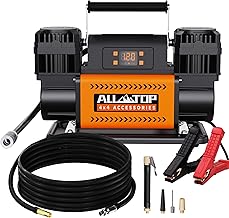
ALL-TOP 12V Dual Cylinder with LCD Panel
The LCD control panel with preset target pressure is the most designer-friendly interface here: set your number, let it stop itself, keep your hands free. At 12.35 CFM it’s genuinely overland-grade, and airing four tires back up after a sand run stops feeling like a chore.
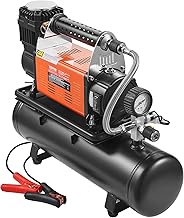
VEVOR 12V Heavy Duty with 6L Tank
The 6-liter tank changes the character of the tool — you get instant air for seating beads, blowing out dust, or running small pneumatics, not just slow inflation. It’s the bulkiest option, so treat it as a permanent fixture in a truck bed or RV bay rather than glovebox kit.
Uharbour 12V 10.6 CFM Offroad Compressor
Serious dual-cylinder output with a straightforward gauge and a carry bag that keeps hoses and clamps from becoming a tangle. A strong choice if you want near-top-tier airflow without the tank’s storage penalty.
GSPSCN 12V Heavy Duty Dual Cylinder
All-metal construction and dual cylinders give it a reassuring, unfussy solidity, and it moves air roughly six times faster than a basic single-piston inflator. The gauge is the weak point in low light, so pair it with a decent lantern rather than relying on the unit alone.
Frequently Asked Questions
Do I need a compressor with a built-in light?
It helps, but treat it as secondary illumination. The AstroAI 12-LED model is excellent for signalling your presence and lighting the immediate wheel area; for detailed work I’d still add a diffused lantern set slightly above and behind you.
Can I run one of these off a household outlet?
Only if it’s explicitly dual-voltage, like the AstroAI 12V/120V unit. Most 12V compressors draw high current and need a direct battery or socket connection — an undersized adapter is a fire risk, not a shortcut.
Should I get a tank model?
Choose a tank if you want burst air for tools and bead-seating and have permanent storage space. If you only inflate tires, a tankless dual-cylinder unit is lighter, cheaper and just as quick.
How long can these run continuously?
Compact inflators typically want a cool-down after 10–15 minutes; heavy-duty dual-cylinder units handle longer stretches. Check the stated duty cycle and give the motor a break between tires.
Final Thoughts
For most households, the AstroAI Dual Power inflator is the sensible default — small enough to live in the car, versatile enough for the garage. If you run oversized tires, the ALL-TOP dual cylinder with its preset LCD panel is the one I’d fit, and the VEVOR 6L tank kit earns its bulk for anyone who wants real air on tap.