Key takeaways
- Sheen over color: Matte and satin finishes diffuse light and stay comfortable near a table lamp; high-gloss tops act like reflectors and will throw a visible hotspot the moment a bulb is within a few feet. If you love a glossy look, angle your light sources away from the tabletop plane.
- Tone temperature: Warm bulbs push honey and oak finishes further amber and can make cool greys look muddy. Natural oak and mid-brown tones flatter almost any bulb; espresso and near-black finishes need a nearby light source or a light rug beneath them to avoid reading as a dark void.
- Grain visibility: Open, pronounced grain catches raking light beautifully from a floor lamp or sconce placed low and to the side. Flat, uniform veneers look cleaner overhead but lose that texture entirely, so pair them with contrast elsewhere.
- Surface real estate: If you plan to put a small lamp or candles on the table, protect at least a third of the top for it. Extendable and lift-top designs are great, but confirm the mechanism doesn’t force fixtures to move every time you use it.
- Base and shadow: Open shelves and slim legs let light pass through and keep the floor visible, which makes a room feel larger at night. Solid plinths and closed boxes create a dense shadow footprint, striking in a well-lit room, heavy in a dim one.
What's inside
Most people shop for a coffee table by looking at it in daylight, on a white studio background, at eye level. Then it arrives, the sun goes down, the table lamps come on, and the piece behaves like a different object entirely. A glossy top turns into a mirror that bounces a hard hotspot back at the ceiling. A cool-grey wash reads green under warm bulbs. A dense, dark stain swallows every lumen in the room and leaves a hole in the middle of the seating area. A coffee table sits lower than almost anything else you own, which means it lives in the bottom third of your lighting scheme, the zone where light pools rather than travels.
This guide looks at wooden coffee tables the way a lighting designer would: how the finish handles sheen and glare, how the grain reads at 2700K, whether the silhouette casts shadow lines you’ll actually enjoy, and how much usable surface you get for a lamp, a candle cluster, or a low bowl. I’ve focused on widely available picks across the shapes and mechanisms most rooms need, from extendable and lift-top workhorses to simple two-tier and oval forms. Every recommendation below is judged on how it looks and functions after dark, not just in a catalog photo.
As an Amazon Associate we earn from qualifying purchases.




How to Choose a Wooden Coffee Table (2026)
- Sheen over color: Matte and satin finishes diffuse light and stay comfortable near a table lamp; high-gloss tops act like reflectors and will throw a visible hotspot the moment a bulb is within a few feet. If you love a glossy look, angle your light sources away from the tabletop plane.
- Tone temperature: Warm bulbs push honey and oak finishes further amber and can make cool greys look muddy. Natural oak and mid-brown tones flatter almost any bulb; espresso and near-black finishes need a nearby light source or a light rug beneath them to avoid reading as a dark void.
- Grain visibility: Open, pronounced grain catches raking light beautifully from a floor lamp or sconce placed low and to the side. Flat, uniform veneers look cleaner overhead but lose that texture entirely, so pair them with contrast elsewhere.
- Surface real estate: If you plan to put a small lamp or candles on the table, protect at least a third of the top for it. Extendable and lift-top designs are great, but confirm the mechanism doesn’t force fixtures to move every time you use it.
- Base and shadow: Open shelves and slim legs let light pass through and keep the floor visible, which makes a room feel larger at night. Solid plinths and closed boxes create a dense shadow footprint, striking in a well-lit room, heavy in a dim one.
The Best Wooden Coffee Tables of 2026, Reviewed
Miereirl 42″–65″ Extendable Coffee Table
The sliding top and dual-tone finish give you two distinct looks and a genuinely flexible footprint, which matters in an apartment where seating gets rearranged for guests. The two-tone contrast holds up well under warm light because the lighter panel reflects just enough to keep the darker section from going flat.
Round Espresso Wood Coffee Table (32″)
A compact round in espresso is the classic small-space move, and the curved edge means no harsh corner shadows in tight walkways. Give it a light rug or a nearby lamp, since a dark round in a dim room can read as a hole rather than a piece of furniture.
IFGET 48″ Modern 2-Tier in Natural Oak
Natural oak is the most forgiving finish in this roundup under almost any bulb temperature, and the curved profile catches soft gradients instead of hard edges. The lower storage shelf keeps clutter off the top surface, which is exactly what you want if a lamp or candle grouping is going to live up there.
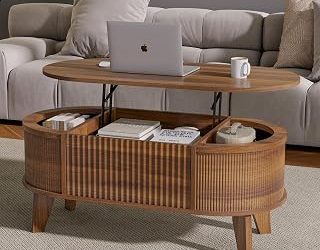
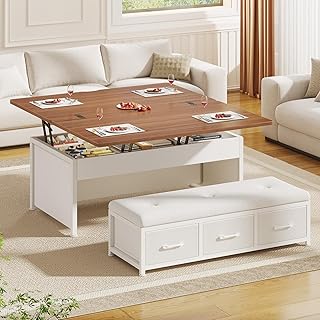
Itaar 43″ Lift Top Coffee Table Set
The lift mechanism, drawers, hidden compartment, and ottoman bench make this the most functional option here, ideal if the room doubles as a workspace. The white finish bounces light generously, brightening dim corners, though it shows fingerprints and glare more readily than a mid-tone wood.
47″ Solid Wood Farmhouse Coffee Table
Solid wood with visible grain rewards low, raking light better than anything veneered, so place a floor lamp off to one side and let the texture do the work. The dark brown finish is handsome but light-absorbing, so budget for a warm secondary source nearby.
Frequently Asked Questions
Can I put a lamp on a coffee table?
Yes, and a small one at 40 to 60 watts equivalent adds a lovely low pool of light. Keep the shade bottom near eye level when seated so the bulb isn’t visible, and choose a matte top to avoid reflected glare.
Does finish color affect how bright my room feels?
Noticeably. Light tables reflect a meaningful amount of light back into the space, while dark finishes absorb it. A dark table isn’t a problem, it just needs light sources or a lighter rug close by to stay balanced.
Solid wood or veneer?
Solid wood gives you real grain depth and can be refinished; quality veneer offers a smoother, more uniform surface and better price stability. For lighting purposes, solid wood and textured veneers show more character under directional light.
What about oval versus rectangular?
Ovals soften shadow edges and improve flow in tighter rooms. The Honyee 47.2″ oval is a good example, its rounded profile keeps light and traffic moving smoothly.
Final Thoughts
For most rooms, the IFGET 48″ in natural oak is the safest bet: forgiving under any bulb, softly curved, and quietly modern. Choose the Itaar lift top if you need storage and a work surface, or the Miereirl extendable if your seating plan changes often and you want a table that adapts with it.