Key takeaways
- Stand or straps: Tree straps are lighter and cheaper, but they lock you into the two trees you own. A steel stand is the design tool — it lets you position the hammock relative to a sunset line, a wall wash, or a fire pit, then move it next season.
- Weave and light behavior: Handwoven cotton rope breaks light into a soft crosshatch and glows when lit from below or beside. Solid parachute nylon blocks light entirely and reads as a clean color block — better when you want the hammock to recede into a dark corner.
- Spreader bar versus gathered end: Spreader bars hold the fabric flat and open, keeping the silhouette low and architectural. Gathered-end hammocks cocoon around you, which is more comfortable for sleeping but visually reads as a hanging bundle rather than a piece of furniture.
- Capacity and footprint: Look for 450 lb ratings if two people will use it, and measure the stand’s full length before buying. A 9 ft frame needs real clearance, and crowding it against a railing kills the sense of openness that makes a hammock feel good.
- Packability: If the hammock travels, a carry bag and sub-two-pound weight matter more than aesthetics. If it lives on the patio, prioritize a fade-resistant weave and a pad or pillow you’ll actually leave outside.
What's inside
Most hammock disappointments have nothing to do with the hammock. They happen because the thing gets hung wherever the anchor points happen to be, and then the whole corner of the yard reads wrong — a body suspended in the harsh downlight of a porch fixture, or a beautiful woven bed sitting in a dead zone where no light lands after seven o’clock. I spend my working hours deciding where light falls in a room and where it deliberately doesn’t, and a hammock is one of the few pieces of outdoor furniture that changes the entire mood of a space simply by existing in it. It draws a low horizontal line, it casts a soft irregular shadow, and it tells everyone standing nearby that this area is for slowing down.
This guide looks at outdoor hammocks the way I’d look at a fixture spec: what it does to the space, not just what it costs. I’ve weighted freestanding stands heavily, because a stand lets you place the hammock where the light is good rather than where the trees happen to be. I’ve also considered fabric and weave, since an open rope lattice and a solid parachute nylon behave completely differently once a lantern or a string of bulbs comes on. Below are six picks that work across patios, decks, backyards, and trailheads.
As an Amazon Associate we earn from qualifying purchases.




How to Choose a Hammock For Outdoors (2026)
- Stand or straps: Tree straps are lighter and cheaper, but they lock you into the two trees you own. A steel stand is the design tool — it lets you position the hammock relative to a sunset line, a wall wash, or a fire pit, then move it next season.
- Weave and light behavior: Handwoven cotton rope breaks light into a soft crosshatch and glows when lit from below or beside. Solid parachute nylon blocks light entirely and reads as a clean color block — better when you want the hammock to recede into a dark corner.
- Spreader bar versus gathered end: Spreader bars hold the fabric flat and open, keeping the silhouette low and architectural. Gathered-end hammocks cocoon around you, which is more comfortable for sleeping but visually reads as a hanging bundle rather than a piece of furniture.
- Capacity and footprint: Look for 450 lb ratings if two people will use it, and measure the stand’s full length before buying. A 9 ft frame needs real clearance, and crowding it against a railing kills the sense of openness that makes a hammock feel good.
- Packability: If the hammock travels, a carry bag and sub-two-pound weight matter more than aesthetics. If it lives on the patio, prioritize a fade-resistant weave and a pad or pillow you’ll actually leave outside.
The Best Hammock For Outdoors (2026)s Reviewed
Camping Hammock Lightweight Parachute Hammock with Tree Straps
This is the pick for anyone who wants the hammock to follow them — beach, backpacking trip, festival campsite — and the included tree straps mean you’re not improvising knots at dusk. The blue nylon reads deep and saturated under warm light, which makes it disappear pleasantly into a treeline rather than competing with a campfire.
Double Outdoor Hammock with Stand and Carrying Bag, Dark Gray
A cotton rope bed on a complete stand, with a polyester pad that makes it genuinely usable for long afternoons rather than ten-minute novelty sits. Dark gray is the most forgiving color outdoors: it holds up against dirt, and it stays neutral under everything from cool moonlight to a 2200K bulb.
Extra Large 2 Person Camping Hammock, Dark Gray
Generous enough that two adults aren’t negotiating elbow space, and the extra fabric width creates a deeper cocoon for actual sleeping. No stand included, so plan your anchor points before ordering.
Double Hammock with Stand for Outside, Heavy-Duty (Coffee)
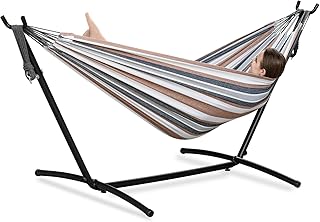
The 450 lb capacity and 9 ft heavy-duty steel frame make this the most confident freestanding option here, and assembly is genuinely straightforward. The coffee tone is the sleeper feature — warm browns pick up incandescent and string-light color beautifully in a way that gray never quite does.
Portable Outdoor Hammock with Stand, Dark Blue
Balance ropes, a soft pillow, and a carrying bag mean this one works as a semi-permanent patio piece that can still relocate for a weekend. The dark blue is the quietest of the bunch after sundown, which is exactly what you want if the hammock sits at the edge of a lit seating area.
Frequently Asked Questions
Do I need a stand if I have trees?
Not strictly, but a stand gives you placement freedom. Trees dictate where you hang; a stand lets you choose the view, the shade line, and the relationship to your lighting.
Can rope hammocks stay outside year-round?
Cotton rope tolerates weather better than most people expect, but it will gray and weaken with constant sun and rain. Store it through winter and it will last several times longer.
How much clearance does a hammock stand need?
Leave at least a foot beyond each end of the frame and roughly three feet of side clearance so the hammock can swing without contact. Crowding it makes the whole area feel tighter than it is.
What lighting works best around a hammock?
Low and warm. Anything overhead shines directly into your eyes when you lie back, so use ground-level lanterns, a nearby wall wash, or string lights hung above and behind the head end.
Final Thoughts
If you want one purchase that transforms a patio corner, the Double Hammock with Stand in coffee is the strongest all-around choice — high capacity, easy assembly, and a color that flatters warm evening light. The Lazy Daze Double Handwoven Rope Hammock is the one to buy if you already own a 12–14 ft stand and want a genuinely beautiful woven bed, while the lightweight parachute hammock with tree straps remains the obvious pick for anyone whose best view changes every weekend.