Key takeaways
- Blade and plate contrast: A zero-clearance or tight-tolerance throat plate does more than reduce tearout. It shortens the dark gap around the blade, so your line stays legible right up to the teeth instead of vanishing into a void two inches early.
- Dust capture, treated as an optical spec: Fine dust hanging in the air is a diffuser you didn’t ask for. It flattens contrast, kills the shadow edges you use for alignment, and haloes every LED in the room. Saws with sealed shrouds and above-blade collection keep the air clear and your sightlines sharp.
- Fence and scale readability: Rack-and-pinion fences hold square, but check the scale itself. Matte white markings under a slightly warm 3500K to 4000K light read faster than glossy chrome, which mirrors your fixtures straight back at you.
- Table surface finish: Polished cast aluminum and slick coated steel both bounce overhead light into your eyes at low grazing angles. A satin or lightly textured top scatters that reflection and lets you see the workpiece rather than the ceiling.
- Cut depth, bevel range, and stand height: Furniture work lives in tenon shoulders and mitered case corners, so you want a full 3 inches at 90 degrees and a smooth 0 to 45 degree bevel. Rolling stands also set your eye height, which decides whether your task light reaches the blade or your shoulders block it.
What's inside
Spend enough years aiming light at things people are supposed to see clearly, and you start noticing that most shop mistakes are visibility failures dressed up as skill failures. A pencil line disappears into the blade’s own shadow. A ceiling fixture sits directly behind your head, so your body throws a soft gray band across exactly the three inches that matter. Airborne dust turns a crisp beam into a milky wash. Buyers researching a table saw tend to compare amps and rip capacity, then discover the saw they bought is genuinely accurate and they still can’t track a cut line at the moment of contact.
This guide reviews the table saws worth owning for furniture and cabinet work in 2026, judged on the things that actually govern precision: how the blade and throat plate read under real shop light, whether the fence casts a shadow you can use as a reference edge, how much dust escapes into the air where it scatters your task lighting, and whether the surface finish fights you with glare. Specs are here too, but they’re in service of a simpler question: can you see the cut before you commit to it?
As an Amazon Associate we earn from qualifying purchases.


How to Choose a Table Saw Woodworking (2026)
- Blade and plate contrast: A zero-clearance or tight-tolerance throat plate does more than reduce tearout. It shortens the dark gap around the blade, so your line stays legible right up to the teeth instead of vanishing into a void two inches early.
- Dust capture, treated as an optical spec: Fine dust hanging in the air is a diffuser you didn’t ask for. It flattens contrast, kills the shadow edges you use for alignment, and haloes every LED in the room. Saws with sealed shrouds and above-blade collection keep the air clear and your sightlines sharp.
- Fence and scale readability: Rack-and-pinion fences hold square, but check the scale itself. Matte white markings under a slightly warm 3500K to 4000K light read faster than glossy chrome, which mirrors your fixtures straight back at you.
- Table surface finish: Polished cast aluminum and slick coated steel both bounce overhead light into your eyes at low grazing angles. A satin or lightly textured top scatters that reflection and lets you see the workpiece rather than the ceiling.
- Cut depth, bevel range, and stand height: Furniture work lives in tenon shoulders and mitered case corners, so you want a full 3 inches at 90 degrees and a smooth 0 to 45 degree bevel. Rolling stands also set your eye height, which decides whether your task light reaches the blade or your shoulders block it.
The Best Table Saw Woodworking (2026)s Reviewed
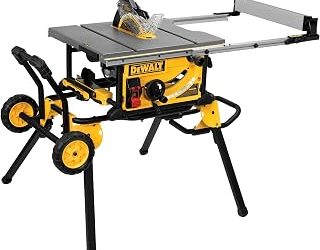
DEWALT DWE7491RS 10″ with Rolling Stand
The 32-1/2 inch rip capacity handles full sheet goods without a helper, and the rack-and-pinion fence stays parallel through repeated resets. Its real advantage for careful work is stand height: raised on the foldable rolling base, the blade sits where a clamp-on task light can rake across the table instead of hitting it head-on.
Evolution R10TS Jobsite Saw
The included zero-clearance plate and dado plate make this the most sightline-friendly saw in the group out of the box, with a tight opening that keeps your pencil line readable to the last millimeter. A 15 amp motor, 26 inch rip, and 3-3/8 inch depth cover almost every furniture cut short of thick slab work.
DOVAMAN DTS10A 10″ Table Saw
A 5300 RPM copper motor and one-side extension give this saw more working surface than its footprint suggests, with 3.35 inches of depth at 90 degrees. The satin table finish is quietly excellent under overhead LEDs, throwing far less glare than polished tops in the same class.
DEWALT DWE7485 8-1/4″ Compact
The smallest saw worth trusting for cabinet parts, and the easiest to reposition when your best light is in one corner of the garage. You give up depth of cut, so plan on it for casework panels and drawer stock rather than heavy joinery.
FINDBUYTOOL 10-Inch Portable Jobsite Saw
A 2.5HP motor, 24 inch rip, and rack-and-pinion fence at a size that fits a shared workshop bay. Dust escape is moderate, so pair it with a shop vac if you rely on a single focused light rather than diffuse ambient coverage.
Frequently Asked Questions
Does dust collection really affect cut accuracy?
Indirectly, and more than people expect. Airborne fines scatter light, reduce contrast on your marked line, and coat the fence scale within an hour. Saws advertising near-total capture, including the 98% collection console models, keep both the air and the reference surfaces readable.
What light should sit above a table saw?
Two diffuse sources at roughly 45 degrees on either side of the blade, not one fixture directly overhead. Cross-lighting cancels the shadow your hands and body cast and keeps the kerf visible through the full pass.
Is 8-1/4 inch enough for furniture?
For panels, drawer sides, and most face frames, yes. For thick tenons, deep bevels, and 4/4 hardwood ripped on edge, a full 10 inch saw with 3 inches of depth saves you from multi-pass workarounds.
Do I need a zero-clearance insert immediately?
It’s the cheapest accuracy and visibility upgrade available, so add one early if your saw doesn’t include it. Cleaner undersides on plywood, less chipout on veneer, and a much tighter read on your layout line.
Final Thoughts
The DEWALT DWE7491RS is the safest all-around choice for a furniture shop, with the rip capacity and stand height that let you light a cut properly. The Evolution R10TS is the pick if visibility at the blade matters most to you, thanks to the included zero-clearance and dado plates, while the DOVAMAN DTS10A offers the best glare-free work surface and extension table for the space it occupies.