Key takeaways
- Footprint and light flow: Measure your island’s footprint against the 36-to-42-inch clearance you need on all sides. Anything tighter, and pendant lights above the island will cast harsh, choppy shadows instead of the soft wash that makes a kitchen feel welcoming.
- Surface material and reflectivity: White faux-marble tops bounce ambient light beautifully, making smaller kitchens feel larger and brighter. Dark or rustic wood finishes absorb light — gorgeous under warm-toned pendants, but they can darken a room that already lacks natural windows.
- Portability versus permanence: Rolling islands on wheels let you reposition the piece relative to your light sources. Push it near a window during the day and back under your pendants at night for a completely different mood.
- Storage and visual clutter: Open shelving looks airy and showcases items under accent lighting, but closed cabinets hide the clutter that kills ambience. Decide which trade-off suits your kitchen’s personality.
- Size-matching your room’s scale: A massive 71-inch island bathes in light and commands attention in open-plan kitchens, while a compact 40-inch piece suits tighter layouts without blocking the path between sink, stove, and refrigerator — the kitchen work triangle.
What's inside
Choosing a kitchen island is less about square footage and more about how a piece reshapes the entire room’s atmosphere. A well-chosen island becomes the gravity point of your kitchen — the surface where warm overhead pendants pool their glow, where morning coffee catches the first stripe of window light, and where evening conversation naturally gathers. Get it wrong, and you end up with a bulky obstruction that swallows light, blocks sight lines, and makes a galley feel like a corridor.
As someone who designs kitchen lighting and ambience for a living, I evaluated these six islands through the lens of spatial flow, material reflectivity, and how each piece interacts with the layers of light that make a kitchen feel alive. Below, you’ll find five top picks — plus a buyer’s guide distilled from real design experience — so you can choose the island that turns your kitchen into a room people actually want to linger in.
As an Amazon Associate we earn from qualifying purchases.



How to Choose a Kitchen Island (2026)
- Footprint and light flow: Measure your island’s footprint against the 36-to-42-inch clearance you need on all sides. Anything tighter, and pendant lights above the island will cast harsh, choppy shadows instead of the soft wash that makes a kitchen feel welcoming.
- Surface material and reflectivity: White faux-marble tops bounce ambient light beautifully, making smaller kitchens feel larger and brighter. Dark or rustic wood finishes absorb light — gorgeous under warm-toned pendants, but they can darken a room that already lacks natural windows.
- Portability versus permanence: Rolling islands on wheels let you reposition the piece relative to your light sources. Push it near a window during the day and back under your pendants at night for a completely different mood.
- Storage and visual clutter: Open shelving looks airy and showcases items under accent lighting, but closed cabinets hide the clutter that kills ambience. Decide which trade-off suits your kitchen’s personality.
- Size-matching your room’s scale: A massive 71-inch island bathes in light and commands attention in open-plan kitchens, while a compact 40-inch piece suits tighter layouts without blocking the path between sink, stove, and refrigerator — the kitchen work triangle.
The Best Kitchen Islands (2026) Reviewed
60″ Rolling Island with Power Outlet
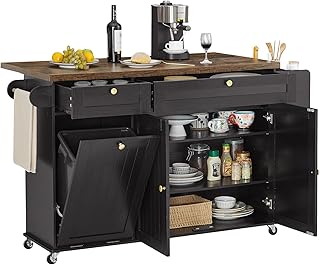
The black-and-rustic-brown finish absorbs light in a way that feels intentional and moody — perfect under Edison-bulb pendants. The built-in power outlet means you can plug in a table lamp or under-cabinet strip right at the island, adding a layer of task lighting exactly where you prep food. Its drop-leaf design lets you reclaim floor space during darker winter months when every inch of reflected light matters.
71″ Modern Large Kitchen Island
This is the showpiece. The white faux-marble top acts like a reflector, spreading light evenly across its broad surface and making the entire kitchen feel more spacious. With seating for four, it transforms into a social hub where pendant clusters or a linear chandelier can frame the gathering zone. The dedicated fridge cavity is a practical touch that keeps the silhouette clean — essential when you’re designing around sight lines and negative space.
Casual Home Hardwood Top Island
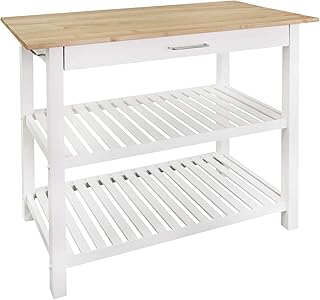
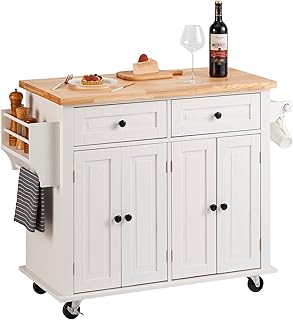
At 40 inches wide, this is the most light-friendly option for smaller kitchens. The natural hardwood top catches warm light without glare, creating a soft focal point rather than an overwhelming one. Its compact profile won’t block window light or cast a deep shadow across the floor, making it an ideal companion for kitchens where every lumen counts.
Homestyles Blue Kitchen Island Cart
Blue is a bold choice that interacts with lighting in fascinating ways — under cool daylight, it reads fresh and crisp; under warm evening bulbs, it deepens into something rich and jewel-toned. The drop-leaf breakfast bar extends your lit surface area when needed, and the wood top grounds the color so it never feels cold. This is an island that changes mood with the clock.
80″-48″ Extendable Kitchen Island
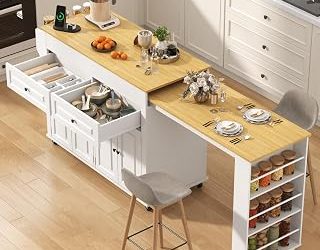
The extendable design is a lighting designer’s dream: fully extended, it provides a long, illuminated dining surface ideal for entertaining; retracted, it frees floor space so your existing lighting scheme reaches further. The three rows of open shelving invite accent-light displays, and the built-in power outlet supports additional light fixtures if you want to layer in even more ambience.
Frequently Asked Questions
What size kitchen island works best for ambient lighting?
For pendants to cast a cohesive pool of light rather than scattered hotspots, islands between 48 and 60 inches wide work best. This gives you room for two to three pendant fixtures spaced 24 to 30 inches apart, which creates the warm, overlapping glow that defines a well-lit kitchen.
Do dark island finishes make a kitchen feel smaller?
Not necessarily. Dark finishes absorb more light, but in a kitchen with ample natural windows or strong overhead fixtures, they create depth and contrast that can actually make the space feel more layered and intentional. The key is pairing the dark surface with sufficient ambient and task lighting above and around it.
Should I choose an island with open or closed storage?
If you plan to install accent lighting inside or above your island’s shelves, open storage showcases your items and adds visual warmth. Closed cabinets are better for maintaining a clean, uncluttered look — especially important in kitchens where visual noise disrupts the calm ambience you’re building.
How does a rolling island affect kitchen lighting design?
A rolling island gives you the flexibility to test different positions relative to your light sources before committing to a fixed layout. Roll it under your pendants for a dramatic centered look, or angle it toward natural light during the day. This adaptability is especially valuable in rental kitchens where you can’t hardwire new fixtures.
Final Thoughts
If I were lighting a kitchen from scratch, I’d reach first for the 71″ Modern Large Kitchen Island — its reflective white surface and generous scale make it the strongest canvas for pendant lighting and social atmosphere. For tighter spaces, the Casual Home Hardwood Top Island keeps the light moving without obstruction. And for anyone who treats their kitchen as a stage that shifts from bright workstation by day to warm gathering spot by night, the 80″-48″ Extendable Kitchen Island offers unmatched versatility in both form and illumination.