Key takeaways
- Suction with weight in mind: Litter is dense — far heavier per particle than dust or hair. Treat 5,000Pa as a workable floor for hard surfaces and aim higher if you have medium-pile rugs, where granules sink below the fibre line and shallow airflow simply passes over them.
- Anti-tangle brush geometry: Cat hair wraps; clumping litter cakes onto bristles when it meets any dampness. Rubber or comb-guarded rollers shed both instead of hoarding them, which spares you the weekly scissors ritual.
- Self-emptying base capacity: A litter home fills a small onboard bin in days. A base rated for multiple weeks means the tray-side mess disappears from your attention entirely — and sealed HEPA bags keep fine clay dust from re-entering the air.
- Navigation that works in the dark: This is where I get particular. Camera-based systems struggle in the low, dim light most people actually live in. LiDAR emits its own laser and maps identically at midnight or noon, so scheduled overnight runs stay reliable and don’t require you to floodlight the house.
- Acoustic and visual footprint: A robot is a fixture, not an appliance you hide. Check quiet-mode volume if it runs during evenings, and note where the status LEDs sit — a bright blue indicator in a room lit to 2700K reads as a glitch. Dock placement matters too: give it a shadowed alcove rather than a sightline.
What's inside
Anyone who works with light for a living learns this the hard way: a low, warm lamp is the most honest critic in the house. Set a floor lamp at ankle height beside a litter box, and the beam skims the floorboards at a shallow angle, throwing a long shadow off every stray granule of clay. What looked like a clean hallway at noon becomes a lunar surface at 7pm. Cat litter is uniquely bad for a room’s mood — it’s granular, pale against dark floors, dark against pale tile, and it travels on paws far beyond the tray. It undoes the calm you spent money building.
This guide approaches robot vacuums the way I’d approach a lighting plot: what does the room need to look and feel like at the end of the day, and what hardware gets it there without becoming a distraction itself. Below you’ll find the machines worth considering in 2026 for litter-heavy homes, plus the specs that actually matter — suction against heavy grit, brushroll design for fur, self-emptying capacity, navigation that survives a dim room, and how much acoustic and visual noise the unit adds to your evenings.
As an Amazon Associate we earn from qualifying purchases.



How to Choose a Robot Vacuum For Cat Litter (2026)
- Suction with weight in mind: Litter is dense — far heavier per particle than dust or hair. Treat 5,000Pa as a workable floor for hard surfaces and aim higher if you have medium-pile rugs, where granules sink below the fibre line and shallow airflow simply passes over them.
- Anti-tangle brush geometry: Cat hair wraps; clumping litter cakes onto bristles when it meets any dampness. Rubber or comb-guarded rollers shed both instead of hoarding them, which spares you the weekly scissors ritual.
- Self-emptying base capacity: A litter home fills a small onboard bin in days. A base rated for multiple weeks means the tray-side mess disappears from your attention entirely — and sealed HEPA bags keep fine clay dust from re-entering the air.
- Navigation that works in the dark: This is where I get particular. Camera-based systems struggle in the low, dim light most people actually live in. LiDAR emits its own laser and maps identically at midnight or noon, so scheduled overnight runs stay reliable and don’t require you to floodlight the house.
- Acoustic and visual footprint: A robot is a fixture, not an appliance you hide. Check quiet-mode volume if it runs during evenings, and note where the status LEDs sit — a bright blue indicator in a room lit to 2700K reads as a glitch. Dock placement matters too: give it a shadowed alcove rather than a sightline.
The Best Robot Vacuums For Cat Litter (2026) Reviewed
eufy C28 Robot Vacuum and Mop Combo
At 15,000Pa with a HydroJet roller mop plus automatic mop washing and drying, this is the most complete answer to litter that has been tracked, stepped on, and smeared. The zero-tangle system handles fur without complaint, and because it empties, refills, and cleans itself, the whole operation stays out of sight and out of mind.
roborock Q7 M5+ Robot Vacuum and Mop
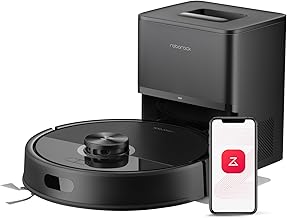
PreciSense LiDAR mapping paired with a dual anti-tangle system makes this the pick I’d recommend for anyone running overnight cycles in a dim home. Seven to nine weeks of self-emptying capacity is genuinely generous for a multi-cat household, and 10,000Pa lifts granules out of low-pile rugs rather than nudging them around.
Shark AV2501S AI Ultra Robot Vacuum
Matrix Clean has the machine cross-hatch a zone instead of making one pass, which is exactly the behaviour you want on the spray radius around a tray. The 30-day bagless HEPA base and self-cleaning brushroll mean fine clay dust stays contained — worth noting if anyone in the house is sensitive to airborne particulates.
Tikom G8000 Max Robot Vacuum and Mop Combo
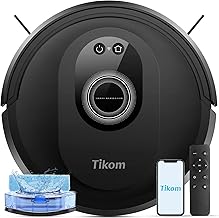
The sensible entry point: 5,000Pa, a 150-minute runtime, and app or remote control, with enough grunt for hard floors and light carpet. There’s no self-empty base, so you’ll handle the bin yourself, but for a single-cat apartment it does the essential work.
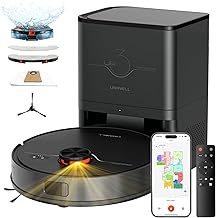
7000Pa LiDAR Robot Vacuum with Self-Empty Station
Ultra-quiet operation and customisable no-go zones make this a good fit for households where the robot has to coexist with people who are reading, working, or asleep. Multi-floor mapping plus Alexa control means you can fence off a feeding station and still automate everything else.
Frequently Asked Questions
Will litter damage a robot vacuum?
Clay granules are abrasive and can wear brush bearings over time, and clumping litter hardens if it meets a wet mop pad. Empty the bin regularly, rinse pads after use, and avoid mopping directly under the tray.
Should the robot run while my cat is around?
Most cats acclimatise within a week or two. Schedule the first few runs while you’re home and the room is softly lit rather than dark, so the noise has a visible, non-threatening source.
Do I still need to sweep near the box?
Occasionally. A daily scheduled pass handles the drift; a mat under the tray catches the heaviest scatter before it reaches the robot’s path.
Is mopping worth it in a cat home?
Yes, for dust film and paw marks on hard floors. Set the litter zone as vacuum-only and let the mop work everywhere else.
Final Thoughts
For most litter-heavy homes, the roborock Q7 M5+ hits the best balance of light-independent LiDAR navigation and long self-empty intervals, while the eufy C28 is the choice if you want mopping fully automated too. On a tighter budget, the Tikom G8000 Max covers the daily scatter without asking much of the room.