Key takeaways
- Dimming floor, not just dimming range: A fixture that only drops to 20% output is still too bright for a wind-down hour. Look for stepless dimming and check that the LED holds a steady, flicker-free glow at its lowest setting rather than stuttering or shifting color.
- Adjustable color temperature: Bedrooms need at least two moods. A 3000K warm setting for evening and a 5000K–6000K daylight setting for dressing and cleaning covers it. Stepless CCT adjustment is better than three fixed presets if you’re particular about matching lamp light.
- Diffuser quality and viewing angle: You will spend time looking straight up at this fixture from a pillow. Frosted or fully enclosed diffusers spread the source evenly; exposed LED arrays create hotspots that read as harsh from bed even at modest brightness.
- DC motor and speed granularity: DC motors run quieter and draw less power than AC equivalents, and six speeds let you find the setting that moves air without generating audible turbulence. Reversible airflow extends usefulness into winter for gentle heat circulation.
- Mounting depth and blade span: Under nine-foot ceilings, flush mount is non-negotiable. Compact 20-inch caged designs suit smaller bedrooms and spots near a bed; a 52-inch span belongs in a primary bedroom where you need real air movement across the whole floor plan.
What's inside
A bedroom asks something unusual of a ceiling fixture: it has to be the brightest thing in the room at 7am and nearly invisible at 11pm. Most fan-light combos only solve half of that. They push out a flat wash of cool white that flattens every texture in the room, or they hum just loudly enough that you notice it in the quiet after you’ve turned off a podcast. Add an eight-foot ceiling and the problem compounds, since a traditional downrod fan eats headroom and casts blade shadows that flicker across the walls every time the light is on.
This guide looks at bedroom fan lights the way a lighting designer would evaluate any fixture: color temperature range, dimming behavior at the low end, how the diffuser handles glare from a reclined viewing angle, and whether the motor stays out of the way acoustically. Every model below is a low-profile flush mount suited to standard ceiling heights, and each earns its place for a specific kind of room rather than being a generic all-rounder.
As an Amazon Associate we earn from qualifying purchases.



How to Choose a Ceiling Fan Light For Bedroom (2026)
- Dimming floor, not just dimming range: A fixture that only drops to 20% output is still too bright for a wind-down hour. Look for stepless dimming and check that the LED holds a steady, flicker-free glow at its lowest setting rather than stuttering or shifting color.
- Adjustable color temperature: Bedrooms need at least two moods. A 3000K warm setting for evening and a 5000K–6000K daylight setting for dressing and cleaning covers it. Stepless CCT adjustment is better than three fixed presets if you’re particular about matching lamp light.
- Diffuser quality and viewing angle: You will spend time looking straight up at this fixture from a pillow. Frosted or fully enclosed diffusers spread the source evenly; exposed LED arrays create hotspots that read as harsh from bed even at modest brightness.
- DC motor and speed granularity: DC motors run quieter and draw less power than AC equivalents, and six speeds let you find the setting that moves air without generating audible turbulence. Reversible airflow extends usefulness into winter for gentle heat circulation.
- Mounting depth and blade span: Under nine-foot ceilings, flush mount is non-negotiable. Compact 20-inch caged designs suit smaller bedrooms and spots near a bed; a 52-inch span belongs in a primary bedroom where you need real air movement across the whole floor plan.
The Best Ceiling Fan Light For Bedroom (2026)s Reviewed
POCHFAN 52 Inch Flush Mount Ceiling Fan
The pick for larger primary bedrooms, where a 52-inch span actually moves air from the window wall to the far corner instead of just stirring the ceiling. The brushed nickel finish stays neutral against warm and cool paint alike, and the dimmable light plus six-speed noiseless operation give you enough control to run it as a low ambient glow at night.
LEDIARY Caged Fandalier, White Gold
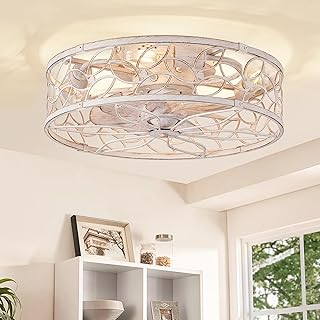
This is the one to choose when the fixture needs to read as a design object rather than a fan. The caged bladeless form throws a subtle patterned shadow that gives the ceiling some visual texture, and app control means you can tune brightness without hunting for a remote in the dark.
LEDIARY 20″ Caged Fandelier, Black Gold
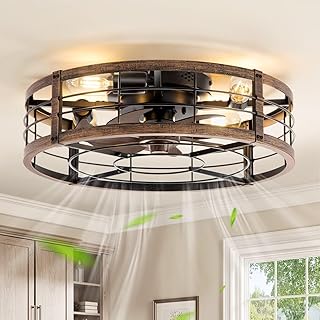
A strong fit for smaller bedrooms with a rustic or industrial lean, where the black cage adds contrast against white ceilings without visually lowering them. The enclosed design is also the safer choice for rooms with lofted beds or low ceilings.
LEDIARY 20″ Stepless Dimmable Fandelier, White
The most capable of the compact models for lighting control, pairing stepless dimming with three color temperatures so you can move from 6000K task light to a warm bedside level on a single fixture. The quiet reversible DC motor makes it a genuine year-round fixture.
ZMISHIBO 19.7″ Low Profile Fandelier, Black
A well-judged package for the price, with a full 3000K–6000K stepless range, six wind speeds, and a built-in timer that’s genuinely useful for falling asleep with airflow and waking without it. The black finish suits darker, moodier bedroom schemes where a white fixture would jump out.
Frequently Asked Questions
What color temperature is best for a bedroom fan light?
Use 2700K–3000K for evenings, since warmer light supports the body’s natural wind-down. Keep a 4000K–5000K setting available for daytime tasks. Fixtures with stepless CCT adjustment let you fine-tune rather than compromise.
Are bladeless caged fans as effective as traditional blades?
Enclosed fandeliers move less total air than a wide-span blade fan, but they excel at directed airflow in compact rooms. For bedrooms under about 150 square feet, the difference is rarely noticeable in practice.
Do I need a downrod for an eight-foot ceiling?
No. Flush mount is the correct choice below nine feet, both for clearance and to avoid blade shadow flicker. Every model here is designed to sit tight against the ceiling.
Will a DC motor fan actually be quiet enough to sleep with?
Generally yes. DC motors produce less electrical hum than AC motors, and at low speeds the dominant sound is soft air movement rather than mechanical noise. Balanced installation matters as much as the motor itself.
Final Thoughts
For a large primary bedroom, the POCHFAN 52-inch flush mount delivers the airflow a wider room genuinely needs. In smaller or design-forward spaces, the LEDIARY 20-inch stepless dimmable fandelier offers the most refined lighting control of the group, while the ZMISHIBO 19.7-inch model covers the same ground with a timer and a darker finish for moodier rooms.