Key takeaways
- Footprint before seat count: Leave 36 inches of clearance on the sides people actually walk, 24 inches where they don’t. A 40-inch round in an open corner seats four more comfortably than a 55-inch rectangle jammed against a wall.
- Finish sheen over finish color: Satin and matte tops scatter light softly across the whole surface. High-gloss laminates mirror your bulb straight into someone’s eyes, and dead-flat black finishes absorb so much output that a 60-watt-equivalent pendant reads dim.
- Fixture drop and top size: A pendant should hang 30 to 36 inches above the top and span roughly half to two-thirds of the table’s narrowest dimension. Extendable tables need a fixture that still looks intentional in both configurations, or a two-light arrangement.
- Edge and leg profile: Tapered legs and thin aprons let baseboard light and daylight travel under the table, which keeps the floor visible and the room reading larger. Chunky pedestals plant a shadow you can’t undo.
- Convertibility you’ll actually use: Hinged leaves and slide-in extensions only earn their place if the mechanism is smooth enough to operate weekly. Test it once at delivery — a stiff leaf becomes a permanently folded leaf.
What's inside
Most small dining rooms fail twice over. First the table eats the floor, then it eats the light. I spend my days specifying fixtures for compact apartments and galley kitchens, and the pattern repeats: someone buys a table sized for the party they hope to throw, hangs a pendant dead center, and ends up with a room that feels like a waiting area after dark. The tabletop is the largest horizontal surface in the room and the second-biggest influence on how bright a space reads, after the walls. Choose it badly and no fixture will rescue you.
This guide looks at compact dining tables the way a lighting designer does — footprint, finish reflectance, edge profile, and how the top behaves under a single hanging fixture. I’ve narrowed the field to drop-leaf, extendable, and bench-tucked sets that hold their proportions in tight rooms, with notes on what each one does to the light falling on it. Every pick below suits a room where the table sits under three feet of usable ceiling clearance and does double duty as a desk, prep counter, or homework station.
As an Amazon Associate we earn from qualifying purchases.



How to Choose a Dining Room Table For Small Space (2026)
- Footprint before seat count: Leave 36 inches of clearance on the sides people actually walk, 24 inches where they don’t. A 40-inch round in an open corner seats four more comfortably than a 55-inch rectangle jammed against a wall.
- Finish sheen over finish color: Satin and matte tops scatter light softly across the whole surface. High-gloss laminates mirror your bulb straight into someone’s eyes, and dead-flat black finishes absorb so much output that a 60-watt-equivalent pendant reads dim.
- Fixture drop and top size: A pendant should hang 30 to 36 inches above the top and span roughly half to two-thirds of the table’s narrowest dimension. Extendable tables need a fixture that still looks intentional in both configurations, or a two-light arrangement.
- Edge and leg profile: Tapered legs and thin aprons let baseboard light and daylight travel under the table, which keeps the floor visible and the room reading larger. Chunky pedestals plant a shadow you can’t undo.
- Convertibility you’ll actually use: Hinged leaves and slide-in extensions only earn their place if the mechanism is smooth enough to operate weekly. Test it once at delivery — a stiff leaf becomes a permanently folded leaf.
The Best Dining Room Table For Small Space (2026)s Reviewed
Hinged Drop Leaf Round Dining Table
Folding from 36 inches down to 22, this is the most honest small-space solution here — against a wall it becomes a console, and the dark brown satin top stays warm rather than glassy beneath a single pendant. Best paired with a compact shade around 12 inches wide so the fixture doesn’t overwhelm the folded profile.
Modern 47.2″–63″ Extendable Dining Table
The removable leaf makes this the most flexible pick for rooms that host occasionally, and the walnut tone carries warm-white light beautifully without going yellow. Plan for a linear fixture or two small pendants; a single center light leaves the extended ends noticeably underlit.
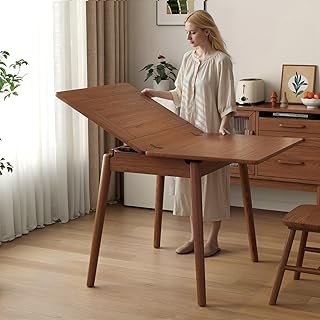
Solid Wood Expandable Table for 2–6
At 23.6 inches closed it works as a genuine two-person breakfast table, then opens to 47.2 for guests, and the solid walnut has enough grain texture to hold shadow detail under directional light. The lightest-feeling option on this list visually, thanks to slim legs and open sightlines underneath.
Gizoon 5-Piece Dining Set for 4
A complete set for apartments where you’d rather not shop twice, with upholstered chairs that absorb the acoustic slap small hard-surfaced dining nooks are prone to. The black wood top does drink light, so specify a warmer, higher-output bulb than you’d think and add a dimmer.
Tatub 3-Piece Bench Dining Set
Benches slide fully under the top, which clears the floor plane and makes a breakfast nook feel twice its size when nobody’s seated. The brown finish is forgiving under both daylight and lamplight, an underrated quality in rooms with one window.
Frequently Asked Questions
Round or rectangular for a small room?
Round for open corners and traffic paths — no sharp edges to route around, and one central pendant covers it evenly. Rectangular for narrow rooms where the table can run parallel to the longest wall.
How high should the light hang above a small table?
Thirty to thirty-six inches from tabletop to the bottom of the shade. Lower reads intimate but blocks sightlines across the table; higher spills onto walls and washes out the surface.
Do dark tabletops make a small room feel smaller?
They can, particularly matte black or espresso. Dark tops reflect far less light back into the room, so compensate with brighter output, a dimmer for control, and lighter chairs or a pale rug underneath.
What if I need to seat six or more sometimes?
An extendable model handles it better than a permanently large table. If your room is genuinely long, a full-size option like the HIPIHOM 70.9″ bench set is the honest answer — but light it with a linear fixture, not one pendant.
Final Thoughts
For most compact rooms, the Hinged Drop Leaf table is the pick that solves the space problem outright, while the Solid Wood Expandable Table for 2–6 offers the best balance of daily usability and visual lightness. If you want everything settled in one order, the Tatub 3-Piece bench set clears the floor plane and keeps a small nook feeling open — just pair whichever you choose with a dimmable, warm-white fixture and the room will do the rest.