Key takeaways
- Decibel rating, read honestly: Anything at or below 60 dBA sits under normal conversation and won’t force you out of the room. The jump from 70 dBA to 90 dBA isn’t a fifth louder — it’s roughly four times as loud to your ear. Treat published dBA as your primary spec, not a footnote.
- CFM at 90 PSI: Blow guns and interior nozzles are forgiving. Detail spray guns and small HVLP heads are not. Match sustained CFM to your thirstiest tool with headroom, or the motor will run continuously and turn your quiet unit into a loud one.
- Tank capacity versus recovery: A larger tank means fewer motor cycles, which matters enormously in a shared or finished space. Small tanks aren’t disqualifying, but they trade silence-between-bursts for portability.
- Oil-free, always, for finish work: Oil-lubricated pumps risk carrying trace lubricant downstream, which shows up as fisheyes in clear coat and haze on glass. Oil-free also means no maintenance ritual and no spill risk on a finished floor.
- Physical and visual footprint: Consider where this thing lives when it isn’t running. Vertical or twin-tank aluminum bodies tuck into corners cleanly; wheeled units move out of a sightline in seconds. Matte and brushed finishes read far better under warm task lighting than gloss red plastic.
What's inside
I spend my working life shaping how rooms feel after dark — the fall-off of a wall wash, the color temperature of a reading lamp, the moment a dimmer curve stops feeling mechanical. Which is why the air compressor question lands on my desk more often than you’d expect. Detailing bays, furniture finishing corners, and garage-adjacent studios are increasingly designed spaces now, lit and staged like any other room in the house. Then a compressor kicks on, and every bit of that carefully built calm collapses under a sound like a shop vac fighting a leaf blower. Noise is ambience. A machine that measures 90 dBA doesn’t just annoy you; it flattens your attention, shortens your sessions, and makes precision work feel like a chore.
This guide looks at compressors through that lens: acoustic footprint first, then the practical numbers that decide whether a unit can actually run a detailing gun, a blowout nozzle, or a tire top-off without stalling. I’ve weighted sound pressure, motor behavior at low RPM, tank recovery, physical presence in a finished space, and how each unit handles the stop-start rhythm of detail work — where you’re spraying for ten seconds, wiping for two minutes, and spraying again. Below are the models worth your outlet.
As an Amazon Associate we earn from qualifying purchases.



How to Choose a/an Air Compressor For Detailing (2026)
- Decibel rating, read honestly: Anything at or below 60 dBA sits under normal conversation and won’t force you out of the room. The jump from 70 dBA to 90 dBA isn’t a fifth louder — it’s roughly four times as loud to your ear. Treat published dBA as your primary spec, not a footnote.
- CFM at 90 PSI: Blow guns and interior nozzles are forgiving. Detail spray guns and small HVLP heads are not. Match sustained CFM to your thirstiest tool with headroom, or the motor will run continuously and turn your quiet unit into a loud one.
- Tank capacity versus recovery: A larger tank means fewer motor cycles, which matters enormously in a shared or finished space. Small tanks aren’t disqualifying, but they trade silence-between-bursts for portability.
- Oil-free, always, for finish work: Oil-lubricated pumps risk carrying trace lubricant downstream, which shows up as fisheyes in clear coat and haze on glass. Oil-free also means no maintenance ritual and no spill risk on a finished floor.
- Physical and visual footprint: Consider where this thing lives when it isn’t running. Vertical or twin-tank aluminum bodies tuck into corners cleanly; wheeled units move out of a sightline in seconds. Matte and brushed finishes read far better under warm task lighting than gloss red plastic.
The Best Air Compressor For Detailing (2026)s Reviewed
California Air Tools CAT-4610AC
The twin aluminum tanks give you a genuinely low, unobtrusive profile and enough stored air for continuous panel-by-panel work without constant cycling. At 1.0 hp and rated among the quietest in its class, it’s the unit I recommend when the compressor has to coexist with a room people actually spend time in.
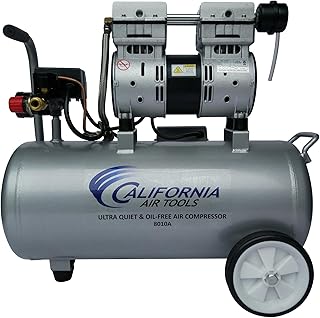
California Air Tools 8010A
Eight gallons and a 60 dBA rating is the sweet spot for detailing: long stretches of usable pressure with a motor that stays conversational when it does engage. The wheels and light aluminum tank mean you can park it out of your lighting scheme and roll it back when needed.
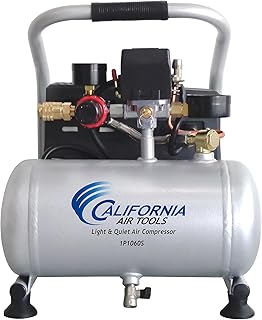
California Air Tools CAT-1P1060S
At 56 dBA and one gallon, this is the quietest option here and the most furniture-friendly — small enough to sit on a shelf between uses. It’s built for blow-off, interior detailing, and short bursts rather than sustained spray work, so be realistic about your tool list.
8 Gallon Ultra Quiet 1.5HP Oil-Free
The strongest spec sheet in the group at 4.52 CFM and 115 PSI max, which puts real spray guns and light bodywork within reach. Seventy decibels is louder than the California Air Tools units but still far below a conventional shop compressor, and the extra output means less continuous running.
BOSTITCH BTFP02012-WPK Pancake Kit
A 150 PSI, six-gallon pancake with a genuinely useful accessory bundle, making it the best entry point if you’re building a kit from nothing. It’s the loudest of the tanked units, so plan on hearing protection or scheduling loud work outside quiet hours.
Frequently Asked Questions
Do I really need a tank compressor for detailing?
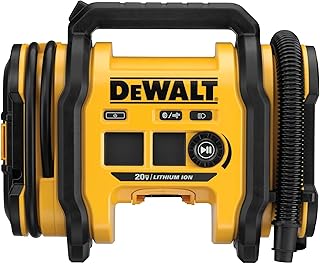
For drying crevices, clearing vents, and blowing out trim, a cordless inflator like the DEWALT DCC020IB handles occasional tasks and doubles as tire maintenance. For anything involving a spray gun or extended blow-down, you need a tank.
How quiet is quiet enough indoors?
Under 60 dBA, you can hold a conversation and keep music at a normal level. Above 70 dBA, the room stops being pleasant and you’ll unconsciously cut sessions short.
Will an oil-free pump wear out faster?
Modern oil-free pumps in this category are rated for thousands of hours at low RPM, which is precisely why these units run quietly. Low-speed operation is the reason for both the long service life and the reduced noise.
Does tank material matter?
Aluminum resists internal corrosion better than steel and cuts weight significantly, which matters if you’re relocating the unit regularly. Either way, drain the tank after each session.
Final Thoughts
If the space matters as much as the work, the California Air Tools 8010A is the pick — eight gallons of capacity at 60 dBA is the best balance of capability and calm on this list. Choose the CAT-4610AC for a lower, tidier footprint in a finished room, or the CAT-1P1060S if near-silence and shelf-sized storage outrank sustained output.