Key takeaways
- Teak, acacia, painted wood furniture and cushion fabric: 400–800 PSI, wide fan, detergent doing the labor
- Wood decking and cedar fencing: 500–1200 PSI, moving with the grain
- Vinyl siding, composite decking, resin wicker: 1200–1600 PSI
- Cars, boats, powder-coated aluminum: 1200–1900 PSI
- Brick, pavers, natural stone patios: 2000–2800 PSI
- Concrete driveways, garage slabs, oil staining: 2800–3500 PSI
What's inside
Most of my work involves deciding where light lands after dark, and the surfaces around a home are half of that job. A patio that has gone gray reads as a dead zone under a warm sconce, swallowing lumens instead of returning them. Clean bluestone bounces light back at roughly the warmth you paid for. Faded teak drinks it. That is the practical reason a pressure washer belongs in a furniture-and-outdoor-living conversation: pressure is a lighting tool as much as a cleaning one, and getting the PSI wrong can permanently change how a surface handles light.
Below is how I think about pressure ratings when prepping a space for evening use — what PSI actually measures, why flow rate matters just as much, which numbers suit which materials, and where the practical ceiling sits for a homeowner who owns furniture worth protecting. A few machines and accessories I keep coming back to are noted throughout.
As an Amazon Associate we earn from qualifying purchases.


PSI Alone Doesn’t Clean Anything
PSI is force at the tip. GPM (gallons per minute) is how much water carries that force across the surface and flushes the loosened grime away. Multiply them and you get cleaning units, which is the honest comparison figure. A 3400 PSI machine at 2.6 GPM produces roughly 8,840 cleaning units; a 2500 PSI unit at 1.76 GPM lands near 4,400. That gap shows up as time, not just power. High PSI with thin flow etches a stripe and leaves the residue sitting there. Balanced PSI and GPM lift a whole panel evenly, which is what you want on anything that will be lit at a low grazing angle later, since uneven cleaning telegraphs badly under directional light.
Match The Number To The Material
There is no single best PSI — there is a best PSI per surface. Rough working ranges:
- Teak, acacia, painted wood furniture and cushion fabric: 400–800 PSI, wide fan, detergent doing the labor
- Wood decking and cedar fencing: 500–1200 PSI, moving with the grain
- Vinyl siding, composite decking, resin wicker: 1200–1600 PSI
- Cars, boats, powder-coated aluminum: 1200–1900 PSI
- Brick, pavers, natural stone patios: 2000–2800 PSI
- Concrete driveways, garage slabs, oil staining: 2800–3500 PSI
Note where furniture sits on that list. Almost everything you sit on wants a fraction of what a driveway wants.
Where The Practical Ceiling Is
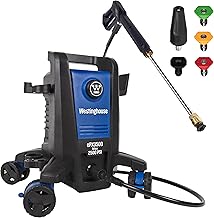
For most homes the useful range runs 2000 to 3400 PSI, and the split comes down to electric versus gas. Electric machines like the Westinghouse ePX3500, rated around 2500 max PSI and 1.76 GPM, cover furniture, fences, cars, and patios without drama — no fuel, no pull start, quiet enough to run on a Sunday morning, and the anti-tipping base matters more than it sounds when you are dragging a hose around chair legs.
Gas earns its keep on large hardscape. The Westinghouse WPX3400 at 3400 PSI and 2.6 GPM, or the DeWalt DXPW3300-S at 3300 PSI and 2.4 GPM with its AAA axial cam pump, will strip a long driveway in one session instead of three. Both are more machine than a small balcony needs. If your outdoor space is mostly seating and softscape, buying to the driveway spec means owning a tool you have to consciously detune every time you use it.
Tips And Wands Set Your Real Pressure
The number on the box is the maximum the pump can produce. What reaches the surface depends on the nozzle and your distance from it. A 0° red tip concentrates everything into a pencil and will carve wood; 15° and 25° handle concrete and stone; 40° white is your furniture and siding tip; the black soap nozzle drops pressure deliberately so detergent can sit and work.
Accessories give you finer control than the machine does. A foam cannon kit with a dual connector shift valve and its own nozzle set lets you pre-soak cushions, frames, and vehicle panels so you can clean at lower pressure afterward. An adjustable gun such as the GDHXW with extension wand, or a straightforward replacement like the Sooprinse 3000 PSI gun with M22-14 fitting and color-coded quick-connect tips, lets you dial down on delicate surfaces and reach soffits and pergola beams without a ladder.
Test Where Nobody Will Look
Before committing to a whole surface, run a test patch on a hidden section — under a bench, behind a planter, the back edge of a deck board. Start at the widest tip and the farthest distance, then close in. Water damage on wood and composite often does not show at midday; it shows at 7pm when a wall grazer rakes across the surface and every furred fiber throws a shadow. Check your test patch under raking light, not overhead light.
Tips
- Keep the tip 12 to 18 inches off delicate surfaces and never stop moving — dwelling in one spot is what leaves those tell-tale wand marks.
- Apply detergent low-pressure, let it dwell two to five minutes without drying, then rinse. Chemistry costs less than PSI.
- Trigger the gun before angling toward the surface, so the initial pressure spike lands in open air.
- Clean wood and stone on an overcast day; fast evaporation causes streaking and blotching that becomes visible once your lighting goes on.
Frequently Asked Questions
What PSI is best for outdoor furniture?
Stay between 400 and 800 PSI with a 40° tip for teak, painted metal, and resin wicker. Cushion covers are better hand-washed. If your machine cannot throttle down, back the wand off to two feet and rely on soap.
Is 4000 PSI better than 3000?
Not for residential use. Above roughly 3500 PSI you are into surface-prep and commercial territory, where the risk of gouging concrete, blowing out mortar joints, and forcing water behind siding rises faster than the cleaning benefit.
Electric or gas for a patio and garden furniture?
Electric. Something in the 2000–2500 PSI class handles seating, fencing, and pavers with less noise and no maintenance routine. Add gas only if you have significant concrete.
Can too much pressure ruin how a surface looks under lighting?
Yes. Over-pressuring raises wood grain and opens the pores of stone, both of which scatter light instead of reflecting it. The surface then reads dull and patchy at night, and no fixture change fixes it.
Conclusion
The best PSI is the lowest number that does the job on your specific materials, which for most homes means a 2000–2500 PSI electric machine for furniture, fencing, and vehicles, stepping up to 3300–3400 PSI in gas only when large concrete is in the mix. Pair whatever you choose with a proper nozzle set and a foam cannon, treat pressure as something you dial rather than unleash, and your surfaces will keep returning light the way they were designed to.