Key takeaways
- Light placement and glare path: Ceiling-mounted fixtures directly overhead put light in your peripheral vision every time you look up. Corner-recessed or rear-wall lighting bounces off the wood instead, giving you illumination without a hotspot to squint past.
- Chromotherapy that holds and dims: Confirm the controller lets you lock a single color and lower its intensity. Fixed-brightness units that only cycle are effectively decorative, and full-output blue or green at close range is genuinely unpleasant after ten minutes.
- Wood tone as a reflector: Hemlock reads pale and neutral, throwing light back cleanly and making small cabins feel larger. Aspen is lighter still and near-scentless. Darker cedar absorbs more and reads intimate but needs more lumens to avoid feeling cave-like.
- Glass area versus privacy: Tempered glass doors pull room light in and make the cabin feel open, but they also mean the sauna reads as lit furniture in your space. Consider what the cabin looks like from your sofa at night, not just from inside.
- Where the cabin sits in your room’s light: Position away from windows that will backlight the door glass and away from overhead downlights that spill through the roof vent. A corner with soft ambient light on two sides gives the best result.
What's inside
Most sauna shoppers arrive with a spec sheet mentality — watts, wood species, EMF readings in milligauss — and leave with a cabin that heats beautifully but feels like a utility closet with a bench in it. That gap matters more than people expect. A sauna session is fifteen to forty minutes of sitting still in a small illuminated box, which means the quality of the light hitting your skin and the walls around you is doing as much work as the heaters. Harsh cool-white LEDs, an unshaded reading lamp, or chromotherapy that cycles like a novelty disco puck will keep your nervous system alert precisely when you’re asking it to stand down.
This guide looks at low-EMF infrared saunas through that lens: how the cabins are lit, how the glass handles daylight and reflection, where the interior light sits relative to your eyeline, and whether the chromotherapy system is genuinely dimmable and holdable on a single hue. Shielded low-EMF heating is the baseline requirement here — every unit below meets it — so the deciding factors become footprint, wood tone, and the ambience the cabin creates in the room it lives in.
As an Amazon Associate we earn from qualifying purchases.


How to Choose a/an Low Emf Infrared Sauna (2026)
- Light placement and glare path: Ceiling-mounted fixtures directly overhead put light in your peripheral vision every time you look up. Corner-recessed or rear-wall lighting bounces off the wood instead, giving you illumination without a hotspot to squint past.
- Chromotherapy that holds and dims: Confirm the controller lets you lock a single color and lower its intensity. Fixed-brightness units that only cycle are effectively decorative, and full-output blue or green at close range is genuinely unpleasant after ten minutes.
- Wood tone as a reflector: Hemlock reads pale and neutral, throwing light back cleanly and making small cabins feel larger. Aspen is lighter still and near-scentless. Darker cedar absorbs more and reads intimate but needs more lumens to avoid feeling cave-like.
- Glass area versus privacy: Tempered glass doors pull room light in and make the cabin feel open, but they also mean the sauna reads as lit furniture in your space. Consider what the cabin looks like from your sofa at night, not just from inside.
- Where the cabin sits in your room’s light: Position away from windows that will backlight the door glass and away from overhead downlights that spill through the roof vent. A corner with soft ambient light on two sides gives the best result.
The Best Low Emf Infrared Sauna (2026)s Reviewed
OUTEXER Far Infrared Sauna Spa Room
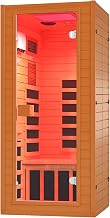
The tempered glass door and seven-color interior lighting make this compact 1200W cabin read as a designed object rather than an appliance, and the pale wood interior keeps the small footprint from feeling closed in. At roughly 35 by 28 inches it suits a bedroom corner or bathroom alcove where a larger cabin would dominate the sightline.
Joyous 2-Person Hemlock Infrared Sauna
Seven carbon fiber heaters across a Canadian hemlock shell is a well-balanced pairing — the pale wood diffuses the chromotherapy light evenly instead of letting it pool in one corner. This is the pick if you want two-person capacity without the cabin reading as bulk in a shared living space.
Bergamo 4-Person Low EMF Infrared Sauna
Four-person cabins are as much about the room’s proportions as the sauna’s, and this one earns the floor space if you have a basement or dedicated wellness area with control over the surrounding light. The larger interior volume also means the lighting has room to fall off naturally, which reads softer than the same fixtures in a one-person box.
Dynamic Saunas Venice 2-Person
Dynamic’s sub-8mG EMF rating is among the more clearly stated figures in this category, and the Venice’s two-person layout with generous door glass sits comfortably in a finished room rather than needing to be hidden. Note the curbside delivery — plan your route and your helper before it arrives.
1-Person Hemlock Sauna with Red Light and Bluetooth
Red light therapy alongside standard chromotherapy gives you a genuinely warm low-intensity setting for evening sessions, which is the mode most people end up living in. The 33-inch square footprint and 70-inch height slot into tight spaces, and the Bluetooth speakers mean you aren’t propping a phone on a hot bench.
Frequently Asked Questions
What counts as genuinely low EMF?
Readings under 3mG at seated distance are excellent; under 8mG is the common commercial threshold and what most reputable manufacturers publish. Ask for the measurement distance alongside the number, since a figure taken twelve inches from the panel means little if your back rests three inches away.
Will chromotherapy lighting actually do anything?
Treat it as ambience engineering rather than medicine. Warm amber and red at low intensity support winding down because they don’t suppress melatonin the way cool light does — that effect is real, while broader color-healing claims are not well supported.
Can these run on a standard household outlet?
Most one- and two-person cabins draw around 900–1600W on a standard 120V circuit, which is fine on a dedicated line. Larger four-person units often need their own circuit, so check the amperage before you commit to a location.
Does wood species change the experience?
Yes, visually more than thermally. Aspen and hemlock stay pale and near-odorless, keeping small cabins bright; cedar brings scent and a darker, more enclosed feel that some people prefer and others find heavy in a compact space.
Final Thoughts
For most homes, the Joyous 2-Person Hemlock hits the best balance of capacity, light-friendly pale wood, and a footprint that doesn’t take over a room. If you’re working with a genuinely tight corner, the OUTEXER Spa Room delivers the glass-door openness and dimmable color that keep a small cabin from feeling like a box, while the Dynamic Saunas Venice is the pick for buyers who want a clearly published EMF figure and a cabin that looks intentional in a finished space.