Key takeaways
- Match the noise to the room’s floor: A bedroom at night sits near 30dB. Anything above roughly 45dB will read as a presence rather than a background, so look for a published sleep-mode figure, not just the word “quiet.”
- Check the light discipline: The best units let you kill the display entirely. Second best is a dimming panel. Worst is a fixed blue LED, which is exactly the wavelength that keeps you alert.
- Treat added glow as a design choice: Seven-colour ambient lighting can work beautifully as a low-level floor wash, but only if you settle on one warm setting and leave it there. Cycling colour reads as gadget, not ambience.
- Size honestly, then undersize slightly: A unit running gently at 60% is quieter than a small one straining at full tilt. Peltier models suit closets and baths; compressors earn their noise in basements.
- Plan the drain and the sightline together: Continuous hose drainage removes the nightly emptying ritual, but route it where it won’t cross a lit walkway or catch a lamp’s spill.
What's inside
Damp rooms rarely announce themselves with a puddle. They show up as a lampshade that smells faintly of basement, a paper diffuser that has gone soft and wavy, a walnut side table whose finish reads dull under a warm bulb instead of catching it. As someone who spends most of my working life tuning how a room feels after sunset, I’ve learned that humidity is a lighting problem as much as a comfort one. Moist air scatters light differently, dulls surfaces, and quietly undoes the layered glow you spent a weekend building.
The catch is that most machines sold to fix this arrive with their own atmosphere problems: a compressor drone that flattens a quiet evening, and a control panel bright enough to read by at 3am. This guide looks at silent dehumidifiers through that lens — how loud they actually sit in a still room, how much light they leak, and whether the glow they add helps or hurts. Below are the models worth living with, plus what to check before you buy.
As an Amazon Associate we earn from qualifying purchases.


How to Choose a Silent Dehumidifier (2026)
- Match the noise to the room’s floor: A bedroom at night sits near 30dB. Anything above roughly 45dB will read as a presence rather than a background, so look for a published sleep-mode figure, not just the word “quiet.”
- Check the light discipline: The best units let you kill the display entirely. Second best is a dimming panel. Worst is a fixed blue LED, which is exactly the wavelength that keeps you alert.
- Treat added glow as a design choice: Seven-colour ambient lighting can work beautifully as a low-level floor wash, but only if you settle on one warm setting and leave it there. Cycling colour reads as gadget, not ambience.
- Size honestly, then undersize slightly: A unit running gently at 60% is quieter than a small one straining at full tilt. Peltier models suit closets and baths; compressors earn their noise in basements.
- Plan the drain and the sightline together: Continuous hose drainage removes the nightly emptying ritual, but route it where it won’t cross a lit walkway or catch a lamp’s spill.
The Best Silent Dehumidifiers of 2026, Reviewed
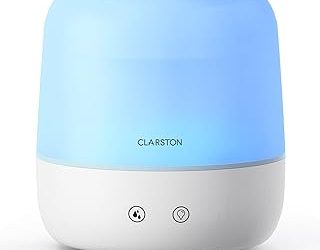
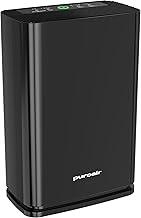
95oz Quiet Dehumidifier with 7-Colour Ambient Light (Black)
The black shell disappears against dark flooring and the ambient light doubles as a gentle night marker, which is genuinely useful in a hallway or basement stair landing. Set it to a single amber tone and it behaves like a small accent fixture rather than a competing light source.
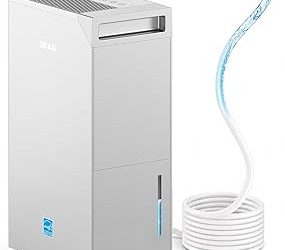
95oz Quiet Dehumidifier with 7-Colour Ambient Light (Grey)
Mechanically the same proposition in a softer finish that suits pale oak, linen, and the warm-neutral palettes most people build bedrooms around. The 1000 sq ft rating is optimistic for open plans, but in a single room it holds humidity steady without ever announcing itself.
Eva-Dry EDV-1200
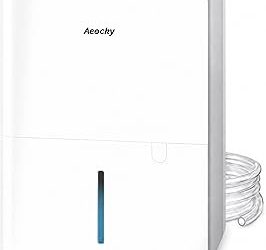
At 35dB with no compressor, this is the closest thing to a silent partner for a closet, ensuite, or boat cabin — it hums at roughly the level of a dimmer’s own faint buzz. Coverage tops out near 133 sq ft, so treat it as a targeted tool rather than a whole-room solution.
HOGARLABS 30 Pint
Three modes and a digital panel give you real control over how hard it works, and the auto-restart means a power blip won’t leave a basement to reabsorb moisture for a week. The panel is bright, so plan on tucking it below eye level if it shares a room with evening lighting.
KNKA 34 Pint
The intelligent humidity control and 24-hour timer let you push the noisier work into daylight hours and keep evenings calm — a scheduling trick I recommend to every client with an open-plan lower floor. Drain hose support makes it a set-and-forget fixture in a utility corner.
Frequently Asked Questions
What decibel level actually counts as silent?
Nothing electrical is truly silent. Below about 40dB the sound stops registering as a separate event in a furnished room; above 50dB it becomes the thing you notice when a conversation pauses.
Will the ambient light disturb sleep?
Blues and greens will. A dim amber or red setting sits far enough down the spectrum to function as a wayfinding glow without suppressing melatonin, which is why I default to those tones.
Peltier or compressor?
Peltier units are near-silent and low-wattage but slow, and they lose effectiveness in cold rooms. Compressors extract far more water per day and handle unheated basements, at the cost of a cyclical hum.
Where should I place it?
Central, with clear air on all sides, and ideally out of any lamp’s throw so the casing doesn’t become an unintended highlight. Keep it off rugs, which restrict the base intake.
Final Thoughts
For a bedroom or living room where atmosphere matters most, the 95oz ambient-light models in black or grey give you moisture control and a usable low-level glow in one object. Pair either with an Eva-Dry EDV-1200 in the closet or bath, and step up to the KNKA 34 Pint if you’re fighting a genuinely damp basement.