Key takeaways
- Light quality over light quantity: Look for genuine 660nm and 850nm wavelengths rather than a vague “red light” claim, and check whether the panel faces your torso at bench height. A therapy panel aimed at your ankles is decoration.
- Chromotherapy you’d actually leave on: Seven-color systems vary wildly in tuning. The useful ones offer a low-saturation amber and a deep warm red you can hold for a full session; the weak ones only look good in product photos.
- Heater distribution and wattage: Seven-panel layouts around 1200–1290W on standard 120V give even, wraparound warmth without a dedicated circuit. Fewer panels means hot spots and longer preheats.
- Wood and glass as reflectors: Canadian hemlock stays pale and bounces warm light softly, which is why it flatters low-lumen interiors. Tempered glass doors extend that glow outward — worth considering if the sauna sits in a shared living space.
- Footprint and sightlines: Measure ceiling clearance, not just floor area. A 73-inch cabinet reads very differently against an eight-foot ceiling than a nine-foot one, and corner placement almost always looks more intentional than a wall-center install.
What's inside
Most people shopping for a home sauna focus entirely on heat output and cabin size, then discover something unexpected on day one: the light is what they actually live with. A cabin lit like a walk-in closet feels clinical no matter how well it warms up, and a chromotherapy panel cycling through electric magenta can undo the whole point of a twenty-minute wind-down. Working in ambience design, I see this constantly — the mechanical specs get scrutinized, the visual environment gets whatever the manufacturer bundled in.
This guide reviews the infrared sauna brands worth your money in 2026 through that second lens as well as the first. I’ve weighed heater coverage, wood quality, EMF ratings, and footprint alongside the things that determine whether a cabin reads as a retreat or a box: how red light therapy panels are positioned, whether color modes are tuned or garish, how bench and glass surfaces handle reflected warmth, and how the whole unit sits inside a normally furnished room.
As an Amazon Associate we earn from qualifying purchases.


How to Choose a/an Infrared Sauna Brands (2026)
- Light quality over light quantity: Look for genuine 660nm and 850nm wavelengths rather than a vague “red light” claim, and check whether the panel faces your torso at bench height. A therapy panel aimed at your ankles is decoration.
- Chromotherapy you’d actually leave on: Seven-color systems vary wildly in tuning. The useful ones offer a low-saturation amber and a deep warm red you can hold for a full session; the weak ones only look good in product photos.
- Heater distribution and wattage: Seven-panel layouts around 1200–1290W on standard 120V give even, wraparound warmth without a dedicated circuit. Fewer panels means hot spots and longer preheats.
- Wood and glass as reflectors: Canadian hemlock stays pale and bounces warm light softly, which is why it flatters low-lumen interiors. Tempered glass doors extend that glow outward — worth considering if the sauna sits in a shared living space.
- Footprint and sightlines: Measure ceiling clearance, not just floor area. A 73-inch cabinet reads very differently against an eight-foot ceiling than a nine-foot one, and corner placement almost always looks more intentional than a wall-center install.
The Best Infrared Sauna Brands (2026)s Reviewed
1-2 Person Infrared Sauna with Red Light Therapy and Bluetooth
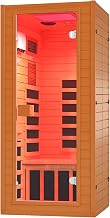
At 40″ x 36″ x 73″ this is the most flexible option here — genuinely usable for two, still slim enough for a spare bedroom corner. The seven-color therapy light is the standout for ambience: the warmer settings paired with the brown exterior finish produce a lounge-like glow rather than the sterile white wash cheaper cabins default to.
springspa Full Spectrum Infrared Sauna, 1 Person
Seven heating panels and 1290W on a standard outlet mean this reaches temperature fast, which matters more than people expect for evening use. The 660nm and 850nm red light therapy sits at a sensible height, and the hemlock interior keeps the whole cabin visually soft even at low light levels.
DYNAMIC SAUNAS Cordoba Full Spectrum, 2-Person
The most substantial build on this list and the one I’d recommend to anyone treating the sauna as a permanent room feature rather than a temporary addition. The extra interior volume changes how light behaves — you get gentle falloff toward the corners instead of the flat, evenly-lit feel of a single-person box.
Full Spectrum Infrared Sauna with Foot Warmer, 1 Person
The dedicated foot warmer is the detail that separates this from its near-identical competitors, and it addresses the most common complaint about compact cabins: warm torso, cold feet. Same seven-panel, 1290W configuration and proper near-infrared wavelengths, in a smaller footprint than the two-person units.
Infrared Sauna Tent with 3L Steamer
A completely different proposition — folding, portable, and paired with a steamer for humid heat, with nine heat levels and a 99-minute timer. Don’t expect ambience from a fabric enclosure, but for renters or anyone unwilling to commit a permanent 12 square feet, it delivers the thermal benefit without the cabinetry.
Frequently Asked Questions
Does chromotherapy lighting actually do anything?
The clinical evidence is thin compared to red light therapy at specific wavelengths. What it reliably does is shape how the space feels, and that affects whether you use the sauna consistently — which is where the real benefit lives.
Should I worry about EMF levels?
Low-EMF construction, like the OUTEXER model’s, is now standard among reputable brands. If a listing avoids mentioning EMF entirely at this price tier, treat that silence as an answer.
Can I run one of these on a normal outlet?
Yes — the 1200–1290W units here all run on 120V household circuits. Give the sauna its own outlet rather than sharing with a space heater or dryer.
How much clearance does a cabin need?
Allow four to six inches at the back and sides for ventilation and cable routing. That gap also lets ambient room light wrap the cabin, which visually softens what is otherwise a large rectangle.
Final Thoughts
For a permanent installation where the sauna becomes part of the room’s character, the DYNAMIC SAUNAS Cordoba earns its footprint through build quality and the way its larger interior handles light. Solo users should look at the springspa Full Spectrum for its fast heat-up and well-placed therapy panels, or the 1-2 Person Infrared Sauna with 7-Color Therapy Light if the ambient lighting matters as much to you as the heat.