Key takeaways
- Light layers, not light sources: A single overhead fixture flattens everything. Look for cabins that separate functions — a warm reading lamp near the bench, chromotherapy for mood, and low-level accent glow. Three modest sources beat one bright one every time.
- Hemlock and how it reflects: Canadian hemlock is pale and low-resin, which means it bounces warm light softly instead of yellowing it or throwing knot-shadows across the ceiling. It’s the reason well-lit hemlock cabins read as amber rather than orange.
- Glass door orientation: Tempered glass is standard, but plan where it faces. A door pointed at a bright kitchen or west-facing window turns your dim cabin into a fishbowl. Position it toward a wall or a dimmable room lamp.
- Heater layout and body coverage: Carbon fiber panels distributed across back, calves, and floor deliver more even radiant heat at lower surface temperatures than a few high-output ceramic rods. Six to seven panels in a two-person cabin is a sensible target.
- Low EMF as baseline, not bonus: Any far infrared sauna sold in 2026 should publish low EMF figures for its heating elements. Treat it as an entry requirement and spend your attention on ergonomics, bench depth, and control placement instead.
What's inside
Most sauna shopping happens in a spreadsheet: wattage, EMF readings, panel counts, cubic feet. Then the cabin arrives, you climb in for the first time, and the thing that actually determines whether you use it three times a week or three times a year turns out to be the light. A single unshaded bulb at eye level, a chromotherapy panel that strobes rather than glows, a glass door that turns your hallway fixture into a spotlight on your face — these are the details that quietly decide whether a sauna feels like a retreat or a waiting room.
I design lighting and ambience for residential wellness spaces, and I evaluate saunas the way I evaluate any small enclosure people go into to decompress: how the light falls, where it comes from, how it interacts with the wood, and whether you can turn it down. This guide covers the far infrared saunas worth buying in 2026, judged on heat performance and build quality, but also on the layered lighting most reviews skip entirely.
As an Amazon Associate we earn from qualifying purchases.


How to Choose a Far Infrared Sauna (2026)
- Light layers, not light sources: A single overhead fixture flattens everything. Look for cabins that separate functions — a warm reading lamp near the bench, chromotherapy for mood, and low-level accent glow. Three modest sources beat one bright one every time.
- Hemlock and how it reflects: Canadian hemlock is pale and low-resin, which means it bounces warm light softly instead of yellowing it or throwing knot-shadows across the ceiling. It’s the reason well-lit hemlock cabins read as amber rather than orange.
- Glass door orientation: Tempered glass is standard, but plan where it faces. A door pointed at a bright kitchen or west-facing window turns your dim cabin into a fishbowl. Position it toward a wall or a dimmable room lamp.
- Heater layout and body coverage: Carbon fiber panels distributed across back, calves, and floor deliver more even radiant heat at lower surface temperatures than a few high-output ceramic rods. Six to seven panels in a two-person cabin is a sensible target.
- Low EMF as baseline, not bonus: Any far infrared sauna sold in 2026 should publish low EMF figures for its heating elements. Treat it as an entry requirement and spend your attention on ergonomics, bench depth, and control placement instead.
The Best Far Infrared Sauna (2026)s Reviewed
Dynamic Saunas Barcelona 1-2 Person
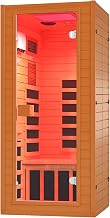
The Barcelona pairs 360° heating with red light therapy, and the red panel is genuinely useful as an ambience layer — run it alone at the end of a session and the hemlock takes on a deep ember tone that no chromotherapy LED replicates. Solid construction, roomy for its footprint, and the Bluetooth audio is clean enough for low-volume ambient tracks.
Far Infrared Corner Sauna, 2-3 Person
This is the most thoughtfully lit cabin in the group: two dedicated LED reading lamps plus three chromotherapy lights, which means you can actually read at the bench without flooding the room. The corner geometry also tucks it into wasted floor area, and the diagonal bench gives two people real shoulder space.
OUTEXER 1200W Single-Person Sauna
A compact 1200W cabin with seven-color lighting and a tempered glass door, built for apartments and spare corners where a two-person unit simply won’t fit. The color cycling is more decorative than therapeutic, but at its warmest settings it produces a convincingly cozy interior.
Joyous 2-Person Low EMF Sauna
Seven carbon fiber heaters spread the radiant load properly, so you get even warmth without hot spots against your back. The chromotherapy light is a single well-diffused unit rather than a cluster, which I prefer — less visual noise, and the hemlock does the rest of the work.
2 Person Red Light Therapy Sauna (48x44x77in)
A strong value pick that combines red light therapy with a seven-color panel and dual Bluetooth speakers in a genuinely spacious two-person shell. Worth noting the interior is bright when everything is switched on, so treat the presets as options rather than a default.
Frequently Asked Questions
Is chromotherapy lighting actually beneficial?
The clinical evidence is thin. What it reliably does is shape mood and perceived warmth, which matters for consistency of use. Treat it as ambience design, not medicine.
How dark should a sauna be?
Dimmer than you’d guess. Low, warm light from below eye level relaxes the nervous system faster than overhead brightness, which is why bench-level reading lamps outperform ceiling fixtures.
Do I need a dedicated circuit?
Most single and two-person 110V cabins run on a standard household outlet, but they should have that circuit to themselves. Larger units may require 240V — confirm before delivery.
How long does assembly take?
Two people, ninety minutes to three hours for a clip-together hemlock cabin. Plan your lighting environment first; repositioning a fully assembled sauna is miserable.
Final Thoughts
If you want the best-lit cabin available, the 2-3 Person Corner Sauna with its dual reading lamps and three chromotherapy lights is the one to buy. The Dynamic Saunas Barcelona is the better pick if red light therapy and even 360° heat are your priorities, and the Joyous 2-Person is the balanced middle choice — seven-panel coverage with restrained, well-diffused lighting that lets the hemlock carry the mood.