Key takeaways
- A real humidistat, not a timer: Mold grows on your walls, not just in the tank. A sensor that holds the room at 40–50% and cuts the mist automatically is the single most protective feature you can buy — far more useful than extra capacity.
- Reach-in geometry: If your whole hand plus a cloth can’t get to the bottom of the tank, the corners will never get scrubbed. Wide top-fill openings and dishwasher-safe tanks turn weekly cleaning from a chore into a thirty-second job.
- Material honesty: Smooth, non-porous surfaces resist biofilm far better than textured plastic. Stainless steel tanks, like the one on the Feekaa, are the low-maintenance end of this spectrum; BPA-free tanks with minimal internal ribbing are the practical middle.
- No wick, no cartridge, no mystery: Evaporative wicks are absorbent by design, which makes them a reservoir for whatever you didn’t rinse. Filterless ultrasonic units cost less to run and leave nothing hidden to rot.
- Light discipline: Check that the nightlight dims to something warm and that the display can go fully dark. A humidifier parked at eye level with a bright indicator becomes a small blue lighthouse — it will flatten the ambience of an otherwise well-lit room and interfere with sleep.
What's inside
I light rooms for a living, which means I spend a lot of time thinking about the objects that sit in the glow — the lamp bases, the diffuser plumes, the small appliances that end up throwing their own light at 2 a.m. A humidifier is the odd one out in that lineup: it’s the only thing in a bedroom that is simultaneously a light source and a standing pool of water. Get the second part wrong and you don’t just get musty air, you get pink biofilm in the tank seams, a sour smell riding the mist, and dark spots creeping along the cold wall behind the nightstand. Most “mold problems” traced back to a humidifier are really two problems — a tank you can’t reach into, and a room pushed past 55% humidity by a machine with no idea when to stop.
This guide looks at humidifiers through both lenses: which ones are genuinely easy to keep clean and dry, and which ones behave themselves visually once the overheads go off. Below are the models worth your money in 2026, plus the selection criteria I actually use when specifying one for a nursery, a plant corner, or a bedroom where the light needs to stay soft.
As an Amazon Associate we earn from qualifying purchases.


How to Choose a Humidifier No Mold (2026)
- A real humidistat, not a timer: Mold grows on your walls, not just in the tank. A sensor that holds the room at 40–50% and cuts the mist automatically is the single most protective feature you can buy — far more useful than extra capacity.
- Reach-in geometry: If your whole hand plus a cloth can’t get to the bottom of the tank, the corners will never get scrubbed. Wide top-fill openings and dishwasher-safe tanks turn weekly cleaning from a chore into a thirty-second job.
- Material honesty: Smooth, non-porous surfaces resist biofilm far better than textured plastic. Stainless steel tanks, like the one on the Feekaa, are the low-maintenance end of this spectrum; BPA-free tanks with minimal internal ribbing are the practical middle.
- No wick, no cartridge, no mystery: Evaporative wicks are absorbent by design, which makes them a reservoir for whatever you didn’t rinse. Filterless ultrasonic units cost less to run and leave nothing hidden to rot.
- Light discipline: Check that the nightlight dims to something warm and that the display can go fully dark. A humidifier parked at eye level with a bright indicator becomes a small blue lighthouse — it will flatten the ambience of an otherwise well-lit room and interfere with sleep.
The Best Humidifier No Mold (2026)s Reviewed
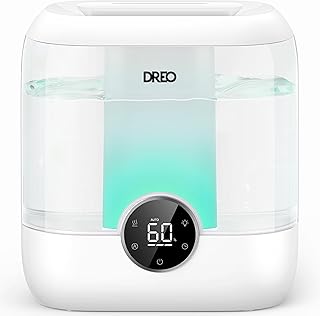
DREO 6L HM524
Precise humidity targeting plus a 60-hour tank means it spends most of its time idling rather than saturating the room, which is exactly the behavior you want in a closed bedroom. The wide mouth makes rinsing genuinely quick, and at 28 dB it disappears behind ordinary room noise.
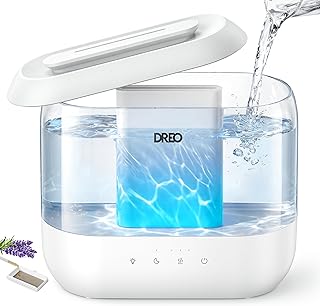
DREO 4L HM311
A supersized opening on a mid-size tank — easily the best cleaning access per dollar in this group. Its nightlight is soft enough to work as a low-level wayfinding glow without washing out a warm bedside lamp.
Levoit NeoClassic 650S
The 6.2L dishwasher-safe tank plus app scheduling is the most hands-off setup here; you can hold a target range from your phone and let the sensor do the restraint for you. Top fill, 26 dB, and 62 hours of runtime make it the natural pick for a large bedroom or a serious plant shelf.
KZF 9L Smart Humidifier
Best suited to open-plan spaces or dry offices where 2.3 gallons won’t sit around for days going stale. Three mist modes and remote control let you dial the plume down to a whisper, which matters visually — a tall column of mist catching lamplight reads as haze, not atmosphere.
Levoit NeoClassic 450
At 21 dB it’s the quietest unit on this list and the one I’d put in a nursery, with a dishwasher-safe 4.2L tank that removes every excuse not to clean it. The 42-hour runtime and dimmable night light make it easy to live with on a nightstand.
Frequently Asked Questions
Can a humidifier cause mold in my room?
Yes, if it overshoots. Sustained humidity above roughly 55% lets condensation form on cold glass and exterior walls, and that’s where mold takes hold. A humidistat-equipped model plus a cheap hygrometer across the room solves it.
How often does it actually need cleaning?
Rinse and dry the tank every few days, and do a proper descale weekly with white vinegar or citric acid. The step people skip is drying — leaving the tank open and empty for an hour breaks the biofilm cycle better than any additive.
Are essential oils a mold risk?
Only use them in a dedicated oil tray, never in the water tank. Oils leave a residue that traps minerals and holds moisture, and they can degrade plastics over time.
Does distilled water help?
It won’t stop microbial growth, but it eliminates white mineral dust and the scale that gives biofilm somewhere to anchor. Worth it in hard-water areas.
Final Thoughts
For most bedrooms, the Levoit NeoClassic 650S is the smartest long-term choice — dishwasher-safe, app-controlled, and quiet enough to forget. The DREO HM524 is the better buy if you’d rather set humidity once and never open an app, and the NeoClassic 450 is my nursery recommendation for its near-silent operation and genuinely dimmable glow.