Key takeaways
- Match the undertone to your bulbs: Warm white lighting (2700K–3000K) pushes beiges toward amber and can make cool greys look dingy. If your kitchen runs warm, taupe and greige hold their character. Under neutral or daylight-balanced fixtures, true greys and blues stay clean.
- Watch how pile catches raking light: Low, dense pile absorbs light evenly and stays visually quiet. Longer or looped pile creates micro-shadows that read as texture under a downlight but also show every footprint and vacuum track when light strikes at a shallow angle.
- Favor matte fibers over shiny ones: Polyester with a high sheen bounces specular highlights back at eye level, especially near a window. Brushed, low-luster surfaces diffuse instead, which keeps the floor plane calm and stops the rug from competing with your countertops.
- Insist on real backing, not just a claim: Rubber or TPR backing that grips hard flooring matters more in a kitchen than anywhere else. A rug that creeps toward the dishwasher is a trip hazard, and lifted corners cast shadow lines that make a room look unfinished.
- Buy for the wash cycle, not the unboxing: Distressed and abstract prints hide crumbs and stains better than solids, and pigment-dyed fibers hold up through repeated washing. If a rug fades unevenly, it will show first along the brightest lit stretch of floor.
What's inside
Kitchens are the most aggressively lit rooms in a house. You have overhead cans, under-cabinet strips, a pendant or two over the island, and often a window throwing hard daylight across the floor by mid-morning. Every one of those sources hits the floor at a different angle and a different color temperature, which is why a runner that looked calm and creamy in a product photo can read pink, yellow, or oddly grey once it’s down between your sink and your stove. Most shoppers choose a kitchen runner on pattern alone, then wonder why the room suddenly feels off.
This guide approaches the problem the way I approach a lighting plan: as a question of surface behavior. Below are six washable kitchen runners assessed for how their fibers handle glare, how their pile reads under raking light, whether their undertones stay honest at 2700K versus 4000K, and whether they hold their color through repeated laundering. Grip, absorbency, and comfort underfoot are all covered too, because a rug that photographs well and slides underfoot is a failure by any measure.
As an Amazon Associate we earn from qualifying purchases.



How to Choose a Kitchen Runner Rug (2026)
- Match the undertone to your bulbs: Warm white lighting (2700K–3000K) pushes beiges toward amber and can make cool greys look dingy. If your kitchen runs warm, taupe and greige hold their character. Under neutral or daylight-balanced fixtures, true greys and blues stay clean.
- Watch how pile catches raking light: Low, dense pile absorbs light evenly and stays visually quiet. Longer or looped pile creates micro-shadows that read as texture under a downlight but also show every footprint and vacuum track when light strikes at a shallow angle.
- Favor matte fibers over shiny ones: Polyester with a high sheen bounces specular highlights back at eye level, especially near a window. Brushed, low-luster surfaces diffuse instead, which keeps the floor plane calm and stops the rug from competing with your countertops.
- Insist on real backing, not just a claim: Rubber or TPR backing that grips hard flooring matters more in a kitchen than anywhere else. A rug that creeps toward the dishwasher is a trip hazard, and lifted corners cast shadow lines that make a room look unfinished.
- Buy for the wash cycle, not the unboxing: Distressed and abstract prints hide crumbs and stains better than solids, and pigment-dyed fibers hold up through repeated washing. If a rug fades unevenly, it will show first along the brightest lit stretch of floor.
The Best Kitchen Runner Rugs (2026) Reviewed
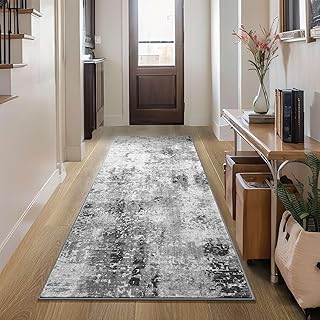
2×6 Washable Vintage Runner
The distressed farmhouse print is the smartest choice here for busy, brightly lit kitchens: the faded pattern breaks up glare and disguises the water spots that plague solid runners near a sink. It’s soft enough to work in a bedroom or entryway too, so it earns its keep beyond the kitchen.
BEQHAUSE Taupe Kitchen Runner (24″x60″)
Taupe is the most forgiving neutral under warm bulbs, staying honest where a cool grey would look muddy. The absorbent surface handles splash zones without going soggy, and the matte finish keeps the floor plane quiet rather than reflective.
PADOOR Extra Large Runner Set (2-Piece)
A 2.5′ x 6′ runner plus a 20″ x 32″ mat lets you treat the galley and the sink station as two separate zones, which is exactly how you’d plan task lighting. The grey reads cleanly under neutral fixtures and the pair keeps proportions coherent in longer kitchens.
BEQHAUSE Blue Kitchen Runner (24″x60″)
The blue is the most interesting option on this list from a color standpoint, cooling down kitchens that run heavy on oak, brass, or warm LED. Same absorbent build and non-slip base as the taupe version, so you’re trading nothing for the color.
Ompaa 2×6 Abstract Grey Runner
The soft abstract pattern gives a low-contrast texture that holds up visually under both pendant light and daylight without reading as busy. Rubber backing keeps it planted, and the grey suits modern kitchens with cooler cabinet finishes.
Frequently Asked Questions
What size runner works best in a kitchen?
A 2′ x 6′ runner suits most galley kitchens and the length of a standard counter run. Leave a few inches of bare floor on each side so the rug reads as a deliberate element rather than wall-to-wall coverage.
Will a light-colored runner look dirty quickly?
Not necessarily. Mid-tone neutrals like taupe and greige hide crumbs better than either white or charcoal, both of which show debris in high contrast under direct light.
Can these go in a washing machine?
All the picks here are machine washable. Wash cold and skip high-heat drying, which degrades rubber backing faster than anything else.
Do I need a separate rug pad?
With bonded rubber or TPR backing, usually no. On polished tile or very slick vinyl, a thin gripper pad adds security without raising pile height.
Final Thoughts
For most kitchens, the BEQHAUSE Taupe Runner is the safest bet, since taupe stays true under nearly any bulb temperature. Choose the PADOOR two-piece set if you have a longer kitchen with distinct work zones, or the 2×6 Washable Vintage Runner if you want a pattern that quietly forgives everyday mess.