Key takeaways
- Match diameter to your beam spread: A single pendant lights a circle roughly its own diameter plus the mounting height. Tables up to 48 inches usually work with one fixture; at 59 inches you want a wider shade, a linear cluster, or supplementary wall light so the outer seats are not eating in dusk.
- Read the finish as a reflectance value: Matte rustic wood returns a soft, forgiving 15 to 25 percent and swallows light, so plan for higher output. Glossy sintered stone and glass push specular reflection, meaning they bounce the fixture itself back at your guests.
- Choose the shade before the table: Any high-gloss top demands a diffused or opaque-bottom pendant. A bare bulb or narrow-beam spot over polished stone creates a scorching reflected image right where the serving dishes go.
- Align color temperature with the undertone: Warm 2700K flatters brown and walnut wood and keeps skin tones healthy. Cool white above 3500K makes rustic grain look gray and gives white stone a clinical, cafeteria cast. Dim to warm if your fixture offers it.
- Consider what the base does to shadow: A single pedestal or open X-frame lets light reach the floor, keeping the room visually larger at night. Four solid legs cut four hard shadow lines and read heavier under downlights.
What's inside
Most round dining tables get chosen in daylight and then live their real life after sunset. That gap is where buyers get burned: a top that looked calm and even under a showroom’s flat overheads turns into a mirror once a single pendant hangs 30 inches above it, throwing a bright hotspot across the center and leaving the rim in shadow. Diameter and seat count are easy to measure. How a surface handles light is the part nobody checks, and it is the part you notice every single evening.
This guide reads round tables the way a lighting designer would: reflectance, glare, how much fill a finish demands, and how the base shapes shadow on the floor. Below are the strongest picks for 2026, followed by a selection checklist built around your fixture rather than your floor plan, short reviews of the top five, and answers to the questions that come up once the dimmer goes in.
As an Amazon Associate we earn from qualifying purchases.


How to Choose a Round Dining Table (2026)
- Match diameter to your beam spread: A single pendant lights a circle roughly its own diameter plus the mounting height. Tables up to 48 inches usually work with one fixture; at 59 inches you want a wider shade, a linear cluster, or supplementary wall light so the outer seats are not eating in dusk.
- Read the finish as a reflectance value: Matte rustic wood returns a soft, forgiving 15 to 25 percent and swallows light, so plan for higher output. Glossy sintered stone and glass push specular reflection, meaning they bounce the fixture itself back at your guests.
- Choose the shade before the table: Any high-gloss top demands a diffused or opaque-bottom pendant. A bare bulb or narrow-beam spot over polished stone creates a scorching reflected image right where the serving dishes go.
- Align color temperature with the undertone: Warm 2700K flatters brown and walnut wood and keeps skin tones healthy. Cool white above 3500K makes rustic grain look gray and gives white stone a clinical, cafeteria cast. Dim to warm if your fixture offers it.
- Consider what the base does to shadow: A single pedestal or open X-frame lets light reach the floor, keeping the room visually larger at night. Four solid legs cut four hard shadow lines and read heavier under downlights.
The Best Round Dining Tables Reviewed (2026)
Terra 59″ Round Dining Table with Pedestal Base
The walnut engineered top has a smooth but low-sheen finish that holds warm light without flaring, and the 1-inch edge catches a soft highlight that makes the whole slab look thicker than it is. The mid-century pedestal keeps the floor open, so a low-hung pendant still reads generous rather than crowded.
POVISON 59″ Round Sintered Stone Table
Glossy white sintered stone is the most efficient bounce surface here: it lifts ambient levels noticeably and can cut the wattage you need overhead. Pair it with a diffused or drum-shade fixture, because the same gloss that brightens the room will happily reflect a bare filament straight into someone’s eyes.
POVISON 51″ Round Glass Dining Table
Tempered glass is the designer’s choice when you want light to pass through rather than sit on top, and the black X carbon steel base becomes a graphic silhouette under a directional fixture. Expect visible reflections of the pendant in the surface, so a shade with an opaque or frosted underside is essentially required.
42″ Round Farmhouse Table with Storage
Matte rustic wood with dark metal legs absorbs light rather than reflecting it, which makes this the most glare-free option and the friendliest to a single unshaded bulb or vintage-style fixture. The compact 42-inch footprint sits neatly inside one pendant’s usable pool of light, and the storage shelf keeps clutter out of that lit zone.
jiteentarou 47″ Rustic Round Wood Table
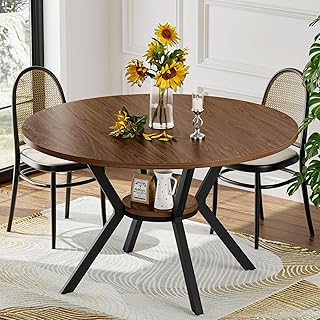
The thickened waterproof brown top gives you a deep, even matte field that looks especially good under warm 2700K light and candles, with grain that reads clearly at low levels. At 47 inches for four, it stays inside comfortable range for one centered fixture without needing a second light source.
Frequently Asked Questions
How high should a pendant hang over a round table?
Aim for 30 to 34 inches from the tabletop to the bottom of the shade. Lower concentrates the pool and feels intimate; higher spreads coverage but raises the odds of glare into sightlines across the table.
What bulb color temperature works best?
Stay at 2700K for wood tops and 2700K to 3000K for white stone or glass. High CRI, above 90, matters more than brightness because it keeps food and skin tones looking accurate.
My glossy table reflects the light fixture. Can I fix it?
Yes. Swap to a shade with a diffuser or solid bottom, add a dimmer, and lean on runners or a centerpiece to break up the reflected image. Wall sconces or cove light also let you drop the pendant’s output.
Should the fixture diameter match the table?
Roughly half to two-thirds the table diameter is the reliable ratio. A 59-inch top wants something around 30 to 36 inches wide, or a cluster covering that span.
Final Thoughts
For a table that behaves well under almost any fixture, the Terra 59″ walnut pedestal is the safest pick, with its low-sheen top and floor-freeing base. If you want the surface to help brighten the room, the POVISON 59″ sintered stone table earns its place as long as you pair it with a diffused shade, while the 42″ farmhouse table with storage remains the most glare-forgiving choice for small, warmly lit kitchens.