Key takeaways
- Cut-line visibility: Shadow-line systems cast the blade’s own silhouette onto the workpiece, so the mark stays accurate as the blade wears. Lasers need periodic calibration and wash out under bright ambient light. If your shop already has strong overhead lighting, a shadow system wins.
- Blade quality and tooth count: A 60-tooth or higher blade in hardwood leaves a face smooth enough to skip sanding before finishing. Coarse blades leave micro-ridges that catch grazing light and read as streaks in a gloss or satin topcoat.
- Bevel arrangement: Double bevel saves you from flipping long, awkward stock — a real advantage when cutting mitered returns for lit shelving where both ends must match. Single bevel is lighter, cheaper, and fine for repetitive one-direction work.
- Dust extraction: Fine dust suspended in air scatters your task lighting and kills contrast right where you need it. Look for a shroud that actually seats against the blade and a port that accepts a 2-1/2 inch vacuum hose, not just the token bag.
- Rail design and footprint: Compact rail geometry lets the saw sit tight against a wall, which matters if your bench lighting is fixed and you can’t move the station to chase the beam. Check the rear clearance spec before you commit.
What's inside
Every miter joint eventually gets judged under light, not under a tape measure. A 0.4-degree gap that vanishes on the bench under flat overhead fluorescents will open into a black wedge the moment a wall sconce grazes it from the side, or an LED strip washes down the face of a cabinet. Raking light is merciless: it turns hairline seams into shadow lines and mild tearout into a fuzzy gray halo. Anyone building furniture destined for lit interiors — floating shelves with recessed channels, valance boards, mitered plinths under cove lighting — needs a saw that cuts clean enough to survive that scrutiny.
This guide looks at slide compound miter saws through that lens. We weigh how well each machine holds a bevel, how the cut face reads under low-angle light, whether the onboard illumination actually helps you find your line, and how much airborne dust the saw throws into the beam of your task lighting. Six saws are covered below, spanning 8-inch cordless units up to 12-inch double-bevel workhorses.
As an Amazon Associate we earn from qualifying purchases.




How to Choose a Slide Compound Miter Saw (2026)
- Cut-line visibility: Shadow-line systems cast the blade’s own silhouette onto the workpiece, so the mark stays accurate as the blade wears. Lasers need periodic calibration and wash out under bright ambient light. If your shop already has strong overhead lighting, a shadow system wins.
- Blade quality and tooth count: A 60-tooth or higher blade in hardwood leaves a face smooth enough to skip sanding before finishing. Coarse blades leave micro-ridges that catch grazing light and read as streaks in a gloss or satin topcoat.
- Bevel arrangement: Double bevel saves you from flipping long, awkward stock — a real advantage when cutting mitered returns for lit shelving where both ends must match. Single bevel is lighter, cheaper, and fine for repetitive one-direction work.
- Dust extraction: Fine dust suspended in air scatters your task lighting and kills contrast right where you need it. Look for a shroud that actually seats against the blade and a port that accepts a 2-1/2 inch vacuum hose, not just the token bag.
- Rail design and footprint: Compact rail geometry lets the saw sit tight against a wall, which matters if your bench lighting is fixed and you can’t move the station to chase the beam. Check the rear clearance spec before you commit.
The Best Slide Compound Miter Saw (2026)s Reviewed
Makita LS1110F 10-Inch Slide Compound Miter Saw
Makita’s 10-inch slider pairs a genuinely useful built-in work light with a compact rail system that hugs the wall, and the cut quality out of the box is excellent — faces come off crisp enough to glue up without a shooting board. It’s the saw I’d point at anyone building fitted casework that will live under directional lighting.
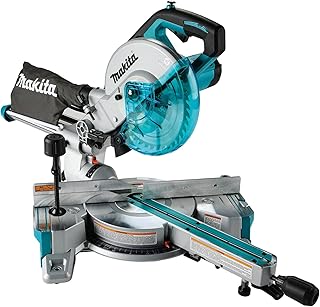
Makita LS0816F 8-1/2-Inch Slide Compound Miter Saw
The smaller LS0816F trades capacity for control, and the reduced blade mass means less deflection on delicate stock like thin trim or LED channel covers. Its integrated light throws a clean, even pool across the fence with no hot spot to blow out your pencil line.
VEVOR 12-Inch Double Bevel Sliding Miter Saw
A 15-amp motor, 60-tooth blade, and LED alignment make this the value pick for anyone cutting composite decking, laminates, or wide hardwood panels. Expect to square the fence and check the bevel stops on arrival, but the mechanicals are sound for the money.
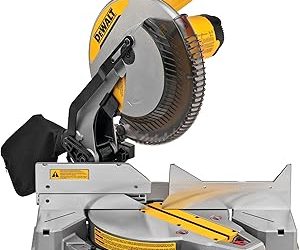
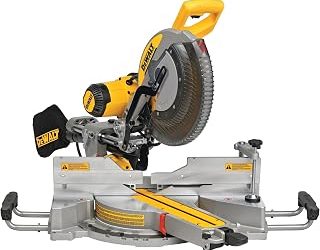
DEWALT DWS780 12-Inch Double Bevel Sliding Compound Miter Saw
The XPS shadow light is still the best cut-line system on the market — no calibration, no wash-out, and it updates automatically as the blade thins. Combine that with the DWS780’s dependable double-bevel action and you have the most trustworthy production saw here.
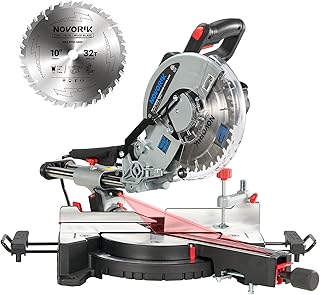
NOVORIK 10-Inch Single Bevel Sliding Miter Saw
A 15-amp motor at 4,000 rpm and a TCT blade deliver more capability than the price suggests, with a laser guide that works well in dimmer shop corners. Single bevel keeps it light and simple for straightforward furniture work.
Frequently Asked Questions
Is a shadow light really better than a laser?
For most people, yes. A shadow line shows the blade’s true kerf edge rather than a projected approximation, and it stays accurate without adjustment. Lasers do have one edge: they remain visible on dark or figured stock where a shadow can get lost.
Do I need a 12-inch saw?
Only if you regularly cut wide boards or thick posts. Ten-inch and 8-1/2-inch saws spin faster, deflect less, and generally leave a finer surface — better for furniture parts that will be seen up close under light.
Is a cordless slider accurate enough for fine work?
Modern brushless units like the SEESII 8-inch are, within their capacity. The 21V platform and 4,200 rpm brushless motor handle trim and small casework cleanly, and the portability is genuinely useful for on-site installs.
How do I stop dust from ruining shop visibility?
Connect a shop vacuum with a HEPA filter directly to the saw port and add a downstream air cleaner. The supplied bags catch chips but let the fine fraction through, and that’s the fraction that hazes your light.
Final Thoughts
For the cleanest joints under critical lighting, the DEWALT DWS780 and the Makita LS1110F are the two to shortlist — the DEWALT for its unbeatable shadow-line accuracy, the Makita for sheer cut refinement in a wall-friendly footprint. If budget drives the decision, the VEVOR 12-inch double bevel gets you capable double-bevel capacity for considerably less.