Key takeaways
- Cut-line visibility: Shadow-casting LED systems project the blade’s actual silhouette onto the workpiece, so there is nothing to calibrate and nothing to drift. Laser lines are quicker to read in dim corners but need alignment checks and can wash out under bright daylight.
- Slide capacity and rail travel: Match crosscut width to what you actually build. Wide apron stock, bed rails, and 1×12 shelving want a 12-inch sliding head; 10-inch saws handle most face frames and chair parts with less bench footprint.
- Single versus double bevel: Double bevel saves flipping long boards, which matters for crown, mitered plinths, and any repeated left-right pattern where flipping introduces cumulative error.
- Dust control at the cut zone: Airborne dust dims your work light and hazes the cut line within a few passes. Look at port geometry and how well the guard channels chips before you judge the included bag.
- Fence height, clamps, and detents: Tall fences support upright stock for base cuts; positive stops speed repetitive angles. A material clamp keeps thin furniture stock from creeping, which is where most invisible errors originate.
What's inside
Cut quality is a lighting problem before it is a blade problem. Most miter saw frustration traces back to a shop where the overhead fixture sits behind you, your own shoulder throws a shadow across the kerf, and the pencil line disappears exactly when the blade approaches it. Buyers then blame the saw for drifting a sixteenth on a mitered face frame, when in truth they never actually saw the line at the moment of contact. Add sawdust haze, a dim garage bay, and a warm-white bulb that flattens grain contrast, and you get furniture joints that read as sloppy under a client’s floor lamp.
This guide looks at compound sliding miter saws through that lens: how each one lets you read the cut line, how the shadow or laser system behaves in real ambient conditions, and how the saw fits the kind of visible, close-inspection joinery that furniture work demands. Below you will find current picks, a buying checklist, short reviews, and answers to the questions we hear most from people building tables, casework, and trim-grade pieces at home.
As an Amazon Associate we earn from qualifying purchases.


How to Choose a Compound Sliding Miter Saw (2026)
- Cut-line visibility: Shadow-casting LED systems project the blade’s actual silhouette onto the workpiece, so there is nothing to calibrate and nothing to drift. Laser lines are quicker to read in dim corners but need alignment checks and can wash out under bright daylight.
- Slide capacity and rail travel: Match crosscut width to what you actually build. Wide apron stock, bed rails, and 1×12 shelving want a 12-inch sliding head; 10-inch saws handle most face frames and chair parts with less bench footprint.
- Single versus double bevel: Double bevel saves flipping long boards, which matters for crown, mitered plinths, and any repeated left-right pattern where flipping introduces cumulative error.
- Dust control at the cut zone: Airborne dust dims your work light and hazes the cut line within a few passes. Look at port geometry and how well the guard channels chips before you judge the included bag.
- Fence height, clamps, and detents: Tall fences support upright stock for base cuts; positive stops speed repetitive angles. A material clamp keeps thin furniture stock from creeping, which is where most invisible errors originate.
The Best Compound Sliding Miter Saw (2026)s Reviewed
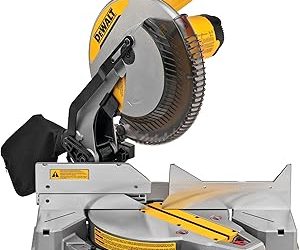
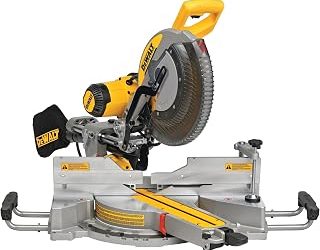
DEWALT DWS780 12-Inch Double Bevel Sliding with XPS
The XPS shadow system is the single best cut-line solution on this list — a bright LED casts the blade’s true shadow directly on your line, so you work by silhouette instead of squinting at a projected dot. For furniture makers doing visible miters in a poorly lit garage, this is the saw that removes lighting from the equation entirely.
DEWALT DWS779 12-Inch Double Bevel Sliding
Mechanically it is the DWS780’s twin, with the same 3800 RPM 15-amp motor and generous crosscut capacity, minus the XPS light. Choose it if you already run good task lighting over your saw station, and put the savings toward a quality blade and a bright, cool-temperature work lamp.
DOVAMAN Updated 10-Inch Sliding Miter Saw
A well-equipped value pick with dual speeds for cutting beyond wood, three TCT blades, and a laser guide plus nine positive stops. Ambidextrous controls are a genuine benefit in tight shops where the saw sits against a wall and your body would otherwise block the light.
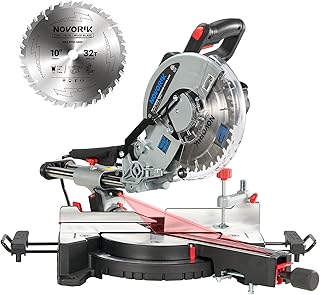
NOVORIK 10-Inch Single Bevel Compound Sliding
A straightforward 15-amp, 4,000 RPM slider with a laser guide, sensible for hobbyists building shelving, small tables, and picture frames. Verify laser alignment out of the box and re-check it after transport, since laser systems only help when they track the blade honestly.
DEWALT DWS715 12-Inch Single Bevel Compound
Not a slider, but a highly accurate chopping saw worth naming for anyone whose work stays under roughly 8 inches wide. The stiff, non-sliding head is inherently rigid, which shows up as cleaner mitered end grain on furniture parts.
Frequently Asked Questions
Is a shadow light really better than a laser?
For accuracy, yes. A shadow shows the blade’s actual width and position, so you see kerf-left or kerf-right immediately. Lasers indicate a plane and require alignment; they are still useful in dark spaces where a projected line reads more clearly than a soft-edged shadow.
What lighting should I add over my miter station?
Aim two shop lights from front-left and front-right at roughly 45 degrees so neither your hands nor your torso casts shadow into the cut. A neutral to cool color temperature around 4000–5000K improves pencil-line contrast on light hardwoods.
Do I need 12-inch or is 10-inch enough for furniture?
Ten inches handles the majority of chair, frame, and cabinet parts. Step up to 12 inches if you regularly crosscut wide aprons, stair treads, or shelving boards over about 10 inches.
Does single bevel limit furniture work?
Rarely, but it costs time. Single-bevel saws require flipping the stock for opposing angles, and every flip is a chance to lose reference on a piece that will be seen from every side.
Final Thoughts
If you want a saw that solves lighting and capacity at once, the DEWALT DWS780 with XPS is the clear choice for furniture-grade joinery. The DWS779 delivers identical cutting performance for less if your shop lighting is already dialed in, and the DOVAMAN 10-inch slider is the sensible entry point for smaller pieces and tighter benches.