Key takeaways
- Body length and sightlines: Short, stubby guns keep the nozzle close to your hand, which means your forearm no longer blocks the raking light across a panel or siding board. If you often work at low sun angles or under a single garage fixture, a short body is the single biggest upgrade available.
- Swivel inlet: A 360° swivel at the inlet decouples hose torque from wrist position. Practically, this lets you rotate the gun to follow a highlight along a curved surface without the hose fighting back — the difference between tracing a reflection and wrestling one.
- Fitting standard: Confirm whether your setup runs 3/8″ quick connect or M22-14mm versus M22-15mm. Guns bundling an adapter cover more ground, but mismatched M22 sizes are the most common source of leaks, and a weeping connection sprays mist that will fog every surface you just finished reading.
- Nozzle range: Five-tip sets (typically 0°, 15°, 25°, 40°, and soap) give you graduated control over spray density. Tight angles cut shadowed grime in recesses; wide angles rinse without leaving the fine spatter pattern that shows up as texture under low light.
- Pressure rating headroom: Choose a gun rated above your machine’s output. A 4000 PSI gun on a 3000 PSI washer runs cool and holds its trigger feel; running a gun at its ceiling produces the pulsing that leaves visible banding on glass and paint.
What's inside
Anyone who has spent an evening washing a car under a shop light knows the frustration: you finally get the surface clean, the sun drops, and every streak you missed appears in the sidelight. Clean is not a chemical outcome, it is an optical one. Pressure washer guns fail buyers in the same way bad fixtures do — the wrong grip angle forces you to work with your back to the light, the wrong nozzle throws a fan so wide it atomizes into haze, and a stiff hose connection means you cannot pivot to see what the beam is actually revealing. The result is a surface that reads clean at noon and blotchy at dusk.
This guide approaches pressure washer guns the way a lighting designer approaches a room: as tools that determine how a surface will eventually be seen. We look at short-body ergonomics that let you keep the working face oriented toward your light source, swivel inlets that free your wrist so you can chase a reflection rather than fight a hose, nozzle sets that give you control over spray density, and foam delivery that clings long enough to lift film instead of sheeting off. Six current options are compared below, with a buying framework and answers to the questions that actually change purchase decisions.
As an Amazon Associate we earn from qualifying purchases.




How to Choose a/an Pressure Washer Guns (2026)
- Body length and sightlines: Short, stubby guns keep the nozzle close to your hand, which means your forearm no longer blocks the raking light across a panel or siding board. If you often work at low sun angles or under a single garage fixture, a short body is the single biggest upgrade available.
- Swivel inlet: A 360° swivel at the inlet decouples hose torque from wrist position. Practically, this lets you rotate the gun to follow a highlight along a curved surface without the hose fighting back — the difference between tracing a reflection and wrestling one.
- Fitting standard: Confirm whether your setup runs 3/8″ quick connect or M22-14mm versus M22-15mm. Guns bundling an adapter cover more ground, but mismatched M22 sizes are the most common source of leaks, and a weeping connection sprays mist that will fog every surface you just finished reading.
- Nozzle range: Five-tip sets (typically 0°, 15°, 25°, 40°, and soap) give you graduated control over spray density. Tight angles cut shadowed grime in recesses; wide angles rinse without leaving the fine spatter pattern that shows up as texture under low light.
- Pressure rating headroom: Choose a gun rated above your machine’s output. A 4000 PSI gun on a 3000 PSI washer runs cool and holds its trigger feel; running a gun at its ceiling produces the pulsing that leaves visible banding on glass and paint.
The Best Pressure Washer Guns (2026)s Reviewed
Tool Daily Short Gun with Foam Cannon
The bundled one-liter foam cannon is the reason to buy this one — thick, slow-draining foam gives you dwell time to see where film is actually lifting rather than guessing. The 1/4″ quick connect and M22 fitting cover most consumer machines, though it will not run off a garden hose.
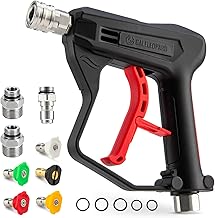
TOOLCY Pro Short Gun, 5000 PSI
The 5000 PSI rating and 360° swivel 3/8″ inlet make this the most capable pick for long sessions on driveways and pool decks, where hose drag normally forces you into awkward angles. The included 3/8″ QC to M22-14mm adapter and five tips mean it drops into most setups without a hardware run.
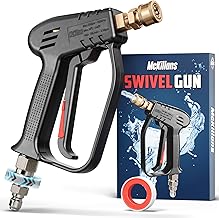
McKillans Short Gun with Swivel
A clean, no-frills swivel gun with a 3/8″ male plug and 1/4″ coupler, built for people who already own their nozzles and foam cannon. The swivel is smooth enough that you can work overhead siding without the hose twisting the gun out of alignment.
MEKOH Short Gun, 4000 PSI
The stubby trigger handle is genuinely compact, which pays off in wheel wells and under bumpers where your hand and the light source compete for the same space. The M22-14mm adapter makes it easy to add an extension wand when you need reach.
Hourleey Pressure Washer Gun, 40 Inch
At 40 inches with the replacement wand extension, this is the outlier here — a full-length option for second-story siding and gutter work where standing back is the point. The 5000 PSI rating and five M22-fitted tips make it a straightforward direct replacement for a failed OEM gun.
Frequently Asked Questions
Will a short pressure washer gun reduce my cleaning power?
No. Pressure and flow are set by your machine, not the gun body length. A shorter body changes reach and sightlines, not output, though you will stand closer to the surface — which is usually an advantage for spotting what you have missed.
What is the difference between M22-14mm and M22-15mm?
Both use the same 22mm thread, but the inner tube diameter differs. A 14mm gun on a 15mm hose will leak. Check your existing fitting before ordering, or choose a gun that ships with the adapter.
Can I use these guns with a garden hose?
Generally no. These are pressure washer components rated for machine output, and several are explicitly not garden hose compatible. Garden hose pressure is far too low to trigger the spray pattern correctly.
Do I need a separate foam cannon?
Only if you want thick clinging foam. The included soap nozzle in most five-tip sets applies a thin solution that sheets off quickly, which is fine for rinse-aid work but not for the dwell time that actually lifts embedded film.
Final Thoughts
For most buyers, the TOOLCY Pro Short Gun offers the best combination of pressure headroom, swivel freedom, and adapter coverage, making it the safest single choice. If foam quality matters more than raw rating, the Tool Daily kit with its one-liter cannon is the better value, and the Hourleey 40-inch gun remains the pick for anyone who needs genuine vertical reach rather than close-quarters control.