Key takeaways
- Damp vs. wet rating: Damp-rated fans belong under a solid, overhanging roof where rain never reaches them directly — covered porches, garages, three-season rooms. If wind-driven rain or spray can touch the housing, you need wet-rated or an IP-rated sealed unit. Installing damp where wet is required voids most warranties and corrodes the motor within a season or two.
- Color temperature and dimming range: Outdoors, 2700K–3000K is the only warmth that flatters skin, wood, and stone after dark. Insist on genuine dimming rather than three-step “brightness levels,” and look for memory so the fixture returns to your last setting instead of resetting to full output every time.
- Blade span against room volume: 44–52 inches suits most covered porches and patios up to roughly 225 square feet. Go 60 inches or wider for open-sided patios, breezeways, and garages, where air escapes sideways and a small fan just stirs the middle of the space.
- Motor type and real CFM: DC and BLDC motors draw a fraction of the power of AC units, run near-silent, and offer six or more speeds — which matters when your lowest setting needs to be a whisper you can talk over. Compare published CFM, not blade count; eight blades don’t guarantee more air than three.
- Light placement and diffusion: A frosted, wide-diffusion lens washes the ceiling and softens blade shadow. A bare or clear lens creates glare and hard flicker. Finish matters too: matte bronze and walnut absorb light and read warm, while polished aluminum and gold bounce it and brighten a dim porch ceiling.
What's inside
Airflow gets all the attention when people shop for an outdoor fan, but ambience is what you actually live with. A porch fan runs three months of the year at full tilt and twelve months as the primary light source over your dinner table, and most buyers discover the mismatch on night one: a 5000K LED disc blasting straight down, blade shadows chopping across the table like a slow strobe, and no way to dim it. The airflow was fine. The evening was ruined.
This guide approaches outdoor ceiling fans the way a lighting designer would — starting with how the fixture treats light, then working back to blade span, motor type, and moisture rating. Below you’ll find the models worth considering in 2026, from a 72-inch aluminum workhorse for deep patios to a plug-in caged fan for gazebos with no wiring at all, plus the specs that separate a fan you tolerate from one that sets the mood.
As an Amazon Associate we earn from qualifying purchases.



How to Choose an Outdoor Ceiling Fan With Lights (2026)
- Damp vs. wet rating: Damp-rated fans belong under a solid, overhanging roof where rain never reaches them directly — covered porches, garages, three-season rooms. If wind-driven rain or spray can touch the housing, you need wet-rated or an IP-rated sealed unit. Installing damp where wet is required voids most warranties and corrodes the motor within a season or two.
- Color temperature and dimming range: Outdoors, 2700K–3000K is the only warmth that flatters skin, wood, and stone after dark. Insist on genuine dimming rather than three-step “brightness levels,” and look for memory so the fixture returns to your last setting instead of resetting to full output every time.
- Blade span against room volume: 44–52 inches suits most covered porches and patios up to roughly 225 square feet. Go 60 inches or wider for open-sided patios, breezeways, and garages, where air escapes sideways and a small fan just stirs the middle of the space.
- Motor type and real CFM: DC and BLDC motors draw a fraction of the power of AC units, run near-silent, and offer six or more speeds — which matters when your lowest setting needs to be a whisper you can talk over. Compare published CFM, not blade count; eight blades don’t guarantee more air than three.
- Light placement and diffusion: A frosted, wide-diffusion lens washes the ceiling and softens blade shadow. A bare or clear lens creates glare and hard flicker. Finish matters too: matte bronze and walnut absorb light and read warm, while polished aluminum and gold bounce it and brighten a dim porch ceiling.
The Best Outdoor Ceiling Fans With Lights (2026) Reviewed
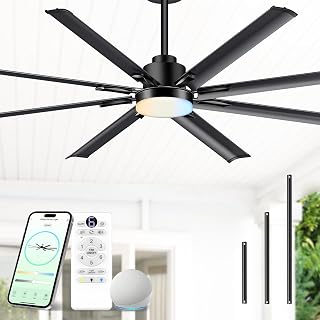
72″ Aluminum Outdoor Ceiling Fan with Light
At 9,744 CFM across eight industrial aluminum blades, this is the fan for wide open patios, deep garages, and covered decks where anything smaller disappears. The dimmable LED with memory and Alexa control is what elevates it — you can hold it at a low amber glow for evening and push to task brightness when the grill’s going.
52 Inch Solid Wood Ceiling Fan with Remote and Wall Control
Real walnut blades give this fan a depth that printed laminate can’t fake, and the grain reads beautifully under warm downlight. The quiet DC motor, six speeds, dimmable light, and both remote and wall control make it the most versatile pick here for a covered porch that doubles as a dining space.
52 Inch Matte Black and Gold Ceiling Fan with Lights
The black-and-gold pairing is the rare outdoor finish that looks deliberate rather than default, and the brass tones catch just enough light to keep a shaded porch from going flat. Three-blade propeller geometry moves air efficiently over patios while the remote handles dimming and speed.
addlon 20″ Plug-In Caged Outdoor Fan with Light
IP65 sealed, hook-hung, and plug-in — this solves gazebos, pergolas, and rentals where running wire isn’t happening. The reversible DC motor, timer, and six speeds punch well above the 20-inch footprint, and the caged form throws a soft patterned glow that works as accent lighting.
Harbor Breeze Merrimack II 52-in Matte Bronze
A five-blade, matte bronze classic that fits traditional and farmhouse porches without any styling effort. The integrated LED kit produces even, glare-free illumination, and the bronze finish hides pollen, dust, and coastal haze better than lighter finishes.
Frequently Asked Questions
What’s the real difference between damp-rated and wet-rated?
Damp-rated fans tolerate humidity and condensation but not direct water contact. Wet-rated and IP65 units use sealed housings and gasketed lenses that survive rain and hose spray. Open-sided patios and pergolas almost always need wet-rated.
How bright should an outdoor fan light be?
Aim for 800–1,200 lumens over a seating area and up to 2,000 for dining or task use — but only if it dims. Dimming down beats under-lighting, because a fixture you can’t dial back becomes the brightest object in your sightline all evening.
Why does the light seem to flicker when the fan runs?
That’s shadow strobe from blades passing between the LED and your eye, not a wiring fault. Frosted, wide-diffusion lenses and light mounted below the blade plane both reduce it, as does adding a second warm light source nearby so the porch isn’t lit from one point.
Can I control an outdoor fan with my phone or a smart speaker?
Some models include it natively — the 72-inch aluminum fan supports Alexa out of the box. Others ship with RF remotes that can be paired to a smart bridge, though a wall control is often the more reliable everyday choice outdoors.
Final Thoughts
For most covered porches, the 52-inch solid wood walnut fan hits the best balance of quiet DC performance, dimmable warm light, and material quality you’ll actually enjoy looking at. Choose the 72-inch aluminum fan if you’re moving air across a large or open space and want smart dimming built in, and the addlon 20-inch caged fan when there’s no wiring to work with and you need light and breeze from a single plug.