Key takeaways
- Throat depth vs. your real parts: A 9-inch benchtop handles shade rings, backplates, and small curved brackets. Step up to 10 inches if you are cutting drum shade formers or wide arcs for cove valances, where the offcut needs room to swing clear.
- Two speeds, not one: The slow range is for metal. Brass stems, aluminum channel, and steel rod need low surface feet per minute or the teeth glaze over. A single-speed wood saw will not serve you the first time a client asks for a machined-looking pendant.
- Table flatness and a real miter gauge: Cast aluminum or cast iron with a scale beats stamped steel. Angled cuts on mitered light boxes and reveal trim only close cleanly if the table stays true under hand pressure.
- Blade width you can actually change: A 1/8-inch or 1/4-inch blade tracks the tight radii in scrollwork and organic shade profiles; a 1/2-inch blade resaws. Check that the guides and tension mechanism accept both without a fight.
- Portable or fixed: Handheld deep-cut saws go to the install and cut conduit, threaded rod, and unistrut in place. Benchtop saws stay home and do the joinery. Working designers usually end up owning one of each.
What's inside
Anyone who builds light for a living learns quickly that the fixture is only half the work. The other half is the edge. A shade rib that wanders off its radius throws a shadow that ripples on the wall. A walnut sconce body cut with a coarse, chattering blade catches the grazing light and shows every tooth mark at seven o’clock in the evening, when the room is finally doing what you designed it to do. Most home shops try to solve this with a jigsaw and sandpaper, and most of them end up with fixtures that photograph well and live poorly.
A band saw is the tool that fixes this. It cuts tight curves in hardwood, resaws thin stock for diffuser frames, and trims brass or aluminum tube for pendant stems without the shriek and burn of an abrasive wheel. This guide covers what actually matters when you are cutting parts that light will land on, from throat depth to blade speed, followed by five machines worth putting in a furniture and lighting shop in 2026.
As an Amazon Associate we earn from qualifying purchases.

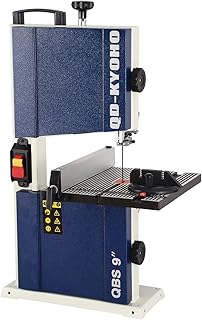


How to Choose a Band Saw Best (2026)
- Throat depth vs. your real parts: A 9-inch benchtop handles shade rings, backplates, and small curved brackets. Step up to 10 inches if you are cutting drum shade formers or wide arcs for cove valances, where the offcut needs room to swing clear.
- Two speeds, not one: The slow range is for metal. Brass stems, aluminum channel, and steel rod need low surface feet per minute or the teeth glaze over. A single-speed wood saw will not serve you the first time a client asks for a machined-looking pendant.
- Table flatness and a real miter gauge: Cast aluminum or cast iron with a scale beats stamped steel. Angled cuts on mitered light boxes and reveal trim only close cleanly if the table stays true under hand pressure.
- Blade width you can actually change: A 1/8-inch or 1/4-inch blade tracks the tight radii in scrollwork and organic shade profiles; a 1/2-inch blade resaws. Check that the guides and tension mechanism accept both without a fight.
- Portable or fixed: Handheld deep-cut saws go to the install and cut conduit, threaded rod, and unistrut in place. Benchtop saws stay home and do the joinery. Working designers usually end up owning one of each.
The Best Band Saw Best (2026)s Reviewed
DEWALT 20V MAX Portable Band Saw (DCS374B)
This is the saw for site work, cutting 5-inch capacity through pipe, strut, and threaded rod cleanly enough that the cut end needs no dressing before it disappears into a canopy. The integrated hang hooks matter more than they sound when you are on a lift with a fixture in one hand, and since it is a bare tool it slots into an existing 20V battery kit without duplicating chargers.
WEN 10-Inch Band Saw with Stand (BA3962)
The extra inch of throat and the included stand make this the most complete shop machine here for the money, with two speeds that cover both hardwood curves and light nonferrous stock. It is the one I would hand someone building their first run of wall sconces and drum shade formers.
SKIL 9-Inch 2-Speed Benchtop Band Saw (BW9501-00)
A compact, well-mannered saw that tracks accurately once tensioned, with a 2.8-amp motor that suits thin hardwood, plywood diffuser frames, and acrylic. Best suited to shops where bench space is the scarcest resource.
DeWalt 9-Inch Two-Speed Band Saw
The 3.5-amp motor and 1700/2500 SPM range give it more grunt than typical benchtop machines, and the integrated LED worklight genuinely helps when you are following a pencil line on dark walnut or wenge. A sensible pick if you cut mixed materials daily.
VEVOR Portable Variable Speed Band Saw
A 10-amp, 1100W handheld with variable speed from roughly 138 to 472 ft/min and a removable base, which lets it work as both a portable cutter and a small stationary saw. The 0 to 45 degree adjustment is useful for angled tube ends on stem-mounted fixtures.
Frequently Asked Questions
What blade should I use for tight shade curves?
A 1/8-inch or 1/4-inch blade with 14 to 18 TPI. Narrower blades follow smaller radii; as a rough guide, a 1/4-inch blade will cleanly track a 5/8-inch radius.
Can these saws cut brass and aluminum for fixture parts?
Yes, on the low speed setting with a fine-tooth bimetal blade. Keep at least three teeth engaged in the wall thickness of any tube, and back thin stock with scrap wood to stop grabbing.
Do I need dust collection?
For wood, yes. Band saws throw fine dust below the table, and in a room where you also test lighting, airborne dust reads immediately as haze in a narrow beam. A shop vac on the lower port is enough.
Benchtop or handheld first?
Benchtop, if your work is mostly wood and shade construction. Handheld first only if you install as much as you build.
Final Thoughts
For a home furniture and lighting shop, the WEN 10-Inch with stand is the best all-round starting point, and the DeWalt 9-Inch two-speed is worth the premium if you cut hardwood and metal in the same afternoon. Add the DEWALT DCS374B when installs start outnumbering builds.