Key takeaways
- Overhead clearance first: Measure from floor to the lowest point of your ceiling, beams and fan blades included. Freestanding propane towers typically stand 87–92 inches and want three feet of air above the reflector, which rules them out under an eight-foot soffit. Wall or tripod-mounted infrared solves this outright.
- Fuel dictates the mood: Propane gives you a live amber flame around 1,800–2,000K — the same visual warmth as a candle, and it reads as ambience even before you feel the heat. Electric infrared gives a quieter dull-red glow with no flicker, which suits minimal, architectural patios better.
- Glare and mounting height: An exposed infrared element at eye level is a hot spot in every photograph and every conversation. Mount it at seven to nine feet, angled down roughly 45 degrees, so the emitter sits above sightlines and the warmth lands on people rather than in their eyes.
- Match coverage to your seating zone, not your square footage: A 41,000–50,000 BTU tower warms roughly a nine-foot radius; a 1,500W infrared panel covers a two-seat nook. Heating the space between furniture is wasted output.
- Look for enclosure-honest safety features: Anti-tilt shutoff, a weighted or water-fillable base, CSA certification, and lockable casters all matter more under a roof where ventilation is partial. Never run a propane unit in a space enclosed on more than two sides.
What's inside
A covered patio is a lighting designer’s favorite problem child. You have a ceiling to bounce light off, walls to graze, and a wide-open fourth side that leaks every bit of warmth you produce. Come October, most people discover their beautifully lit outdoor room has become a beautifully lit cold room — string lights glowing away over chairs nobody wants to sit in. The instinct is to buy the biggest BTU number available, but heat under a roof behaves nothing like heat in an open yard. Clearance shrinks, reflected heat builds, and a tall flame tower that looks spectacular on a lawn suddenly has nowhere to breathe.
This guide treats a patio heater as what it actually is: a fixture. It occupies sightlines, throws shadows, adds color temperature to the scene, and either flatters your space or bulldozes it. Below are the heaters worth your money for a roofed patio in 2026, with notes on how each one behaves visually as well as thermally — glare, glow quality, footprint, and how it sits alongside the lighting you already own.
As an Amazon Associate we earn from qualifying purchases.


How to Choose a/an Outdoor Heater For Covered Patio (2026)
- Overhead clearance first: Measure from floor to the lowest point of your ceiling, beams and fan blades included. Freestanding propane towers typically stand 87–92 inches and want three feet of air above the reflector, which rules them out under an eight-foot soffit. Wall or tripod-mounted infrared solves this outright.
- Fuel dictates the mood: Propane gives you a live amber flame around 1,800–2,000K — the same visual warmth as a candle, and it reads as ambience even before you feel the heat. Electric infrared gives a quieter dull-red glow with no flicker, which suits minimal, architectural patios better.
- Glare and mounting height: An exposed infrared element at eye level is a hot spot in every photograph and every conversation. Mount it at seven to nine feet, angled down roughly 45 degrees, so the emitter sits above sightlines and the warmth lands on people rather than in their eyes.
- Match coverage to your seating zone, not your square footage: A 41,000–50,000 BTU tower warms roughly a nine-foot radius; a 1,500W infrared panel covers a two-seat nook. Heating the space between furniture is wasted output.
- Look for enclosure-honest safety features: Anti-tilt shutoff, a weighted or water-fillable base, CSA certification, and lockable casters all matter more under a roof where ventilation is partial. Never run a propane unit in a space enclosed on more than two sides.
The Best Outdoor Heater For Covered Patio (2026)s Reviewed
Paraheeter Outdoor Electric Infrared Heater, 1500W
The most patio-cover-friendly pick here: wall or tripod mounted, waterproof, remote controlled, and completely unbothered by low ceilings since the heat throws forward instead of upward. Its steady carbon-red glow is subtle enough to layer under warm-white string lights without fighting them for attention.
EAST OAK 50,000 BTU Patio Heater with Table
The strongest output on this list, and the integrated round table earns its keep — it gives the column visual purpose so it reads as furniture rather than equipment. Reserve it for tall, open-sided covered patios with ten feet or more of headroom.
Amazon Basics 46,000 BTU Portable Propane Heater
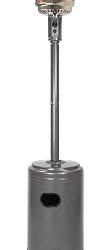
A well-executed commercial-style tower with a water-fillable base for stability and a genuine nine-foot warm radius. The slate gray finish disappears against most masonry and dark trim, which is exactly what you want from a 91-inch object in a small space.
Pamapic 41,000 BTU Propane Heater with Cover
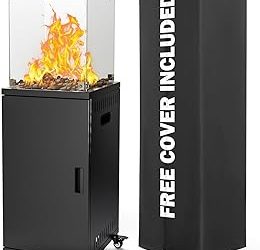
CSA certified, lockable casters, and the included cover means it can overwinter in a corner without looking neglected. The ink finish is the most designed-looking of the towers here and photographs beautifully once the flame is lit at dusk.
Cuisinart COH-500 Tabletop Patio Heater, 11,000 BTU
For bistro tables, balconies, and any patio where a full tower would be absurd, this delivers a real flame with an anti-tilt switch and a burner screen guard in a footprint the size of a table lamp. Its 30-square-foot range is intimate by design — treat it as a task light for warmth.
Frequently Asked Questions
Can I use a propane patio heater under a roof?
Under an open-sided roof with adequate clearance, yes. Enclosed or screened-in porches are a no — combustion products need somewhere to go, and manufacturers specify a minimum of two fully open sides.
How much ceiling height do I actually need?
Plan on the unit’s height plus about 36 inches for propane towers, so roughly 11 feet. Below nine feet, choose infrared and mount it on a wall or the tripod instead.
Will an electric infrared heater trip my circuit?
A 1,500W unit draws about 12.5 amps and should have a dedicated 15-amp GFCI circuit. Sharing one with outdoor lighting and a speaker system is how people discover their breaker panel’s limits mid-party.
Does patio heater glow interfere with my lighting scheme?
It contributes to it. Keep your fixed lighting at 2,200–2,700K and the heater’s flame or element will blend as another warm layer; cool-white LEDs will make that same glow look orange and out of place.
Final Thoughts
For most covered patios, the Paraheeter 1500W infrared is the smartest buy — it clears low ceilings, disappears overhead, and heats people rather than air. If you have the headroom and want visible flame as part of the ambience, the Pamapic 41,000 BTU offers the best balance of finish, safety certification, and storage practicality, while the Cuisinart COH-500 remains the right answer for small balconies and bistro-scale seating.