Key takeaways
- Thermostat accuracy over raw wattage: A heater that cycles off within a degree of your target sips power. One with a vague dial overshoots, then blasts again. Look for digital set points in single-degree increments and a true ECO mode that steps down to 750W rather than switching fully off.
- Match the heat type to the room’s rhythm: PTC ceramic units warm moving air fast, ideal for a home office you occupy in bursts. Infrared warms surfaces and bodies directly with almost no noise or air movement, which suits a reading corner or a long evening in one chair.
- Treat noise as part of the ambience: Anything above roughly 40 decibels becomes a presence in the room. Sub-35dB models sit beneath the noise floor of a quiet house, so you notice the warmth and not the appliance.
- Check the light signature after dark: Bright LED panels and cold-white displays are ambience killers in bedrooms. Prioritize dimming, auto-off displays, or a housing that hides the readout from bed height.
- Oscillation, tilt, and placement: Wide oscillation spreads warmth across a sofa or desk span. Adjustable tilt aims heat upward from the floor or down toward your feet, which cuts the runtime needed to feel comfortable.
What's inside
Nearly every plug-in heater on the market draws the same 1500 watts at full tilt, which makes the phrase “energy-saving” slippery. The real savings come from how briefly a heater needs to run at full power, how accurately it holds a set temperature, and whether it can warm the three feet around a person instead of an entire volume of air. In my work staging rooms, I’ve watched clients cool their whole house to save money, then park a heater at their feet and get better comfort for a fraction of the load. That’s zone heating, and it’s the only honest route to a lower bill.
There’s a second cost most reviews ignore: what a heater does to the mood of a room. I design light and atmosphere for a living, and a unit that whines at 50 decibels or throws a hard blue status glow across a dark bedroom undoes the work of every warm lamp and linen shade in the space. The picks below were assessed on both counts — how efficiently they deliver heat, and how quietly they disappear into a well-composed room after sundown.
As an Amazon Associate we earn from qualifying purchases.


How to Choose a/an Energy-Saving Space Heater (2026)
- Thermostat accuracy over raw wattage: A heater that cycles off within a degree of your target sips power. One with a vague dial overshoots, then blasts again. Look for digital set points in single-degree increments and a true ECO mode that steps down to 750W rather than switching fully off.
- Match the heat type to the room’s rhythm: PTC ceramic units warm moving air fast, ideal for a home office you occupy in bursts. Infrared warms surfaces and bodies directly with almost no noise or air movement, which suits a reading corner or a long evening in one chair.
- Treat noise as part of the ambience: Anything above roughly 40 decibels becomes a presence in the room. Sub-35dB models sit beneath the noise floor of a quiet house, so you notice the warmth and not the appliance.
- Check the light signature after dark: Bright LED panels and cold-white displays are ambience killers in bedrooms. Prioritize dimming, auto-off displays, or a housing that hides the readout from bed height.
- Oscillation, tilt, and placement: Wide oscillation spreads warmth across a sofa or desk span. Adjustable tilt aims heat upward from the floor or down toward your feet, which cuts the runtime needed to feel comfortable.
The Best Energy-Saving Space Heater (2026)s Reviewed
DREO Quiet Space Heater, 1500W with Remote
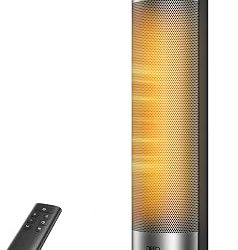
The 70-degree sweep and 11.5 ft/s airflow cover a full desk or two-seater sofa without you nudging the unit around, and the 12-hour timer plus adjustable thermostat keep it from running past the point of usefulness. Eight layers of safety protection and genuinely low operating volume make this the one I recommend for bedrooms where the heater has to share space with a sleeping person.
Airnmore Comfort Deluxe Copper PTC Infrared
Copper PTC infrared warms objects and people rather than churning air, so there’s no draft, no dust lift, and almost nothing to hear — the closest thing to sunlight-through-glass warmth you can plug into a wall. The wood-toned cabinet reads as furniture rather than appliance, and the two-year warranty is unusually generous in this category.
DREO 60° Adjustable Tilt Space Heater
Tilt is the underrated feature here: aiming warmth up from the floor or down across a footwell means you feel comfortable sooner and the thermostat cuts out earlier. Three modes and a compact black profile make it a tidy under-desk companion.
DREO 2026 Upgraded Gold Heater
At 34dB this is the quietest performer of the group, and the brushed gold finish is the rare heater I’d leave visible in a styled living room. Five modes, remote, and a 12-hour timer give you enough control to run it only when someone’s actually in the room.
GiveBest Portable Ceramic Heater
A straightforward 1500W/750W ceramic unit with tip-over and overheat protection, and the low setting is the one you’ll live on — 750W is often plenty for a small office once the space has come up to temperature. The best value pick if you want zone heating without a screen or app.
Frequently Asked Questions
Does a 1500W heater cost a lot to run?
At full power it’s roughly 1.5 kWh per hour, so about 20 cents at average U.S. rates. The savings come from cycling: a well-regulated heater might run 30 percent of the time, and running one at 750W in a single room usually beats heating the whole house by several degrees.
Ceramic or infrared for lower bills?
Infrared is more efficient when you sit still in one place, since it heats you rather than the air. Ceramic wins in rooms you move through or spaces you want warm quickly.
Will the display keep me awake?
Some will. Choose models with dimming or auto-off displays, or position the unit so the readout faces away from the bed — the same logic you’d apply to a bedside clock.
Can these replace central heating?
Not for a whole home, but they let you lower the thermostat several degrees and heat only occupied rooms, which is where the real reduction shows up.
Final Thoughts
For most rooms, the DREO Quiet Space Heater with 70° oscillation is the best balance of coverage, control, and low noise. If your priority is a still, silent, sunlit kind of warmth for one favorite chair, the Airnmore Comfort Deluxe infrared is worth the premium, and the 34dB DREO 2026 Upgraded model in gold is the pick when the heater has to look like it belongs in the room.