Key takeaways
- Put the cabin on its own 15- or 20-amp circuit. A 1990W unit will trip a shared breaker, and voltage sag reduces heater output.
- Dim the surrounding room before you go in. Stepping from bright overheads into a warm cabin makes the interior look dingy by comparison.
- Ask for third-party EMF test results rather than accepting a “low EMF” badge. Reputable brands publish measured figures at seated distance.
- Leave four to six inches behind the unit for airflow and cable routing, and never push it against a heat-sensitive finish.
What's inside
Most sauna guides talk about heat. I want to talk about light, because after fifteen years specifying fixtures for spas, hotel wet rooms, and private wellness suites, I can tell you the thing people actually remember about a sauna session is not the temperature reading. It is how the room felt at 9pm on a February evening — whether the glow was warm and enveloping or whether a raw LED strip was drilling into their retinas from four feet away. Infrared cabins are unusual appliances in that they are simultaneously a heat source, a light source, and a piece of furniture that will sit in your home for a decade.
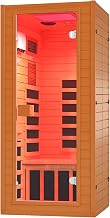
This guide walks through what matters when you choose one: the difference between the infrared you feel and the visible light you see, how to evaluate a chromotherapy panel instead of just counting its colors, why wattage and EMF claims deserve a second look, and how glass, wood tone, and footprint decide whether the cabin reads as a spa or as a shipping crate in your spare room. Below are the models I keep coming back to when clients ask for a starting point.
Our Recommended Picks
As an Amazon Associate we earn from qualifying purchases.




Understand the Two Kinds of Light You’re Buying
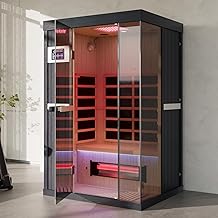
Infrared saunas emit radiation in wavelengths your eye cannot register, and that is the part doing the heating. Far infrared travels in longer wavelengths, warms gently, and dominates most residential cabins. Near infrared sits closer to visible red and penetrates less deeply but heats faster and more locally. Full-spectrum units blend the two, which is why something like the 2-Person Full Spectrum Infrared Sauna at 1990W feels noticeably more intense on the skin than a far-only cabin drawing 1200W. Separately, and independently, there is the visible light: the reading lamp, the chromotherapy panel, the red therapy array. Manufacturers blur these two categories in their marketing constantly. Read the specification twice.
Judge a Chromotherapy Panel by Diffusion, Not Color Count
Seven colors sounds like a feature. In practice, what determines whether that panel feels therapeutic or clinical is diffusion — whether the light passes through a frosted lens or hits you as visible point sources. In a cabin measuring roughly three feet across, an undiffused LED is a glare bomb. When you can see a unit in person or in detailed photos, look for a milky diffuser panel and a light source mounted high, ideally above seated eye level. The 1-2 Person Infrared Sauna with its 7-color therapy light and Bluetooth handles this reasonably for a compact footprint, and the audio matters more than you would expect: sound and light together are what turn twenty minutes of sitting still into something you look forward to.
Red Light Therapy: Look for the Wavelengths
Red light therapy has real research behind it, and the research is wavelength-specific. The numbers that appear in credible studies are 660nm for surface tissue and 850nm in the near-infrared range for deeper penetration. If a listing says “red light therapy” without naming a wavelength, treat it as ambience rather than treatment. Units that publish their figures — the Infrared Sauna Box with 660nm and 850nm lamps, for example — are at least telling you what you are getting. Panel area matters too: the full-spectrum two-person cabin specifies a 12″×12″ array, which gives you a meaningfully larger treatment surface than a scattering of small bulbs.
Cabin, Glass, and How It Reads as Furniture
A wooden box in a corner is a visual dead zone. Glass is what saves it. A tempered glass door bounces light back into the room and stops the unit from reading as a monolith — the OUTEXER Canadian hemlock cabin does this in a footprint of roughly 35 by 28 inches, which is genuinely apartment-viable. At the other end, the 3 Person Hemlock Deluxe cabin with its granite backdrop and full glass front is designed to be looked at, and it holds its own next to real furniture. Hemlock is the standard for good reason: it stays pale, resists resin bleed, and reflects warm light beautifully rather than absorbing it.
Portable Units Are a Legitimate Answer
If you rent, or you are testing whether you will actually use a sauna before committing several hundred pounds of cabinetry to a room, a tent is not a compromise so much as a different product. The Infrared Sauna Tent with 3L steamer offers nine heat levels, a 99-minute timer, and five-layer insulated fabric, and it folds into a closet. You lose the light design almost entirely — the interior is dark and utilitarian — so plan on bringing your own ambience with a warm dimmable lamp nearby and a candle out of contact range.
Tips
- Put the cabin on its own 15- or 20-amp circuit. A 1990W unit will trip a shared breaker, and voltage sag reduces heater output.
- Dim the surrounding room before you go in. Stepping from bright overheads into a warm cabin makes the interior look dingy by comparison.
- Ask for third-party EMF test results rather than accepting a “low EMF” badge. Reputable brands publish measured figures at seated distance.
- Leave four to six inches behind the unit for airflow and cable routing, and never push it against a heat-sensitive finish.
Frequently Asked Questions
How hot does an infrared sauna actually get?
Typically 120–150°F, far cooler than a traditional Finnish sauna at 180°F or more. The heating mechanism is different: infrared warms your body directly rather than warming the air around you, so you sweat at a lower ambient temperature.
Is a one-person cabin big enough?
For a solo user, yes, and compact models are easier to place and cheaper to run. But two-person cabins give you room to stretch out or lie down, which changes the experience considerably. If you have the wall space, size up.
Do I need the steam function?
Steam and infrared are separate technologies. Tent-style units with a 3L steamer produce moist heat, which some people find more comfortable on the airways. Dry infrared cabins are lower maintenance and carry no mildew risk.
How long does assembly take?
Most panel-based cabins clip or buckle together in 45 to 90 minutes with two people. The panels are heavy and awkward rather than complicated. Assemble in the final location.
Conclusion
Choose on three things in this order: the heat spectrum you want, the quality of the visible light inside the cabin, and whether the footprint genuinely fits your room with clearance to spare. Get those right and the sauna becomes part of your evening rather than a thing you feel guilty about not using — and that, more than any specification on the box, is what makes it worth the money.