Key takeaways
- Match CFM with headroom: Size the dryer above your compressor’s actual output, not your gun’s rating. A 20HP unit pushing air through a 35 CFM dryer will overwhelm it and pass wet air downstream during long spray sessions.
- Understand the two approaches: Filter-separators mechanically spin and trap liquid water; refrigerated dryers cool air to condense vapor before it reaches your line. Serious finishing work usually wants both, in that order.
- Drain style affects your routine: Manual drains are cheapest but rely on memory. Semi-auto drains purge when pressure drops. Fully automatic drains suit shops running all day or units mounted somewhere awkward.
- Check port size and thread: A 1/4″ NPT body suits a single airbrush or detail gun; 3/8″ and 1/2″ NPT handle HVLP guns, sandblasters, and plasma cutters without choking flow.
- Look at element quality and gauges: A 5 micron brass or sintered element outlasts plastic mesh, and a built-in regulator lets you dial pressure at the wall instead of chasing it at the gun.
What's inside
In finish work, air is a material. Every satin lacquer on a walnut credenza, every hand-rubbed patina on a brass pendant, every powder-coated ceiling canopy passes through a hose before it touches the piece. When that hose carries moisture, the result shows up as fisheyes in a clear coat, blush in a dark stain, or flash rust blooming under a primer coat on a steel lamp base. Compressors make water as a byproduct of doing their job: hot compressed air holds vapor, the tank and line cool it, and the condensate arrives at the gun tip at the worst possible second. Anyone who has ruined a two-day gradient on a plaster sconce with a single spit of water understands the stakes.
This guide covers the equipment that separates that water from your air, from small point-of-use bowls that mount at the tool to refrigerated units that chill the whole supply below its dew point. I have chosen picks with real studio conditions in mind: humid summers, intermittent duty cycles, spray booths shared with plasma work, and shops where the compressor sits three feet from the finishing table. Below you will find what to prioritize, honest notes on each unit, and answers to the questions that come up once air quality starts affecting your surfaces.
As an Amazon Associate we earn from qualifying purchases.


How to Choose a Air Dryer For Compressor (2026)
- Match CFM with headroom: Size the dryer above your compressor’s actual output, not your gun’s rating. A 20HP unit pushing air through a 35 CFM dryer will overwhelm it and pass wet air downstream during long spray sessions.
- Understand the two approaches: Filter-separators mechanically spin and trap liquid water; refrigerated dryers cool air to condense vapor before it reaches your line. Serious finishing work usually wants both, in that order.
- Drain style affects your routine: Manual drains are cheapest but rely on memory. Semi-auto drains purge when pressure drops. Fully automatic drains suit shops running all day or units mounted somewhere awkward.
- Check port size and thread: A 1/4″ NPT body suits a single airbrush or detail gun; 3/8″ and 1/2″ NPT handle HVLP guns, sandblasters, and plasma cutters without choking flow.
- Look at element quality and gauges: A 5 micron brass or sintered element outlasts plastic mesh, and a built-in regulator lets you dial pressure at the wall instead of chasing it at the gun.
The Best Air Dryer For Compressor (2026)s Reviewed
VEVOR 85CFM Refrigerated Air Dryer
This is the choice for a production shop where finishing runs all day and the compressor never fully cools. Rated for 15HP and 20HP systems on standard 110-120V power, it delivers genuinely dry air to the whole building, and the color screen makes dew point and drain cycling easy to verify before you load a gun.
Schulz 35 CFM Refrigerated Air Dryer
A well-proportioned unit for a 7.5HP or 10HP compressor, which describes most serious one-person fixture and furniture studios. The included pre-filter is the detail that matters: it removes bulk water and oil carryover before the chiller, which keeps performance consistent through a humid August.
1/2″ NPT 3 Stage Air Filter Dryer with Regulator
Three stages plus a regulator and auto drain in one wall-mounted assembly, which is exactly what a mixed shop needs when the same line feeds a plasma cutter one hour and a spray gun the next. The 0-240 PSI range and generous port size mean it will not bottleneck high-consumption tools.
AIRZOE AC3110-03 Filter and Regulator Combo
Two filter bodies and a regulator on a single 3/8″ NPT manifold, giving you staged water removal and precise pressure control at the point of use. The 0-145 PSI gauge sits at eye level when wall-mounted, which is a small ergonomic win during long detail sessions on lampshades and trim.
AIRZOE AF3000-03 Water Separator
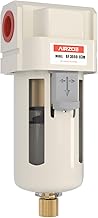
A straightforward 3/8″ NPT separator with a 5 micron brass element and semi-auto drain, best used as the last line of defense at the tool rather than as your only protection. Pair it with a refrigerated dryer upstream, or run it solo for occasional work like blowing dust from upholstery seams and finished surfaces.
Frequently Asked Questions
Is a water separator enough for spraying furniture finishes?
For occasional work in a dry climate, a good separator like the BLCH 1/4″ NPT unit or the AIRZOE AF3000-03 will catch liquid water. For consistent results on dark stains and high-gloss clears, you need a refrigerated dryer to remove vapor that a mechanical filter simply cannot see.
Where in the line should the dryer go?
Install refrigerated dryers downstream of the tank so air has already cooled, then run your line as long as practical before the point-of-use filter. Air that has traveled and cooled drops more water into the bowl instead of into your finish.
Do I need automatic drainage?
If your unit is mounted above head height or behind equipment, yes. Neglected manual bowls fill and pass water through, which defeats the whole installation.
How often does the element need replacing?
Plan on inspecting every few months and replacing annually under regular use, sooner if you notice pressure drop across the housing or oil residue in the bowl.
Final Thoughts
For a working studio finishing fixtures and casegoods, the Schulz 35 CFM refrigerated dryer paired with a point-of-use AIRZOE AF3000-03 is the setup I would build around, giving you truly dry air at the compressor and a final guard at the gun. Higher-volume shops running 15HP or larger should step up to the VEVOR 85CFM, while anyone splitting time between plasma cutting and spray work will get excellent value from the 1/2″ NPT three-stage system with its integrated regulator and auto drain.