Key takeaways
- Support zoning over global firmness: A uniformly hard slab pushes back hardest where you’re widest — shoulders and hips — and leaves a gap under the lumbar arch. Zoned models like the 7-zone hotel-collection hybrids stiffen coils in the midsection specifically so the small of your back has something to rest against.
- Coil gauge and pocketing: Individually pocketed springs move independently, which matters twice over: they contour to your waist instead of averaging your whole body, and they stop a partner’s 2am rollover from traveling across the bed as a jolt.
- Height relative to body weight: Under roughly 200 lbs, a 12-inch profile has enough coil travel. Above that, the 14-inch builds give you more spring height before you bottom out into the base foam, which is where sagging and back pain usually originate.
- Certification and material honesty: Look for CertiPUR-US foams and an explicit fiberglass-free construction. Fiberglass fire barriers are cheap and they fail badly — if the cover ever tears, the cleanup is genuinely miserable.
- A trial window that spans a full adaptation: Switching to firm often means one to three weeks of feeling worse before your spine resettles. A 365-night trial covers that entire adjustment; a 30-day window does not.
What's inside
I spend my working hours thinking about how a room feels at 10pm versus 7am — the warm 2700K wash beside the bed, the dimmer curve that tells a body to stand down. What I learned the hard way is that all that atmospheric work collapses if the surface underneath you fights your spine all night. You can build the most restful room on the block and still wake at 4am with a hot band of ache across your lower back. The mattress is the one fixture in the sleep environment that never stops applying force to you, and when it sags at the hips, no amount of ambience compensates.
This guide looks at firm and extra-firm hybrids through that same lens: what actually holds a lumbar curve in place for eight hours, and what merely feels supportive in the first five minutes. I’ve focused on 12- to 14-inch pocketed-coil builds with zoned reinforcement, sorted by who they suit — heavier frames, side sleepers, couples who wake each other, and people who want firm without the plywood sensation.
As an Amazon Associate we earn from qualifying purchases.


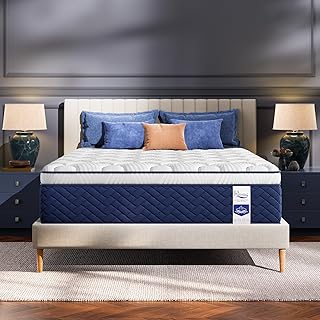
How to Choose a Firm Mattress For Lower Back Pain (2026)
- Support zoning over global firmness: A uniformly hard slab pushes back hardest where you’re widest — shoulders and hips — and leaves a gap under the lumbar arch. Zoned models like the 7-zone hotel-collection hybrids stiffen coils in the midsection specifically so the small of your back has something to rest against.
- Coil gauge and pocketing: Individually pocketed springs move independently, which matters twice over: they contour to your waist instead of averaging your whole body, and they stop a partner’s 2am rollover from traveling across the bed as a jolt.
- Height relative to body weight: Under roughly 200 lbs, a 12-inch profile has enough coil travel. Above that, the 14-inch builds give you more spring height before you bottom out into the base foam, which is where sagging and back pain usually originate.
- Certification and material honesty: Look for CertiPUR-US foams and an explicit fiberglass-free construction. Fiberglass fire barriers are cheap and they fail badly — if the cover ever tears, the cleanup is genuinely miserable.
- A trial window that spans a full adaptation: Switching to firm often means one to three weeks of feeling worse before your spine resettles. A 365-night trial covers that entire adjustment; a 30-day window does not.
The Best Firm Mattress For Lower Back Pain (2026)s Reviewed
Firm 12-Inch Hybrid Queen with Lumbar & Hip Support
This is the sensible default for average-frame sleepers who want firm support without a 14-inch step up in bed height. The lumbar and hip reinforcement is doing the real work here — you feel it as a distinct lack of hammocking through the middle rather than as anything stiff underfoot.
King 14-Inch Extra Firm with Cooling Comfort
The pick for heavier sleepers and couples sharing a king, where deflection over time is the main enemy. The extra profile buys real coil travel for spinal alignment, and the cooling layer keeps the firm top surface from turning into a heat trap, since less sinkage means less airflow around your torso.
Sleepmax Extra Firm 12-Inch Full
Unusually well-judged for a firm mattress that still accommodates side sleeping — the top comfort layer takes just enough shoulder pressure that you’re not waking with a dead arm. The forever warranty alongside the 365-night trial signals genuine confidence in the coil unit.
BedStory Extra Firm 14-Inch Queen
If your partner is the reason you’re awake, this is the one to read twice. The individually pocketed springs deliver the lowest motion transfer in this group while still landing squarely in extra-firm territory for lumbar relief.
BedStory Firm 13-Inch Queen with Zoned Lumbar Support
My favorite balance of the lot: firm enough to hold alignment, plushly finished enough to feel hospitable rather than punitive. The zoned lumbar band is precise, and the 13-inch height sits comfortably with standard sheets and bed frames.
Frequently Asked Questions
Is firmer always better for lower back pain?
No. Research consistently favors medium-firm to firm over extra-firm for most people. Extra-firm helps heavier sleepers and dedicated back sleepers; side sleepers under 150 lbs often do better one notch softer.
How long before my back adjusts?
Give it two to four weeks. Muscles accustomed to compensating for a sagging bed need time to release, and that transition can feel like a step backward before it improves.
Do I need a new foundation?
Probably, if yours has slats wider than about three inches apart. Hybrid coils need continuous support, and a flexing foundation undermines an otherwise excellent mattress.
Hybrid or all-foam for back pain?
Hybrid, in most cases. Pocketed coils resist compression better over years of use, and steady support is what protects a lumbar curve across a decade.
Final Thoughts
For most people reading this, the BedStory Firm 13-Inch Queen with zoned lumbar support strikes the best balance between real spinal support and a bed you actually want to get into. Heavier sleepers and couples should size up to the King 14-Inch Extra Firm, while the Sleepmax Extra Firm 12-Inch is the smartest pick if you sleep on your side but still need firm support underneath you.