Key takeaways
- Mount height and sightline: Set the unit above your typical shoulder pass-through, roughly 48–60 inches, so the housing sits in the bright band of a ceiling fixture rather than the shadowed zone near the floor. Anything mounted low reads as an obstruction and collects grime you won’t see until you’re crouched next to it.
- Retraction behavior: Automatic rewind is the difference between a fixture and a project. A hose that returns itself keeps the wall plane clean; one you coil by hand ends up looped over a hook, throwing an irregular silhouette across your work surface.
- Hose length versus footprint: Measure the farthest point you clean — back fence corner, second car, upper siding — then add fifteen feet for slack. Sixty-five feet handles most attached garages and a single driveway. A hundred feet earns its keep on corner lots and detached structures.
- Pressure and flow together: PSI cuts, GPM carries debris away. Anything in the 2,500–3,200 PSI range with 2.2 GPM or better handles concrete, siding, and vehicles. Chasing pressure alone gives you a machine that etches surfaces without rinsing them.
- Bracket articulation: A 180-degree swivel lets you aim the reel toward the door instead of dragging hose around the housing. It also means you can orient the unit away from your primary light source so the body doesn’t cast a hard shadow onto the wall behind it.
What's inside
A garage wall tells you a lot about how a home is lit and lived in. Most of them are washed in one flat overhead fixture, and every object under it reads as clutter — coiled hose, tangled cord, the pressure washer body parked wherever it fit last. The problem buyers actually face isn’t cleaning power. It’s that the equipment refuses to disappear when it’s off duty, and anything that can’t recede becomes visual noise in the one room where you park, unload groceries, and hunt for a screwdriver in low light.
A wall mounted unit solves that by turning a floor object into a fixture — something mounted at a fixed height, reading as part of the wall plane rather than an obstacle casting shadows across it. This guide covers what to weigh before drilling: mount geometry, hose retraction behavior, motor placement relative to your existing light source, and reach across the footprint you actually clean. Below are the models worth mounting in 2026, reviewed with an eye toward how they live on a wall, not just how hard they spray.
As an Amazon Associate we earn from qualifying purchases.



How to Choose a Wall Mounted Pressure Washer (2026)
- Mount height and sightline: Set the unit above your typical shoulder pass-through, roughly 48–60 inches, so the housing sits in the bright band of a ceiling fixture rather than the shadowed zone near the floor. Anything mounted low reads as an obstruction and collects grime you won’t see until you’re crouched next to it.
- Retraction behavior: Automatic rewind is the difference between a fixture and a project. A hose that returns itself keeps the wall plane clean; one you coil by hand ends up looped over a hook, throwing an irregular silhouette across your work surface.
- Hose length versus footprint: Measure the farthest point you clean — back fence corner, second car, upper siding — then add fifteen feet for slack. Sixty-five feet handles most attached garages and a single driveway. A hundred feet earns its keep on corner lots and detached structures.
- Pressure and flow together: PSI cuts, GPM carries debris away. Anything in the 2,500–3,200 PSI range with 2.2 GPM or better handles concrete, siding, and vehicles. Chasing pressure alone gives you a machine that etches surfaces without rinsing them.
- Bracket articulation: A 180-degree swivel lets you aim the reel toward the door instead of dragging hose around the housing. It also means you can orient the unit away from your primary light source so the body doesn’t cast a hard shadow onto the wall behind it.
The Best Wall Mounted Pressure Washers (2026) Reviewed
Giraffe Tools Essential 100FT
The 1,800W motor and 2,900 PSI output handle long sessions without heat fade, and the hundred-foot retractable hose covers a wide driveway plus a rear patio from one mounting point. The housing is compact enough that it doesn’t interrupt a wall run of shelving or cabinetry.
Giraffe Tools Plus 100FT
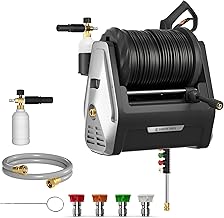
The any-length lock is the meaningful upgrade here — you pull out only what the job needs and the rest stays wound, which keeps loose hose off the floor and out of your walking path. The dark silver finish holds up better than white against garage dust and reads as intentional rather than utility.
EGO POWER+ HPW3204-2
At 3,200 PSI this is the pressure leader in the group, and the cordless platform means no outlet placement constraints on where you mount it. Worth choosing if you already run EGO batteries or need to work well beyond hose reach.
Giraffe Tools Grandfalls G20 65FT
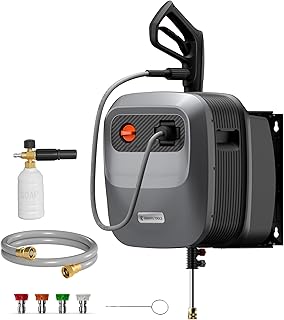
The 180-degree swivel bracket and five quick-connect nozzles make this the most adaptable mount for a tight single-bay garage where you need to redirect the reel rather than reposition yourself. Sixty-five feet is the right call when your cleaning zone stays inside the property line.
Giraffe Tools G20 65FT Grey Hose
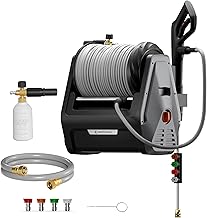
Mechanically the same well-sorted package with a grey hose that disappears against concrete and painted block instead of drawing the eye. A good pick when you want the unit to read as infrastructure rather than equipment.
Frequently Asked Questions
What kind of wall can support one of these?
Mount into studs or solid masonry, never drywall anchors alone. Loaded with water and a full hose, these units carry real weight and a shifting mount will chew the wall behind it.
Do I need a dedicated outlet?
A standard 120V grounded outlet on a 15-amp circuit is sufficient for the corded models. Plan the mount within cord reach so you’re not running an extension along the floor, which defeats the point of getting things off the ground.
Will it freeze in an unheated garage?
Drain the pump and hose before sustained sub-freezing weather, or add pump antifreeze. Most warranty claims on wall units trace back to skipped winterization.
Is a separate foam cannon worth adding?
Yes, if you wash vehicles regularly. The PWACCS Foam Gun with its 1.5-liter reservoir and dual connector produces thicker, longer-clinging foam than most included cannons and stores on a hook beside the reel.
Final Thoughts
For most garages, the Giraffe Tools Plus 100FT is the pick — the any-length lock and clean dark silver housing make it the version that genuinely recedes into the wall. Choose the Grandfalls G20 65FT if your cleaning radius is modest and you want the swivel bracket, or the EGO POWER+ HPW3204-2 if cordless freedom and maximum pressure matter more than a permanent, tidy mount.