Key takeaways
- Inner diameter: Match 1/4″ to residential machines up to roughly 3,200 PSI, and step up to 3/8″ for gas units or any run past 50 feet. The wider bore reduces friction loss, which is what keeps a distant nozzle from going soft.
- Pressure rating with headroom: Choose a hose rated above your washer’s maximum output, not at it. Trigger release sends brief spikes through the line, and a 4,000 PSI hose on a 3,000 PSI machine simply ages more slowly.
- Jacket construction: Steel-braided rubber resists abrasion and stays supple in cold air; polyurethane hybrids weigh far less and coil flat. Both beat generic PVC, which stiffens and takes a memory shape after one winter.
- Fitting size and type: M22 comes in 14mm and 15mm inner stems — the wrong one leaks at the trigger. Note what your washer and gun use before ordering, and favor brass over plated steel for repeated connections.
- Surface safety: If you work over painted decking, sealed stone, or near fixture lenses, prioritize a smooth outer jacket and a swivel coupler. Rough braid dragged under tension leaves marks that show up under raking light.
What's inside
I spend my working hours deciding how light lands on a surface after dark — the grazing wash up a limestone chimney, the low glow that skims a bluestone terrace, the soft pool under a pergola. What most people don’t realize is that lighting is unforgiving toward dirt. A fixture aimed across a wall reveals every algae streak and mildew shadow, and a patio that looks acceptable at noon can look neglected under a well-aimed 2700K flood. Which is why washing season and lighting season are, in my practice, the same season — and why the hose feeding the wand matters more than anyone gives it credit for.
The frustration is almost always the same. The hose that shipped with the machine is stiff, short, and prone to folding on itself the moment you climb a step or round a planter. You lose pressure mid-pass, leave a visible stripe on the render, and drag a coiled black snake across the very stone you just brightened. This guide covers the replacement and extension hoses worth owning in 2026 — what to check before you buy, how diameter and length affect the pressure actually reaching your nozzle, and which models hold up across long, detail-heavy sessions on finished exterior surfaces.
As an Amazon Associate we earn from qualifying purchases.


How to Choose a Pressure Washer Hose (2026)
- Inner diameter: Match 1/4″ to residential machines up to roughly 3,200 PSI, and step up to 3/8″ for gas units or any run past 50 feet. The wider bore reduces friction loss, which is what keeps a distant nozzle from going soft.
- Pressure rating with headroom: Choose a hose rated above your washer’s maximum output, not at it. Trigger release sends brief spikes through the line, and a 4,000 PSI hose on a 3,000 PSI machine simply ages more slowly.
- Jacket construction: Steel-braided rubber resists abrasion and stays supple in cold air; polyurethane hybrids weigh far less and coil flat. Both beat generic PVC, which stiffens and takes a memory shape after one winter.
- Fitting size and type: M22 comes in 14mm and 15mm inner stems — the wrong one leaks at the trigger. Note what your washer and gun use before ordering, and favor brass over plated steel for repeated connections.
- Surface safety: If you work over painted decking, sealed stone, or near fixture lenses, prioritize a smooth outer jacket and a swivel coupler. Rough braid dragged under tension leaves marks that show up under raking light.
The Best Pressure Washer Hoses (2026) Reviewed
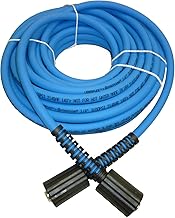
UBERFLEX Kink Resistant Hose, 1/4″ x 50 ft, 3,100 PSI
This is the one I hand to installers who work around finished millwork and low-voltage runs, because it genuinely stays flexible in cool air and doesn’t fight you around corners. The pair of 22MM fittings and US manufacturing make it a straightforward swap for most residential machines.
YAMATIC 3/8″ Hose, 4,000 PSI, 50 ft
The 360-degree swivel quick connect is the standout feature here — it lets the wand rotate freely while you’re working overhead on soffits and fascia, which is exactly where torque builds up. Rated for water from 15°F to 212°F, it handles both winter rinses and hot-water units.
100FT Steel Braid Hose, 4,200 PSI, 3/8″ QC
When the far corner of a property has no convenient spigot, this is the reach solution, and the included adapter set covers most 1/4″ and 3/8″ arrangements. Expect real weight once it’s charged, so plan your coil placement before you start rather than dragging it behind you.
Flexzilla Replacement Hose, 1/4″ x 50 ft, 3,100 PSI
Flexzilla’s hybrid polymer is the lightest hose I use around delicate hardscape, and it lies genuinely flat instead of springing into loops. The ZillaGreen jacket also has a practical advantage after sunset: you can see it, which matters when you’re working near uplights and cable runs.
YAMATIC 50 ft Hose, 1/4″, 3,200 PSI, M22-14mm
A well-priced, kink-resistant replacement with solid brass female fittings, sized for the M22-14mm connections used by Ryobi, Greenworks, Troy-Bilt, and Craftsman electrics. If your factory hose has simply gone stiff, this is the low-drama fix.
Frequently Asked Questions
Can I join two hoses to extend my reach?
Yes, with a matching coupler, though every connection adds a small pressure drop. Beyond about 100 total feet, move to 3/8″ to keep nozzle performance consistent.
Does a wider hose reduce my pressure?
No — the opposite. A larger inner diameter lowers friction loss, so more of the pump’s output reaches the tip. Your machine’s unloader, not the hose bore, sets working pressure.
How do I tell M22-14mm from M22-15mm?
Both have the same 22mm outer thread; measure the inner stem opening. Electric consumer washers usually take 14mm, while many gas units use 15mm.
What ruins a hose fastest?
Coiling it tightly while still pressurized, storing it in freezing conditions, and dragging it over gritty concrete. Depressurize, drain, and hang it in loose loops.
Final Thoughts
For most homes, the UBERFLEX 50-footer is the balanced choice — flexible, well-made, and kind to finished surfaces. Choose Flexzilla if weight and maneuverability around delicate hardscape and fixtures matter most, and step up to the YAMATIC 3/8″ 4,000 PSI hose if you’re running a gas machine or covering real distance.