Key takeaways
- Match the PSI ceiling, then add margin: Your hose must be rated above your machine’s maximum output, not equal to it. A 3,100 PSI washer is happier on a 4,000 PSI line, and the extra wall thickness usually survives more abrasion against masonry edges.
- 1/4″ versus 3/8″ is about the machine, not the hose: Most electric and light gas units use 1/4″; contractor-grade gas machines above roughly 3,000 PSI expect 3/8″. Undersizing restricts flow and starves the pump.
- Know your fitting language before you order: M22-14mm and M22-15mm look identical to the eye and will not seal together. Check the inner pin diameter on your existing coupler, and prefer hoses that ship with 3/8″ quick-connect adapters so you can standardize the whole kit.
- Flexibility beats raw length in tight spaces: A stiff 100 ft line that memory-coils is slower to work with than a supple 50 ft one you can flick straight. If you are threading around landscape fixtures and furniture, prioritize cold-weather pliability.
- Look for brass and swivels at the ends: Solid brass fittings resist the cracking that plastic collars develop after a season outdoors, and a 360° swivel stops torque from transferring down the line every time you pivot the wand.
What's inside
Anyone who works with light for a living develops an odd habit: you stop seeing a patio and start seeing the surface that will bounce a warm 2700K wash back at your guests. Grime kills that bounce. Algae on pavers, chalky film on siding, a haze of pollen across a pergola beam — all of it eats the光 you paid good money to install. So the pressure washer becomes part of the lighting kit, and the hose becomes the part that decides whether you actually finish the job before the sun drops. A hose that coils itself into a knot every eight feet, or splits at the fitting on a cold morning, is the difference between a surface that glows and one that just sits there looking tired.
This guide looks at replacement and extension hoses through that practical lens: reach, flexibility in real temperatures, fitting quality, and whether the thing behaves when you drag it around planters, uplights, and cable runs you would rather not disturb. Below you will find current options spanning 1/4″ homeowner setups through 3/8″ steel-braided commercial lines rated past 4,000 PSI, plus the sizing details that keep you from ordering the wrong connector twice.
As an Amazon Associate we earn from qualifying purchases.


How to Choose a Hose Pipe For Pressure Washer (2026)
- Match the PSI ceiling, then add margin: Your hose must be rated above your machine’s maximum output, not equal to it. A 3,100 PSI washer is happier on a 4,000 PSI line, and the extra wall thickness usually survives more abrasion against masonry edges.
- 1/4″ versus 3/8″ is about the machine, not the hose: Most electric and light gas units use 1/4″; contractor-grade gas machines above roughly 3,000 PSI expect 3/8″. Undersizing restricts flow and starves the pump.
- Know your fitting language before you order: M22-14mm and M22-15mm look identical to the eye and will not seal together. Check the inner pin diameter on your existing coupler, and prefer hoses that ship with 3/8″ quick-connect adapters so you can standardize the whole kit.
- Flexibility beats raw length in tight spaces: A stiff 100 ft line that memory-coils is slower to work with than a supple 50 ft one you can flick straight. If you are threading around landscape fixtures and furniture, prioritize cold-weather pliability.
- Look for brass and swivels at the ends: Solid brass fittings resist the cracking that plastic collars develop after a season outdoors, and a 360° swivel stops torque from transferring down the line every time you pivot the wand.
The Best Hose Pipe For Pressure Washer (2026)s Reviewed
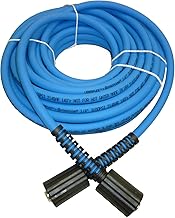
UBERFLEX Kink Resistant 1/4″ Hose, 50 ft
The UBERFLEX earns its reputation on handling: it stays limp and cooperative in cool weather, which matters when you are working a shaded north elevation early in the day. Rated to 3,100 PSI with two 22MM fittings included and built in the USA, it is the one I hand to someone who has never fought a hose before.
YAMATIC 3/8″ Hose, 4,000 PSI, 50 ft
Steel-braided rubber with a genuine 15°F to 212°F service range makes this the serious option for gas machines and hot-water work. The 360° swivel quick connect is the detail you will appreciate most, since it absorbs the twisting that otherwise builds into a kink behind you.
100 ft Steel Braid Extension Hose, 4,200 PSI
When the nearest spigot is a driveway away from the wall you need to clean, this commercial-grade 100 ft run with 3/8″ quick connects and a 1/4″ adapter set solves the problem outright. Expect real weight on the drum, and expect to coil it properly if you want it to lie flat next season.
Westinghouse 50 ft PVC Hose, 3,400 PSI
A straightforward PVC line that fits both gas and electric units and shrugs off sunlight better than budget rubber. It is stiffer than the braided options in the cold, but for warm-season deck and fence work at a sensible price, it does the job without drama.
YAMATIC Flexible 50 ft 1/4″ Hose, M22-14mm, Green
This is the compliance champion of the group — noticeably softer than its black sibling, so it tracks around furniture legs and fixture stakes instead of dragging them. The 3,200 PSI rating and included 3/8″ quick-connect adapters cover nearly every consumer machine on the market.
Frequently Asked Questions
Can I connect two pressure washer hoses together?
Yes, provided both are rated for your machine’s pressure and you use a proper coupler rather than a garden-hose fitting. Expect a small pressure drop per additional 50 ft, which is rarely noticeable on surface cleaning.
Why does my hose keep kinking in the same spot?
That is coil memory, usually from storing the hose tightly wound in the cold. Lay it out in the sun for twenty minutes before use, and store it in wide loops rather than figure-eights.
Do I need a hot-water rated hose?
Only if your unit heats water or you plan to feed it warm water for degreasing. The 15°F to 212°F rated rubber lines cover that; standard PVC does not.
How do I tell M22-14mm from M22-15mm?
Both threads measure 22mm across, but the internal pin differs by a millimeter. Measure the pin, or check your washer’s manual — Ryobi, Craftsman, Greenworks, and Troy-Bilt typically use 14mm.
Final Thoughts
For most homeowners keeping their hardscape and fixtures looking crisp, the UBERFLEX 50 ft is the easiest hose to live with, and the YAMATIC 50 ft in green is a close, more affordable second with better cold-weather flex than its price suggests. If you are running a gas machine or cleaning at distance, step up to the YAMATIC 3/8″ 4,000 PSI line and be done with hose failures for a long while.