Key takeaways
- AHAM verification over square footage claims: A number like “1,500 sq ft” means little without context. AHAM-verified CADR figures are independently tested, and units carrying that mark — the KNKA APH4000 and both LEVOIT models — give you numbers you can actually compare against your room.
- A washable pre-filter is non-negotiable with pets: Fur clogs the outer layer fast. Models with a rinseable pre-filter (KNKA, LEVOIT Vital 100S-P, YARIKI P280) let you protect the expensive HEPA media instead of replacing it every three months.
- Decibels at your sleeping speed, not the marketing number: The 22 dB and 24 dB figures quoted for the YARIKI, VOOPNU, and LEVOIT Core 300 apply to the lowest setting. Check that the low setting still moves enough air for your room, or you will be running it louder than advertised.
- Light discipline in bedrooms: AQI displays and mode LEDs are genuinely useful during the day and genuinely disruptive at 2 a.m. Look for a sleep mode that fully dims the panel rather than merely lowering the fan.
- Carbon capacity for odor, HEPA for dander: HEPA catches particles; it does nothing for that damp-dog smell. If odor is your real complaint, prioritize a substantial activated carbon stage — PuroAir’s CarbonTech layer is the standout here.
What's inside
Anyone who has watched late afternoon sun cut across a living room knows the truth about pet dander: it is visible. That soft haze drifting through a shaft of window light is not dust motes being poetic — it is skin flakes, fur fragments, and dried saliva particles suspended in the air you breathe. A room can look immaculate and still read as murky the moment directional light passes through it, and no amount of vacuuming touches what is airborne.
This guide approaches air purification the way we approach lamp placement and window treatments: as part of how a room feels, not just how it functions. We looked at six HEPA units through the lens of a furnished home — how loudly they intrude on a quiet evening, whether their indicator lights fight your bedside glow, how they sit next to a sofa arm or console table, and whether the coverage claims hold up in the open-plan spaces where pets actually live. Below you will find the picks, the specs that matter, and the ones that are marketing noise.
As an Amazon Associate we earn from qualifying purchases.


How to Choose a HEPA Air Purifier For Pet Dander (2026)
- AHAM verification over square footage claims: A number like “1,500 sq ft” means little without context. AHAM-verified CADR figures are independently tested, and units carrying that mark — the KNKA APH4000 and both LEVOIT models — give you numbers you can actually compare against your room.
- A washable pre-filter is non-negotiable with pets: Fur clogs the outer layer fast. Models with a rinseable pre-filter (KNKA, LEVOIT Vital 100S-P, YARIKI P280) let you protect the expensive HEPA media instead of replacing it every three months.
- Decibels at your sleeping speed, not the marketing number: The 22 dB and 24 dB figures quoted for the YARIKI, VOOPNU, and LEVOIT Core 300 apply to the lowest setting. Check that the low setting still moves enough air for your room, or you will be running it louder than advertised.
- Light discipline in bedrooms: AQI displays and mode LEDs are genuinely useful during the day and genuinely disruptive at 2 a.m. Look for a sleep mode that fully dims the panel rather than merely lowering the fan.
- Carbon capacity for odor, HEPA for dander: HEPA catches particles; it does nothing for that damp-dog smell. If odor is your real complaint, prioritize a substantial activated carbon stage — PuroAir’s CarbonTech layer is the standout here.
The Best HEPA Air Purifiers For Pet Dander (2026) Reviewed
KNKA APH4000
The strongest all-round performer in this group, clearing up to 1,695 sq ft per hour with AHAM verification behind the claim and a dedicated pet mode that steps up fan speed when particulate spikes. The AQI display is bright enough to read across a room, which makes it a better fit for a den or open living area than a dark bedroom.
LEVOIT Vital 100S-P
LEVOIT’s pet-specific unit pairs a washable pre-filter with a wide front intake that handles low-floating fur better than top-draw designs. Its squat, side-vented form factor tucks neatly beside a sofa or under a console without needing overhead clearance.
LEVOIT Core 300-P
The cylindrical Core 300-P remains the sensible choice for bedrooms and smaller rooms, with an H13 True HEPA filter rated to capture 99.97% of fine particulates at a genuinely unobtrusive 24 dB. Its compact footprint and neutral white shell disappear next to a nightstand in a way larger tower units simply cannot.
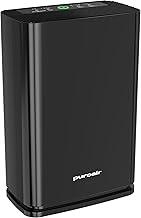
PuroAir 240
Where the PuroAir separates itself is odor control — the reinforced carbon stage is the most serious in this lineup, which matters if litter boxes or wet-dog smell are your actual problem rather than sneezing. Coverage tops out around 1,000 sq ft, so treat it as a room unit rather than a whole-floor solution.
YARIKI P280
The black finish is the quiet win here: most purifiers arrive in glossy white that reads as medical equipment in a warm, low-lit room, and the P280 sidesteps that entirely. It backs the aesthetics with H13 filtration, a washable pre-filter, and a 22 dB low setting suited to bedrooms.
Frequently Asked Questions
Where should I position an air purifier for pet dander?
Place it in the room where your pet sleeps, roughly three feet off the wall with clear intake on all sides. Avoid tucking it behind an armchair or under a shelf — restricted airflow undermines the CADR rating far more than being a few feet from the ideal spot.
Do I need to run it constantly?
Yes, ideally on auto. Dander is generated continuously, so intermittent use means you are always catching up. Auto mode on the KNKA or the LEVOIT units keeps consumption low until particulate levels actually rise.
How often do filters need replacing with pets in the house?
Expect six to eight months rather than the standard twelve, and rinse the washable pre-filter monthly. Pet households simply load filters faster.
Will a purifier stop fur on my furniture?
Partly. It captures fur while airborne, which reduces what settles on upholstery, but anything shed directly onto a cushion still needs a lint roller.
Final Thoughts
For most homes with pets, the KNKA APH4000 offers the best combination of verified coverage and pet-specific tuning, while the LEVOIT Core 300-P is the smarter pick for bedrooms where quiet operation and a small footprint matter more than raw throughput. If odor rather than dander is what actually bothers you, the PuroAir 240 and its carbon stage is the one worth spending on.