Key takeaways
- Depth versus reach-in visibility: A 24-inch shelf holds more, but the rear six inches sit in shadow unless you light from the front. If your garage has one overhead source, favor 16 to 20 inches deep, or plan on a clip-on task light per bay.
- Frame openness: Boltless steel uprights with thin corner posts let ambient light pass vertically between tiers. Solid side panels and closed backs block that spill entirely and turn each level into its own dim compartment.
- Deck material and reflectance: Light-toned particleboard or MDF decking acts as a bounce surface, pushing illumination back up onto whatever sits on the tier above. Black powder-coated wire and dark plastic absorb it, so pair those units with brighter fixtures.
- Load rating honesty: Advertised totals are usually distributed across all tiers, not per shelf. Divide by the tier count, then knock off a margin for uneven loading — a single engine block on one corner is a different stress case than forty evenly spaced paint cans.
- Height relative to your fixture: A 73-inch unit placed directly under a shop light will shade everything beneath it. Position tall shelving along walls perpendicular to your light source, or leave the top tier shallow so light clears it.
What's inside
Most garages are lit by a single bare bulb or one flickering fixture bolted to the ceiling joists, which means every shelf you install casts a shadow over the one below it. You reach for a paint can and find yourself squinting into a dark cavity, running your hand across a shelf you can’t actually see. The storage problem and the visibility problem are the same problem, and buyers rarely realize it until the unit is already assembled and the bottom two tiers have become a black hole where tools go to disappear.
This guide evaluates garage shelving with an eye on how each unit interacts with light — how deep a shelf can go before the back edge falls into gloom, whether the frame is open enough to let a ceiling fixture wash down through the tiers, and which finishes bounce light instead of swallowing it. Load ratings, footprint, and assembly still matter, and they’re covered below. But the shelf you can read labels on at 7am in January is the one you’ll actually keep organized.
As an Amazon Associate we earn from qualifying purchases.




How to Choose a Storage Shelves For Garage (2026)
- Depth versus reach-in visibility: A 24-inch shelf holds more, but the rear six inches sit in shadow unless you light from the front. If your garage has one overhead source, favor 16 to 20 inches deep, or plan on a clip-on task light per bay.
- Frame openness: Boltless steel uprights with thin corner posts let ambient light pass vertically between tiers. Solid side panels and closed backs block that spill entirely and turn each level into its own dim compartment.
- Deck material and reflectance: Light-toned particleboard or MDF decking acts as a bounce surface, pushing illumination back up onto whatever sits on the tier above. Black powder-coated wire and dark plastic absorb it, so pair those units with brighter fixtures.
- Load rating honesty: Advertised totals are usually distributed across all tiers, not per shelf. Divide by the tier count, then knock off a margin for uneven loading — a single engine block on one corner is a different stress case than forty evenly spaced paint cans.
- Height relative to your fixture: A 73-inch unit placed directly under a shop light will shade everything beneath it. Position tall shelving along walls perpendicular to your light source, or leave the top tier shallow so light clears it.
The Best Storage Shelves For Garage (2026)s Reviewed
46″W 5-Tier Wood and Steel Utility Shelf
The pale wood decking on this 71.2 by 46 by 19.7-inch unit is its quiet advantage — each tier reflects overhead light upward, so the shelf below stays readable without added fixtures. At just under 20 inches deep, nothing hides at the back edge.
CX Craftsman 5-Tier Plastic Storage Shelves
Rated at 200 pounds per shelf across a 72.3 by 40 by 24-inch frame, this one earns its place through easy assembly and moisture indifference. The black and red finish absorbs light, so treat it as a candidate for the brightest wall in the space rather than a dim corner.
71.3″ Heavy Duty Steel Garage Shelving, 5000 lb
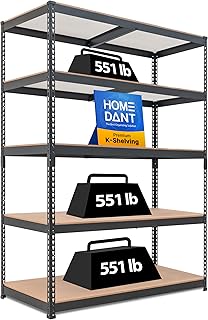
A wide, genuinely industrial platform for engine parts, bulk fluids, and anything you’d hesitate to trust to lighter steel. The 24-inch depth needs front-mounted lighting to stay usable, but the open boltless frame lets ceiling light drop cleanly between tiers.
Black 47.7″ Deep 5-Tier Adjustable Metal Shelving
Boltless construction and adjustable tier spacing make this the most flexible unit here — set one bay tall for bins, another short for hardware trays. The matte black finish reads well against a light wall and hides scuffs better than powder-coated silver.
Garage Shelving 4-Tier, 6000 lb, 79″ Wide
Four tiers instead of five means taller gaps and far more light penetration per level, which is why this 79-inch-wide rack works well in single-fixture garages. The 6000-pound distributed rating covers nearly anything a home shop will stack on it.
Frequently Asked Questions
How do I light shelving that’s already installed?
Adhesive-backed LED strips run along the underside of each tier’s front lip give you shadow-free light exactly where you reach. Battery-powered puck lights work for occasional access; hardwired or plug-in strips suit daily use.
Are wood decks or wire decks better?
Wire decks let light and air through, which suits damp garages and dim spaces. Wood decks give a flat surface for small items and reflect more light upward, but they swell if they get wet.
Should I anchor shelving to the wall?
Yes, for any unit over 60 inches tall. An L-bracket into a stud at the top rail prevents tipping when upper tiers are loaded and lower ones aren’t.
How much clearance should I leave overhead?
At least eight inches between the top shelf and any fixture, more if it’s an older fluorescent tube. This keeps light spreading laterally instead of cooking your top-tier contents.
Final Thoughts
For most garages, the 46″W wood and steel utility shelf is the smartest default — reflective decking, sensible depth, and enough capacity for household storage. If you’re loading heavy, the 79-inch 6000 lb four-tier rack offers the best light penetration among the industrial options, while the Black 47.7″ adjustable boltless unit is the one to pick when your bin sizes keep changing.