Key takeaways
- Work in small overlapping sections, roughly 12 inches square, so no area stays wet while you finish another.
- Make two or three dry passes with the trigger released for every wet pass — recovery is where the soil actually leaves.
- Use warm, not hot, solution on synthetics; excessive heat can glaze fibers and permanently change their sheen.
- Re-inspect with your raking light after everything is bone dry, since residue and rings only become visible at that point.
What's inside
In lighting design, we don’t judge a surface by how it looks under a ceiling fixture at noon. We judge it by how it behaves when light rakes across it at a low angle, because that’s when texture stops hiding. Drag a work lamp low along a sofa arm and you’ll see everything the fabric has been keeping from you: the flattened nap where someone always sits, the halo left by a spill that was blotted but never extracted, the fine grey film of body oil and airborne dust that dulls the weave. Most people clean the stain they can see. The surfaces that actually look new again are the ones cleaned to what the light shows.
This guide takes that approach and turns it into a working method. You’ll learn how to read your sofa’s soil pattern before you touch it with moisture, how to decode the fabric tag so you don’t set a stain or shrink a cushion cover, why dry soil removal has to come first, what hot-water extraction actually does that blotting cannot, and how to dry a cushion so it doesn’t finish with rings or a patchy sheen. There’s also a short section on the portable extractors worth owning, since a machine that pulls water back out is the one piece of gear that changes results rather than just effort.
Our Recommended Picks
As an Amazon Associate we earn from qualifying purchases.



Start With a Light Audit, Not a Bottle
Before anything gets wet, put a bright, directional light source at cushion height — a clamp lamp, a shop light, even a phone torch held nearly flat against the fabric. Walk it slowly across each panel. Low-angle light reveals depth and disturbance: crushed pile reads as a shiny patch, dried residue reads as a matte ring, and soil concentrated along seams shows as darker piping. Mark what you find with painter’s tape or photograph each panel. This takes five minutes and it does two things — it tells you where to concentrate, and it gives you an honest before-and-after reference so you’re not judging progress under flattering evening light.
Decode the Fabric Code Before You Choose a Method
Look under a cushion or beneath the frame for a cleaning code. W means water-based cleaners are safe. S means solvent only, and water will likely leave a permanent ring. WS accepts either. X means vacuum and professional service only — no liquid. If there’s no tag, test on a hidden panel: apply a small amount of your solution, blot, dry fully, then re-check under that same raking light for color shift or a halo. Velvet, chenille, and linen blends are the least forgiving; tight polyester weaves and performance fabrics are the most cooperative.
Do All the Dry Work First
Water turns loose dust into mud and drives it deeper into the weave, so dry soil removal is non-negotiable. Work in this order: remove cushions and vacuum all six sides of each, use a crevice tool along every seam and under the deck, then brush the fabric with a soft upholstery brush to lift matted fibers and bring embedded grit to the surface before vacuuming again. On pet-heavy sofas, a rubber pet brush pulls out hair that suction alone leaves behind. You should see a visible difference in how evenly light reflects off the surface at this stage, before any liquid appears.
Extract Rather Than Blot
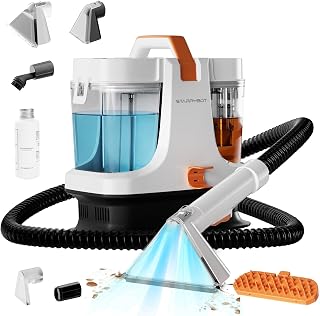
Blotting moves soil around and leaves most of the moisture, and the dissolved dirt, sitting in the padding to wick back up as it dries. That’s the source of most reappearing stains. A portable extractor sprays solution, agitates, and immediately vacuums the dirty water out — which is the entire difference between a stain that fades and one that leaves. Suction rating matters most here. The Uwant 18Kpa Upholstery Cleaner and the Starrybot 18Kpa Pet Stain Extractor sit at the strong end for handheld units, and stronger recovery means shorter drying times and fewer rings. The Shark StainStriker PX202 earns its place on tool variety, with narrow and wide stain heads plus a crevice tool for seams and tufting. The WECLEAN C1 is a straightforward pick if you want machine and solution matched from the start, and the Uwant 2.4 Liter 2-in-1 handles larger sectionals without constant tank refills. For thicker fabrics that need real mechanical agitation, a 450W handheld shampooer and scrubber adds brushing force alongside extraction.
Dry It Deliberately
Uneven drying is what produces the mottled, cloudy look you notice weeks later. Once you’ve made your final dry-suction passes, set up cross-ventilation with a fan aimed across the surface rather than down at it, keep cushions upright and separated so air reaches all faces, and leave the sofa unused for four to eight hours. Groom the nap in one consistent direction with a soft brush while it’s still slightly damp — this is what makes light reflect uniformly and reads as “new” more than cleanliness itself does.
Tips
- Work in small overlapping sections, roughly 12 inches square, so no area stays wet while you finish another.
- Make two or three dry passes with the trigger released for every wet pass — recovery is where the soil actually leaves.
- Use warm, not hot, solution on synthetics; excessive heat can glaze fibers and permanently change their sheen.
- Re-inspect with your raking light after everything is bone dry, since residue and rings only become visible at that point.
Frequently Asked Questions
How often should a sofa be deep cleaned?
Once or twice a year for a normal household, and every three to four months if you have pets, small children, or a sofa that doubles as a dining spot. Weekly vacuuming does far more for long-term appearance than occasional aggressive cleaning.
Can I use a carpet cleaner on upholstery?
Only with a dedicated upholstery attachment. Full-size carpet machines deliver more water than cushion foam can shed, which risks saturation, odor, and mildew in the padding. Handheld extractors are sized correctly for the job.
Will vinegar or baking soda work instead of a cleaning solution?
They handle light odors and fresh spills adequately, but neither has the surfactant action needed to release body oils from fibers. Baking soda in particular leaves gritty residue that dulls the surface unless it’s fully extracted.
What if the stain returns after drying?
That’s wicking — soil still in the padding traveling upward as moisture evaporates. Re-extract the area with clean water only, then place a folded white towel over the spot with a light weight on it while it dries to intercept whatever rises.
Conclusion
The best way to clean a sofa isn’t a single product or a secret solution — it’s a sequence: light it honestly, identify the fabric, remove every bit of dry soil, extract rather than blot, and control the drying so the surface finishes evenly. A capable handheld extractor makes that sequence far easier to execute well, and once you start judging your results under raking light instead of overhead light, you’ll find the standard you’re holding yourself to is the same one the fabric was designed to meet.