Key takeaways
- Treat headline PSI as marketing, not measurement: Cordless units running on 20V-class packs realistically land between 800 and 1,500 PSI at the nozzle. A four-figure claim above that range usually refers to a burst or theoretical peak. Read flow rate and motor type alongside it.
- Flow rate governs rinsing, pressure governs lifting: Loosening algae from a paver needs pressure; carrying that residue off a wide patio needs volume. For surfaces you plan to light, generous GPM matters more, because streaking shows brutally under grazing beams.
- Buy runtime in packs, not minutes: Continuous-trigger figures are optimistic. Two batteries in the box means one charging while one works, which is the difference between finishing a courtyard and abandoning it half-clean.
- Check hose length and intake flexibility: A long suction line lets you draw from a bucket, water butt, or pond and work well away from plumbing. That radius is what makes battery units viable in garden lighting zones.
- Insist on a low-pressure setting and a foam attachment: Powder-coated fixtures, composite decking, and lantern glass need chemistry and dwell time, not force. A soft mode protects finishes you have paid a designer to specify.
What's inside
Lighting only works when the surfaces around it cooperate. I spend my days aiming warm 2700K wash across limestone patios, tuning path lights so they graze a fence board instead of blowing it out, and specifying lanterns whose glass is supposed to disappear. Then a season of pollen, algae, and road film arrives and every one of those decisions quietly stops working. Dull stone absorbs the light I meant it to bounce. Grey siding turns a soft grazing wash into a flat smudge. Cloudy fixture lenses can eat a startling share of output before a single lumen reaches the ground. Clients assume the fittings failed. Usually the surfaces did.
The practical obstacle is access. Ambience lives in the awkward places — under a pergola, along a garden wall thirty metres from the nearest tap, behind a hedge threaded with low-voltage cable I would rather not drag a rigid hose across. Corded washers are overkill there, and often physically impossible. Battery models solve the reach problem, but their marketing is a mess of inflated pressure claims and vague runtime figures. This guide reads them the way I read a spec sheet: what the machine actually does to a surface, how long it does it for, and whether it behaves gently enough to work near fixtures, glass, and wiring.
As an Amazon Associate we earn from qualifying purchases.


How to Choose a Cordless Pressure Washer (2026)
- Treat headline PSI as marketing, not measurement: Cordless units running on 20V-class packs realistically land between 800 and 1,500 PSI at the nozzle. A four-figure claim above that range usually refers to a burst or theoretical peak. Read flow rate and motor type alongside it.
- Flow rate governs rinsing, pressure governs lifting: Loosening algae from a paver needs pressure; carrying that residue off a wide patio needs volume. For surfaces you plan to light, generous GPM matters more, because streaking shows brutally under grazing beams.
- Buy runtime in packs, not minutes: Continuous-trigger figures are optimistic. Two batteries in the box means one charging while one works, which is the difference between finishing a courtyard and abandoning it half-clean.
- Check hose length and intake flexibility: A long suction line lets you draw from a bucket, water butt, or pond and work well away from plumbing. That radius is what makes battery units viable in garden lighting zones.
- Insist on a low-pressure setting and a foam attachment: Powder-coated fixtures, composite decking, and lantern glass need chemistry and dwell time, not force. A soft mode protects finishes you have paid a designer to specify.
The Best Cordless Pressure Washers of 2026 Reviewed
6-in-1 Portable Cordless Washer, 1300 PSI with 2 x 4.0Ah Batteries
The most sensibly balanced unit here: enough pressure to lift winter film from stone without scouring the surface texture that grazing light depends on, and two packs so you can work through a full terrace in one session. My default recommendation for anyone maintaining a lit patio.
5000 PSI Cordless Washer with Foam Cannon
Ignore the pressure figure, which no 4.0Ah platform delivers in any meaningful sense. What justifies its place is the included foam cannon and six-in-one nozzle, a genuinely useful pairing for cleaning fence panels and fixture housings where soak time does the work instead of brute force.
Cordless Washer with 2 x 4.5Ah 21V Batteries and Two Power Levels
The highest capacity packs in this group, plus a proper two-stage power selector and an on/off cut-off rather than a permanently live trigger. That low setting is the one I use around lanterns and step lights.
Handheld Cordless Washer, 1100 PSI with 23FT Hose and Foam Pot
Modest pressure paired with a strong 2.4 GPM flow makes this a rinsing tool first, which suits pale paving and rendered walls that show streaks under uplighting. The long hose reaches most of a small courtyard from a single bucket.
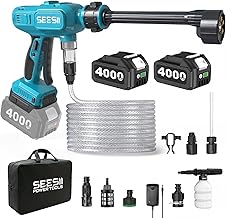
SEESII Cordless Pressure Washer 1250 PSI
The brushless motor and 27-foot hose are the standouts, giving quieter running, better efficiency from its two 4.0Ah packs, and the longest working radius in this lineup. Worth the premium if your lighting scheme extends into the garden proper.
Frequently Asked Questions
Can I clean outdoor light fixtures with one of these?
Only on the lowest setting, from at least a foot away, with the fixture switched off at the circuit and fully cooled. Foam and a soft cloth remain the safer choice for lenses and any painted metal.
Is a cordless washer strong enough for a stone patio?
For seasonal maintenance, yes. For deeply embedded moss or years of neglect, a corded or petrol machine will save you significant time and battery cycles.
How long does a battery realistically last?
Expect eight to fifteen minutes of trigger time per 4.0Ah pack, depending on nozzle choice. Intermittent use across a small area stretches considerably further than that suggests.
Does surface cleaning genuinely change how lighting looks?
Noticeably. Reflectance drops as soiling builds, so a washed pale surface returns markedly more bounce light to the space than the same surface left dirty for a season.
Final Thoughts
For most homes maintaining a lit patio or deck, the 1300 PSI 6-in-1 with dual 4.0Ah batteries hits the right compromise between capability and gentleness. If your scheme runs deeper into the garden, the SEESII 1250 PSI earns its keep on hose length and brushless efficiency, while the 21V twin 4.5Ah model is the one to choose if extended runtime and a genuine low-pressure mode matter most.