Key takeaways
- Carbon by the pound, not the coating: Thin carbon-dusted mats are a marketing gesture. Look for stated carbon weight — several pounds is the threshold where off-gassing from new furniture measurably drops. Anything under a pound is a deodorizer, not a VOC solution.
- A sealed air path: Gases follow the route of least resistance. Gasketed filter seats and a rigid chassis matter more than a high headline CADR, because leaked air is unfiltered air no matter how fast the fan spins.
- Footprint and sightlines: Measure before you buy. A cylindrical unit reads as a side table companion; a tall tower becomes an architectural element and needs breathing room on both sides. Never tuck one against upholstery — you’ll choke the intake and create a dust shadow on the fabric.
- Controllable indicator lighting: This is the detail buyers regret most. Air quality displays and status LEDs throw cold blue-white light across a dark bedroom and flatten every warm layer you’ve built. Insist on a full display-off mode, not just a dimmed one.
- Honest noise floor and filter economics: Check the decibel figure at the speed you’ll actually run overnight, then price a year of replacement carbon. Carbon saturates faster than HEPA, and a cheap machine with expensive annual media is no bargain.
What's inside
A room can be composed perfectly and still feel wrong. I spend my working hours tuning lumens, color temperature, and shadow depth in living rooms and bedrooms, and I’ve learned that the thing clients describe as “the light feels heavy in here” is often not the light at all. It’s the air. New casegoods, engineered panels, foam cushions, adhesives, low-sheen paint that hasn’t finished curing — all of it releases volatile organic compounds for weeks or months after delivery day. You can’t see VOCs the way you see glare on a tabletop, but they register in the body as a faint headache under warm dimmed light, or that chemical sweetness that clings to a freshly styled nook.
The complication is that most air purifiers marketed for allergies are built to trap particles, and VOCs are gases. Passing a gas through a pleated HEPA sheet accomplishes very little. What actually works is a meaningful mass of activated carbon, sometimes blended with potassium permanganate, held in a housing that doesn’t let air sneak around the media. This guide covers what to look for in a VOC-focused machine in 2026, how to place one so it disappears into your room’s visual rhythm instead of interrupting it, and which units earn their footprint on a floor plan.
As an Amazon Associate we earn from qualifying purchases.


How to Choose a/an Air Purifier For Vocs (2026)
- Carbon by the pound, not the coating: Thin carbon-dusted mats are a marketing gesture. Look for stated carbon weight — several pounds is the threshold where off-gassing from new furniture measurably drops. Anything under a pound is a deodorizer, not a VOC solution.
- A sealed air path: Gases follow the route of least resistance. Gasketed filter seats and a rigid chassis matter more than a high headline CADR, because leaked air is unfiltered air no matter how fast the fan spins.
- Footprint and sightlines: Measure before you buy. A cylindrical unit reads as a side table companion; a tall tower becomes an architectural element and needs breathing room on both sides. Never tuck one against upholstery — you’ll choke the intake and create a dust shadow on the fabric.
- Controllable indicator lighting: This is the detail buyers regret most. Air quality displays and status LEDs throw cold blue-white light across a dark bedroom and flatten every warm layer you’ve built. Insist on a full display-off mode, not just a dimmed one.
- Honest noise floor and filter economics: Check the decibel figure at the speed you’ll actually run overnight, then price a year of replacement carbon. Carbon saturates faster than HEPA, and a cheap machine with expensive annual media is no bargain.
The Best Air Purifier For Vocs (2026)s Reviewed
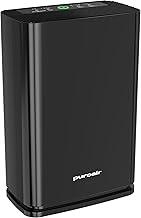
Airpura V700
Purpose-built for chemical loads, with a deep carbon bed sized for outgassing furniture, solvent smells, and wildfire smoke that arrives with both particles and gases. The steel housing is utilitarian rather than decorative, so treat it as equipment and place it behind a chair or beside a console where it reads as intentional.
Austin Air Tabletop C100CC1
The VOC carbon wrap in this compact model punches well above its size, and the tabletop proportions let it sit on a credenza or nightstand without dominating the surface. It’s my go-to recommendation for a single bedroom that just received a new dresser or upholstered bed.
Dyson Purifier Big+Quiet Formaldehyde BP03
Genuinely strong long-range projection and a catalytic filter that breaks formaldehyde down rather than merely holding it, which suits open-plan rooms with a lot of engineered wood. Its sculptural form is a design statement, so plan lighting around it the way you would a floor lamp.
LEVOIT Core 300-P
The most sensible small-room buy on this list: quiet sleep mode, a genuinely dark display when you want one, and a carbon layer adequate for mild odors and light off-gassing. It won’t tame a whole newly furnished apartment, but in a bedroom it’s unobtrusive and dependable.
HAP603 Large Room Purifier
Wide coverage, a 360° outlet that avoids the harsh directional draft cheaper towers produce, and a PM2.5 readout that helps you learn your home’s daily rhythm. Skip the aromatherapy pad if VOCs are your concern — added fragrance is added VOCs.
Frequently Asked Questions
How long does new furniture off-gas?
Most pieces release the bulk of their VOCs in the first two to eight weeks, though particleboard and certain foams can linger for months. Run a carbon-heavy purifier continuously through that window and ventilate when weather allows.
Does a HEPA filter remove VOCs?
No. HEPA captures particulates down to sub-micron sizes but gases pass straight through. Only activated carbon, permanganate media, or a catalytic process addresses VOCs.
Where should I place the unit in a bedroom?
Roughly six to twelve inches off the wall, on the same side as the newest furniture, and out of the path of your dimmable ambient fixtures so the housing doesn’t cast an odd shadow. Avoid corners, which starve the intake.
Will the indicator lights disrupt sleep?
They can. Cool-white LEDs at eye level undo the melatonin-friendly environment a warm 2200K bedside lamp creates, so choose models with a complete display-off setting or cover the panel with removable blackout tape.
Final Thoughts
For a home genuinely loaded with new furnishings, the Airpura V700 is the most capable choice, with the Dyson Big+Quiet Formaldehyde BP03 close behind if you want VOC performance that also holds its own visually in a finished room. For a single bedroom on a sensible budget, the Austin Air C100CC1 delivers real carbon volume in a tabletop form, and the LEVOIT Core 300-P handles lighter loads quietly enough to forget it’s running.