Key takeaways
- Reflectance over raw color: Pearl grays and silvers bounce roughly two to three times more light than black, which means fewer fixtures needed under the hood and along baseboards. Pick dark flooring only if you want a gallery effect and are prepared to add lighting.
- Texture controls glare: Diamond plate and ribbed patterns break up specular reflection into thousands of small highlights, giving you brightness without the mirror-like hotspot you get from smooth epoxy under a bare LED strip.
- Thickness and load rating: Rolls in the 2.2mm to 3mm range handle passenger vehicles and foot traffic; interlocking polypropylene tiles rated 40,000 lb and up are the choice for jacks, engine hoists, and rolling toolboxes.
- Moisture strategy: Solid rolls trap water underneath and need drying time, while open-grid tiles let snowmelt drain through to the slab. Absorbent containment mats hold spills in place instead of letting them spread.
- Installation reality: Rolls need a clear bay and relaxation time to flatten; tiles snap together in sections and let you replace a damaged square without pulling up the room.
What's inside
Most garage floors are lit by two or three cold LED fixtures bolted to the ceiling, and that light has to travel a long way before it does anything useful. Raw concrete absorbs a surprising amount of it, then hands back a patchy, oil-stained gray that makes the whole bay read as unfinished no matter how tidy the shelving is. Buyers usually shop garage flooring for durability alone and end up with a surface that fixes the mess but darkens the room by a stop or more, forcing task lamps and clamp lights to fill in the gaps.
This guide looks at garage flooring the way a lighting designer would: how much of your existing lumens each surface returns, whether it scatters light softly or throws hotspots back at your eyes, and how texture and color temperature interact with cheap shop fixtures. We cover roll-out PVC, interlocking tile systems, and absorbent containment mats, with notes on installation, load ratings, and cleanup so you can pick a floor that works as both a wear layer and a reflector.
As an Amazon Associate we earn from qualifying purchases.



How to Choose Garage Flooring in 2026
- Reflectance over raw color: Pearl grays and silvers bounce roughly two to three times more light than black, which means fewer fixtures needed under the hood and along baseboards. Pick dark flooring only if you want a gallery effect and are prepared to add lighting.
- Texture controls glare: Diamond plate and ribbed patterns break up specular reflection into thousands of small highlights, giving you brightness without the mirror-like hotspot you get from smooth epoxy under a bare LED strip.
- Thickness and load rating: Rolls in the 2.2mm to 3mm range handle passenger vehicles and foot traffic; interlocking polypropylene tiles rated 40,000 lb and up are the choice for jacks, engine hoists, and rolling toolboxes.
- Moisture strategy: Solid rolls trap water underneath and need drying time, while open-grid tiles let snowmelt drain through to the slab. Absorbent containment mats hold spills in place instead of letting them spread.
- Installation reality: Rolls need a clear bay and relaxation time to flatten; tiles snap together in sections and let you replace a damaged square without pulling up the room.
The Best Garage Flooring of 2026, Reviewed
8×20 FT Diamond Plate Garage Floor Roll (2.8mm)
At 2.8mm this is one of the thicker consumer rolls, and the diamond texture does real work diffusing overhead light instead of glaring it back. The black finish will drink lumens, so plan on it if you want a dramatic, low-key bay and have decent fixture coverage; the 20 included tape strips keep the edges from curling at the door threshold.
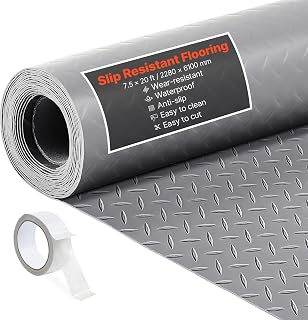
VEVOR Garage Floor Roll, 7.5 x 20 ft (Silver Gray)
The silver gray colorway is the standout here from a lighting perspective, lifting ambient brightness noticeably under the same fixtures that made bare concrete look dingy. At 2.2mm it is a protective wear layer rather than a cushioning one, but it wipes clean easily and the double-sided tape holds well on a swept, dry slab.
Swisstrax Ribtrax PRO Tiles, Pearl Grey (24-Pack)
Commercial-grade polypropylene with a ribbed face, and the pearl grey reads as genuinely bright rather than washed out under 4000K to 5000K shop lighting. No adhesives means you can lift and reconfigure zones, which matters if your lighting layout changes when you add a workbench.
SnapLock RaceDeck Free-Flow Tiles, 48pk Black
The self-draining open grid is the right answer for wet climates, and the 80,000 lb rolling load capacity means jack stands and heavy chests are not a concern. The grid creates a fine shadow pattern that hides tire marks well, though black plus open cells means you should overspecify lighting.
Armor All Jumbo XXL Garage Floor Mat (22′ x 8’10”)
This is a containment mat rather than a finished floor, and it excels at holding meltwater and oil in one absorbent, waterproof footprint. The matte surface produces almost no glare, so it sits quietly under a car without competing with the rest of the room.
Frequently Asked Questions
Does floor color really change how bright my garage feels?
Substantially. A light gray surface can return 40 to 60 percent of incident light versus roughly 5 to 10 percent for black, which is the difference between reading a torque spec at arm’s length and reaching for a headlamp.
Rolls or interlocking tiles?
Rolls are cheaper per square foot and faster to lay in an empty bay. Tiles cost more but drain, tolerate heavier point loads, and let you swap damaged pieces individually.
Will PVC rolls trap moisture against the slab?
Solid rolls can, especially over slabs without a vapor barrier. If your concrete sweats in humid weather, choose an open-grid tile system such as a modular plastic 12×12 tile pack instead.
Do these surfaces handle hot tires?
Quality PVC rolls and polypropylene tiles are formulated for it, unlike thin generic vinyl, which can soften and mark. Let a new roll acclimate flat before parking on it.
Final Thoughts
For most garages, the Swisstrax Ribtrax PRO in Pearl Grey delivers the best combination of light return, load capacity, and serviceability, while the VEVOR silver gray roll gets you a brighter bay for far less money. If containment is the priority over aesthetics, the Armor All Jumbo XXL handles winter slush and oil without adding a single watt to your lighting budget.