Key takeaways
- Frame profile versus your light throw: Wide-splay steel legs cast long, crossing shadows under path lights or low uplights. A tighter or more vertical stand footprint keeps the ground plane readable, which matters if the hammock sits along a walkway rather than in an open corner.
- Fabric behavior after dark: Warm-white bulbs (2700K and below) drain saturation from cool greys and pull yellow into white cotton. Dark grey and brown weaves hold their character under warm light; bright white reads cleanest under neutral 3000K or moonlight-toned fixtures.
- Overhead clearance for suspended lighting: If you plan to run café strings or a lantern above the hammock, you need vertical room between the highest point of the stand and the wire. Arched wooden stands eat that space. Flat A-frames leave it open.
- Canopy or no canopy: A canopy diffuses daylight beautifully and gives you a surface to bounce a small clip light off at night. It also blocks anything hanging above it, so treat canopy models as self-contained and light them from below or the side.
- Portability and seasonal staging: Collapsible stands let you move the hammock as the sun angle shifts through the year, following shade in July and afternoon light in October. If you like rearranging, prioritize a carry bag and tool-free assembly over maximum rated capacity.
What's inside
Most people shop for a standing hammock the way they shop for a sofa: capacity, frame finish, whether it folds. Then they set it up and discover the real problem. The thing is enormous, it floats in the middle of the yard with nothing anchoring it visually, and at seven in the evening it becomes a dark shape that nobody walks toward. A hammock is a piece of furniture you use almost entirely at the edges of the day — late afternoon, dusk, the hour after dinner. If it isn’t lit, it isn’t used.
I design lighting and ambience for residential outdoor rooms, and standing hammocks come up constantly because they’re the one large object clients add without planning for it. This guide looks at six current models through that lens: how the frame reads under low light, whether the fabric holds color after sundown, how much overhead clearance you keep for string lights, and which designs can be positioned near a wall or pergola without fighting your existing fixtures. Capacity and build quality still matter, and I’ve covered them — but I’ve also noted the things you only notice once the sun drops.
As an Amazon Associate we earn from qualifying purchases.




How to Choose a Standing Hammock (2026)
- Frame profile versus your light throw: Wide-splay steel legs cast long, crossing shadows under path lights or low uplights. A tighter or more vertical stand footprint keeps the ground plane readable, which matters if the hammock sits along a walkway rather than in an open corner.
- Fabric behavior after dark: Warm-white bulbs (2700K and below) drain saturation from cool greys and pull yellow into white cotton. Dark grey and brown weaves hold their character under warm light; bright white reads cleanest under neutral 3000K or moonlight-toned fixtures.
- Overhead clearance for suspended lighting: If you plan to run café strings or a lantern above the hammock, you need vertical room between the highest point of the stand and the wire. Arched wooden stands eat that space. Flat A-frames leave it open.
- Canopy or no canopy: A canopy diffuses daylight beautifully and gives you a surface to bounce a small clip light off at night. It also blocks anything hanging above it, so treat canopy models as self-contained and light them from below or the side.
- Portability and seasonal staging: Collapsible stands let you move the hammock as the sun angle shifts through the year, following shade in July and afternoon light in October. If you like rearranging, prioritize a carry bag and tool-free assembly over maximum rated capacity.
The Best Standing Hammocks (2026) Reviewed
ANAGOO Double Hammock with Stand, 500 lbs
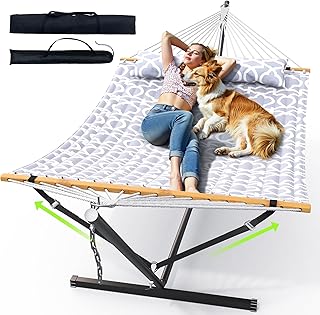
The 500 lb steel frame and balance strap make this the most reassuring two-person option here, and tool-free assembly means you can reposition it as your lighting plan evolves. The white fabric is the caveat: it looks crisp in daylight but goes distinctly cream under warm bulbs, so pair it with neutral-temperature fixtures if the color matters to you.
Hammock with Stand for Outside, 600 lbs
Highest capacity in the group, which usually means a heavier frame and a wider stance — plan for the shadow spread if it’s going near a lit path. It ships with a carrying package, so despite the beefy rating it’s genuinely relocatable across a season.
Goutime Collapsible Hammock Stand, 550 lbs
The three-level adjustment up to ten feet is the standout feature for ambience work: raising or lowering the hang point changes how you sit inside the light, and the double-layer net keeps its shape rather than sagging into a dark pocket. Best all-round pick for people who move furniture around.
Double Hammock with Wooden Stand, Dark Gray
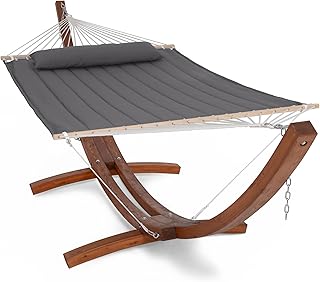
Wood reads warmer than powder-coated steel under any incandescent-toned source, and the dark grey fabric stays true at dusk instead of washing out. The arched frame does claim vertical space, so light this one from the sides with low uplights rather than hanging anything over it.
Standing Patio Hammock with Canopy, Dark Gray
The canopy is the reason to choose this: it softens hard midday light into something usable and creates a genuine enclosed pocket, which is the closest a hammock gets to feeling like a room. Foldable and portable, though the shade means you’ll want a small side lantern rather than overhead strings.
Frequently Asked Questions
Can I hang string lights directly on a hammock stand?
On steel A-frames, yes, using clips rather than wrapping — but keep bulbs away from head height and off the fabric. For anything more ambitious, run the strings to a wall, post, or tree and let the hammock sit underneath.
What color temperature works best around a hammock?
2200K to 2700K. It’s flattering, low-glare, and reads as relaxation rather than task lighting. Save cooler temperatures for steps and thresholds where you need visibility.
Do I need to weigh down or anchor the stand?
Most rated frames are stable on level ground without anchoring. Uneven or soft surfaces are the real risk, so check the footing before you check the capacity number.
Will a portable stand hold up outdoors year-round?
Powder-coated steel handles seasons well, but folding models are designed to come inside. Storing the hammock fabric out of UV and damp is what actually preserves the color you chose it for.
Final Thoughts
For most outdoor rooms the Goutime Collapsible Stand is the smartest buy, because adjustable height and easy relocation let you chase good light rather than settle for whatever falls on a fixed spot. If you want a hammock that looks intentional at dusk, the Double Hammock with Wooden Stand in dark grey holds its tone best under warm fixtures, and the canopy model earns its place if you’re building a shaded, self-lit pocket rather than integrating with existing overheads.