Key takeaways
- Chromotherapy quality over color count: Seven colors sounds generous, but what matters is whether the diodes dim smoothly and whether the amber and red settings are warm enough to use after sunset. Harsh, fully saturated color in a 40-inch-wide cabin reflects off every surface and reads as glare, not mood.
- Red light therapy vs. mood lighting: These are separate systems. Therapeutic red panels are positioned to face your torso at close range; chromotherapy lights wash the ceiling or corner. If a listing mentions only one, assume you are getting only one.
- Glass area and reflection: A large tempered glass door makes a small cabin feel twice its size and lets ambient room light in, which reduces the cave effect. The tradeoff is mirroring at night, so consider where the door faces relative to windows and overhead fixtures.
- Wood tone under low light: Canadian hemlock stays pale and neutral, so it takes color beautifully and never looks muddy. Darker brown finishes absorb more light and need a brighter interior fixture to avoid feeling closed in.
- Footprint, ceiling height, and spill: Measure the diagonal for doorways, then check the interior height if you are over six feet. Also look at where the control panel sits; a top-mounted display spills light upward into the room, which matters in a shared bedroom or basement lounge.
What's inside
Most people shopping for a home sauna focus entirely on watts and wood species, then discover the real problem the first evening they use it: the light is wrong. A cabin that heats beautifully can still feel like a walk-in closet under a bare LED strip, and a chromotherapy panel set to full-saturation blue at 9pm will undo the wind-down you just spent forty minutes earning. Add glare bouncing off a tempered glass door, a control panel that glows like a smoke alarm, and light spilling across a dark bedroom floor, and the whole ritual starts to feel clinical rather than restorative.
I design lighting and ambience for residential wellness spaces, so this guide looks at infrared saunas the way I look at any small room: how the fixtures behave in a tight volume, how warm wood tone reads under low-CRI diodes, whether red light therapy is genuinely usable or just a marketing wavelength, and how the cabin sits in a room once it is switched off. Below are six units worth considering in 2026, spanning full two-person cabins, single-person hemlock towers, and one collapsible tent for renters.
As an Amazon Associate we earn from qualifying purchases.


How to Choose a/an At Home Infrared Sauna (2026)
- Chromotherapy quality over color count: Seven colors sounds generous, but what matters is whether the diodes dim smoothly and whether the amber and red settings are warm enough to use after sunset. Harsh, fully saturated color in a 40-inch-wide cabin reflects off every surface and reads as glare, not mood.
- Red light therapy vs. mood lighting: These are separate systems. Therapeutic red panels are positioned to face your torso at close range; chromotherapy lights wash the ceiling or corner. If a listing mentions only one, assume you are getting only one.
- Glass area and reflection: A large tempered glass door makes a small cabin feel twice its size and lets ambient room light in, which reduces the cave effect. The tradeoff is mirroring at night, so consider where the door faces relative to windows and overhead fixtures.
- Wood tone under low light: Canadian hemlock stays pale and neutral, so it takes color beautifully and never looks muddy. Darker brown finishes absorb more light and need a brighter interior fixture to avoid feeling closed in.
- Footprint, ceiling height, and spill: Measure the diagonal for doorways, then check the interior height if you are over six feet. Also look at where the control panel sits; a top-mounted display spills light upward into the room, which matters in a shared bedroom or basement lounge.
The Best At Home Infrared Sauna (2026)s Reviewed
1-2 Person Infrared Sauna with Red Light Therapy and Bluetooth
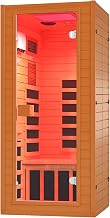
This is the most complete ambience package of the group, pairing a dedicated red light therapy panel with seven-color chromotherapy, Bluetooth, and radio in a 40 × 36 × 73-inch brown cabin. The darker finish does drink up light, so lean on the warmer color settings rather than the cool ones for evening sessions.
Ceramic Infrared Sauna, 2 Person with Granite Backdrop
The granite backdrop and deluxe glass front make this the best-looking cabin here when the lights are off, which matters more than buyers expect in a living space. Far and near infrared plus low EMF construction give it genuine spa credibility, and the glass area keeps the interior from feeling enclosed.
OUTEXER Far Infrared Sauna, Canadian Hemlock
A tidy 1200W single-person cabin in pale hemlock, which is the ideal canvas for its seven-color system since the wood renders each hue cleanly instead of dulling it. The tempered glass door and compact 35.2 × 27.6-inch footprint suit apartments and narrow basement corners.
Far Infrared Sauna for 1 Person, 1050W with Oxygen Ionizer
Fast 1050W heating, chromotherapy, Bluetooth, and an oxygen ionizer make this the most sensory-complete solo cabin, and assembly is genuinely straightforward. A strong pick if you want the full ritual without committing two square meters of floor.
Infrared Sauna Tent with 3L Steamer
For renters and small apartments, this folding tent delivers nine heat levels, a 99-minute timer, and remote control without any construction. There is no built-in lighting, which is actually an advantage: you control the ambience entirely with the room around it.
Frequently Asked Questions
Does chromotherapy actually do anything?
The clinical evidence is thin, but the perceptual effect is real. Warm amber and red light at low intensity supports evening wind-down, while cooler tones feel more alerting. Treat it as ambience design, not medicine.
Can I use red light therapy and the sauna at the same time?
Yes, and that is the point of an integrated panel. Sit within a foot or two of the emitter, keep sessions moderate, and close your eyes or look away from the diodes.
How much power do these draw?
Most single-person cabins in this range run 1000 to 1200W on standard 110V household circuits. Avoid sharing a circuit with a space heater or dryer.
Hemlock or a darker finish?
Hemlock for color accuracy and a brighter interior; darker brown for a cabin that recedes visually in a furnished room.
Final Thoughts
If you want the fullest lighting experience, the 1-2 Person Infrared Sauna with red light therapy and seven-color chromotherapy covers the most ground. The Ceramic 2 Person with granite backdrop is the one I would specify for a room where the sauna is visible furniture, and the Infrared Sauna Tent remains the smartest choice for renters who would rather build ambience with the space around it.